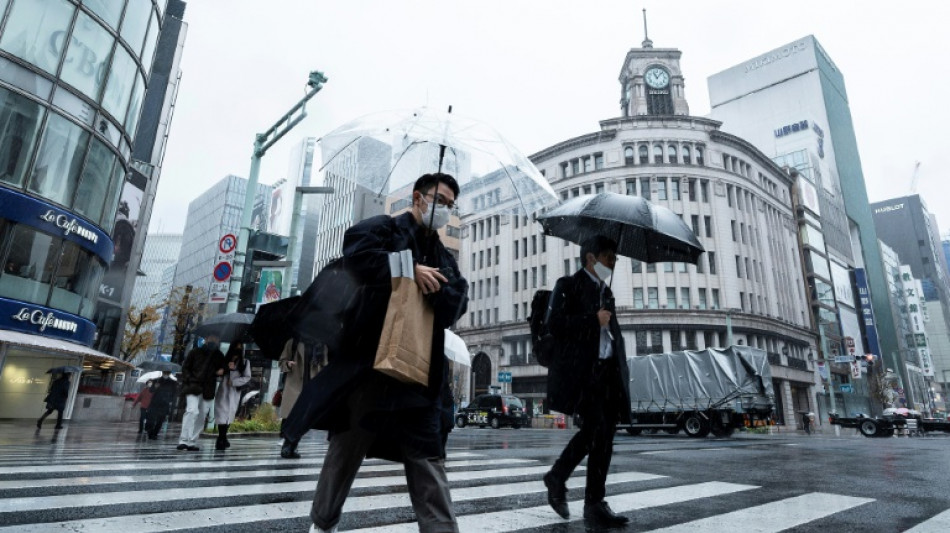
Japan inflation at 3.7% in November, highest since 1981 / Photo: Richard A. Brooks - AFP

 Melting glaciers an 'immediate' climate risk: author of UN report

 Folarin Balogun's move to Everton collapses

 Pacific islands to face food shortages over global warming: scientists

 Venice jury head Maggie Gyllenhaal questions lack of women directors

 Stocks drop, bond yields rally on Mideast flare-up

 China expands Egypt investments in first Xi visit in a decade

 Messi departure leaves Argentina facing rebuild after golden era

 Ourbit SuperCEX Launches "Cosmic Wheel Season 3. Oracle Realm" on September 2 with 3M USDT Prize Pool

 Ebola death toll passes 3,000 in DR Congo: official data

 Hong Kong democracy activist Wong pleads guilty to foreign collusion

 World record prize winner Romantic Warrior retires from horse racing

 5,000 US sailors arrive in Thailand after months at sea

 Joshua Wong, Hong Kong's pro-democracy poster child

 Nepal tunnel rescuers seek trapped workers but hit dead ends

 Zverev wins wild five-setter, Rybakina and Gauff ease through at US Open

 US energy secretary arrives in Venezuela to discuss oil deal

 Meloni government becomes Italy's longest-lasting

 Funerals in Nepal for missing, a week after deadly floods

 US aircraft carrier arrives in Thailand after months at sea

 US aircraft carrier approaches Thai port after months at sea

 Nepal's young PM faces gravest test after flood catastrophe

 What rainbow? LGBTQ Indonesians on edge as hostility mounts

 O'Connor eyes Wallabies World Cup swansong after Force return

 Syria UXO causing death, injury every six hours: charity

 Tiger Woods set to change not guilty plea in DUI case: court documents

Prices in Japan rose at their fastest pace since 1981 in November, data showed Friday, fuelled in part by higher energy costs.
Core consumer prices, which exclude volatile fresh food costs, climbed 3.7 percent last month compared to a year earlier, data released by the internal affairs ministry showed.
Prices jumped the most for processed food items and were also higher for electricity and durable goods like air conditioners.
The November figure is well below the sky-high levels that have sparked concern in the United States, Britain and elsewhere, but far exceeds the Bank of Japan's long-term goal of 2.0 percent.
Even excluding fresh food and energy, the index was up 2.8 percent.
"Although low by international standards, Japanese consumer price inflation at three percent to four percent is high enough to feel uncomfortable with stagnant wage growth," wrote Sarah Tan, economist at Moody's Analytics, in a note.
The headline core consumer price index (CPI) has risen consistently since the beginning of the year, putting pressure on the Bank of Japan to tweak its longstanding monetary easing policies.
The US Federal Reserve and other central banks have sharply hiked interest rates this year to tackle inflation.
But Japan, which since the 1990s has swung between periods of sluggish inflation and deflation, has gone against the grain and continues to keep interest rates at ultra-low levels as it tries to kickstart its economy.
The Bank of Japan says it sees the recent price increases as temporary and that there is no reason to change course yet.
The starkly different approaches taken by the BoJ and the Fed have driven down the value of the yen against the dollar this year from about 115 yen per dollar in March to as low as 151 yen.
The currency has recovered somewhat, helped by government interventions.
This week, the Japanese central bank delivered a shock tweak to its ultra-easy monetary policy, prompting the yen to strengthen rapidly.
While the adjustment falls short of a rate hike, analysts said it could help arrest the yen's declining value.
Koya Miyamae, senior economist at SMBC Nikko Securities, said prices were likely to continue rising in the short term.
"The core CPI rose in November due to rises in food prices and gas. The index will likely rise further, nearing or potentially rising above four percent in December," he told AFP.
"But core CPI will remain above two percent next year, while the pace of the rise in wages is not catching up with inflation," he added.
Most analysts expect price rises in Japan to peak around the end of the year or early 2023.
"Inflation will likely average four percent in December given delayed pass-through of higher producer prices," Tan said.
"It is expected to decline in 2023 as policy support kicks in," with global inflation also moderating as commodity prices temper and supply chain disruptions are fixed.
X.Matos--PC