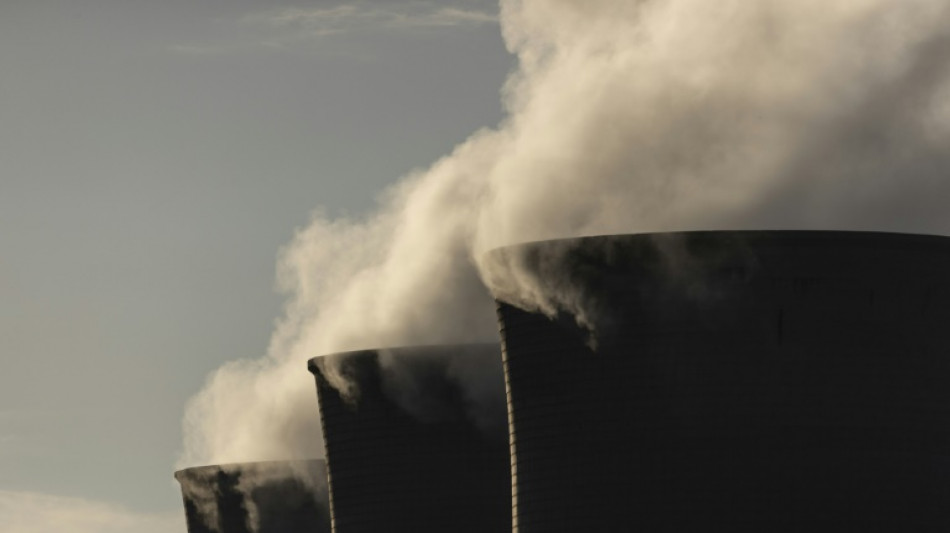
S.Africa's Eskom warns of long electricity crisis / Photo: GUILLEM SARTORIO - AFP

 ANC’s Renewal Rhetoric Fades as Voters Reject Party in 2026 Local Elections

 Foreign Investors Return to Indian Markets After 10-Month Selloff

 Honda CR-V and Toyota RAV4 Lead Canada’s Most Stolen Vehicles List for 2025

 China Extends Tariff Suspension on US Imports to Stabilize Trade Ties

 JR East Launches 'teppay' to Integrate Suica Balance with Mobile Payments
Beleaguered electricity firm Eskom warned South Africans on Friday to brace for a prolonged electricity crisis as it struggles to power up the continent’s most advanced economy.
While it hopes to spare the country rolling blackouts on Christmas Day, the state-owned company warned the first three months of next year will be difficult.
"We are going to have a challenging period over the next three months," Eskom chief operating officer Jan Oberholzer told a media briefing.
"It's going to be a difficult period."
South Africa has endured electricity shortages for the past 15 years, but power cuts reached new extremes this year, which Eskom blames on sabotage, crime and ageing power stations.
The country generates most of its power from coal-fired plants, but also gets some from Koeberg, a nuclear station near Cape Town.
But one unit at the 40-year-old nuclear plant will be offline next year for refurbishments, removing nearly a gigawatt of precious capacity from the grid.
"The outlook for next year is going to be very constraint," outgoing Eskom CEO Andre de Ruyter said during the presentation of the company's annual financial results.
South Africa needs between four and six gigawatts of additional production capacity and "this has become a matter extreme urgency", said de Ruyter.
Currently, total energy demand stands at around 25 gigawatts, according to official statistics.
The outgoing CEO, who handed in his resignation earlier this month but will stay on the job until March next year, cited a lack of political support and corruption as some of the obstacles to turning around the utility.
The government last week said it had begun deploying the military to protect the country's electricity plants as the long-running power crisis worsens.
"Our country (risks) becoming ...ungovernable if we do not tackle fraud, corruption, sabotage and other crimes," de Ruyter warned.
"A number of our power stations are in the grips of criminal syndicates," he added.
Results released Friday showed that the company posted a 12.3 billion-rand ($720-million) net loss during the financial year ending March 2022, compared to a 25-billion-rand loss over the same period the previous year.
M.A.Vaz--PC

