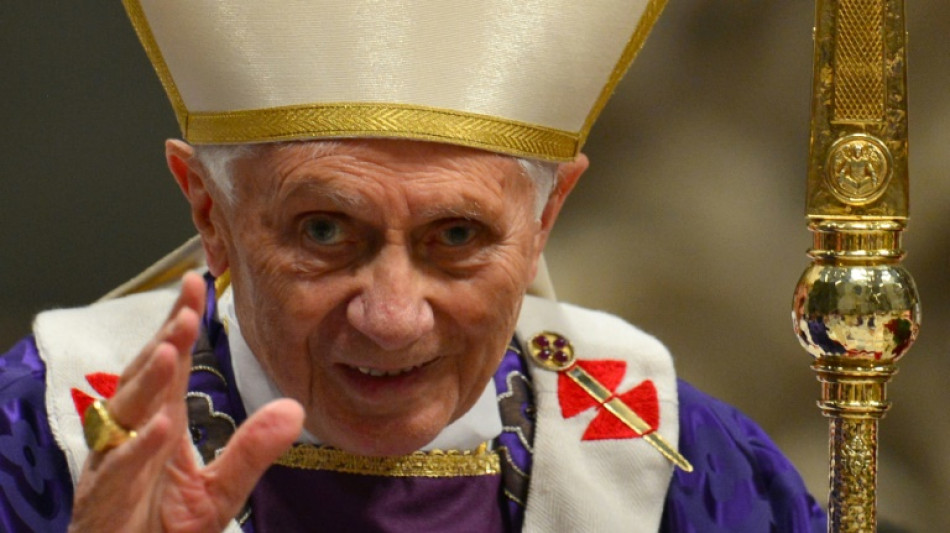
Benedict XVI: The pope who walked away / Photo: GABRIEL BOUYS, GABRIEL BOUYS - AFP/File

 World record prize winner Romantic Warrior retires from horse racing

 5,000 US sailors arrive in Thailand after months at sea
 Joshua Wong, Hong Kong's pro-democracy poster child

 Nepal tunnel rescuers seek trapped workers but hit dead ends
 Zverev wins wild five-setter, Rybakina and Gauff ease through at US Open
 US energy secretary arrives in Venezuela to discuss oil deal
 Meloni government becomes Italy's longest-lasting
 Funerals in Nepal for missing, a week after deadly floods

 US aircraft carrier arrives in Thailand after months at sea

 US aircraft carrier approaches Thai port after months at sea
 Nepal's young PM faces gravest test after flood catastrophe
 What rainbow? LGBTQ Indonesians on edge as hostility mounts
 O'Connor eyes Wallabies World Cup swansong after Force return
 Syria UXO causing death, injury every six hours: charity
 Tiger Woods set to change not guilty plea in DUI case: court documents
 Zelensky warns airlines Russian skies not safe due to Ukraine drones
 UK vows anti-settler measures as Israel warns of retaliation

 New pro Koivun among US Presidents Cup picks
 G20 finance leaders close talks marked by US welcoming Russia
 From Hollywood to big time tennis: teen makes US Open debut
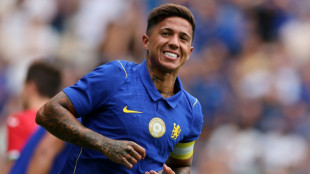
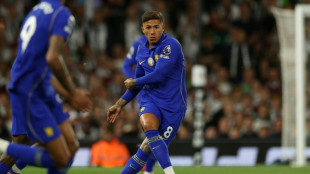 Man City secure Premier League record deal to sign Fernandez
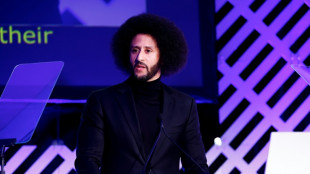 Kaepernick says NFL 'blackballing me' decade after protest
 Atletico loan David from Juve, send Lemar to Elche
 Chelsea 'keeper Sanchez makes deadline-day move to Como
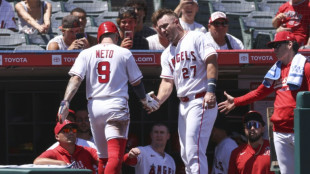 Kroenke to buy baseball's Los Angeles Angels: statement
Benedict XVI, who died on Saturday aged 95, was the first pope to resign since the Middle Ages after a papacy beset by Church infighting and outcry over paedophilia.
The German Joseph Ratzinger, known for his conservative views, stepped down in February 2013 after almost eight years as head of the Catholic Church, blaming his declining physical and mental health.
As pope emeritus, he spent the rest of his life in study and prayer, and playing his beloved Mozart on the piano in a former convent inside the Vatican. In recent years, he appeared in increasingly shaky health.
But just as the issue of child sex abuse had dogged his papacy, his final years were overshadowed by allegations that he personally failed to stop four clerics accused of abuse while archbishop of Munich.
Benedict firmly denied being involved in any cover-up, while the Vatican strongly defended his record on tackling abuse.
The former pope had had a troubled term in St Peter's, when he often appeared overwhelmed by the challenges facing a Church that was losing influence and followers.
Years of Vatican turmoil took their toll and culminated in his shock decision to become the first pope since 1415 to retire, in an announcement delivered to cardinals in Latin.
"The strength of mind and body... has deteriorated in me to the extent that I have had to recognise my incapacity to adequately fulfil the ministry," said Benedict, then 85.
Subsequently eclipsed by the dynamism and popularity of his successor Francis, Benedict was quoted a year later as saying that the decision was the result of a mystical experience.
In a March 2021 interview, he said "fanatical" Catholics had repeatedly voiced doubts about whether he stepped down willingly, but he insisted: "There is only one pope."
- 'Abuses and errors' -
Benedict was 78 when he succeeded the long-reigning and popular John Paul II in April 2005.
He had previously served as the Church's chief doctrinal enforcer, earning the nickname "God's Rottweiler" and a reputation as a generally conservative thinker on theological issues.
As pope he came under fire for a string of public relations blunders, and a perceived lack of charisma.
Most importantly, as an ever-growing number of victims spoke out of their abuse, mostly as children, at the hands of priests, he was criticised for his failure to act decisively to end Church cover-ups.
Before his election as pope, Benedict led the Vatican's doctrinal congregation -- once known as the Holy Office of the Inquisition -- giving him ultimate responsibility to investigate abuse cases.
He became the first pontiff to apologise for the scandals that emerged around the world, expressing "deep remorse" and meeting with victims in person.
In 2010, he admitted that the Church "did not act quickly or firmly enough to take the necessary action" on an issue that severely tarnished its image.
But critics accused him of failing to enforce justice.
"He has made lofty statements. He has not matched those statements with deed or action. Under his reign, the children remained at risk," said Barbara Blaine, founder and president of the Survivors Network of those Abused by Priests, who died in 2017.
In January 2022, a damning report commissioned by the Church authorities in Munich accused him of personally failing to stop the abuse of minors by four priests while he was archbishop between 1977 and 1982.
Benedict's aides issue a strong denial but in a rare personal statement, he asked for forgiveness for what happened on his watch.
"I can only express to all the victims of sexual abuse my profound shame, my deep sorrow and my heartfelt request for forgiveness," he said in a letter.
"I have had great responsibilities in the Catholic Church. All the greater is my pain for the abuses and the errors that occurred in those different places during the time of my mandate."
- Traditional teaching -
Benedict focused much of his energy on issues dear to his heart: religion's role in the modern world, inter-faith dialogue and a critique of unregulated capitalism that carried strong resonance during the global economic crisis in 2008.
He made waves during a 2009 trip to the Holy Land, where he called for a two-state solution to the Israeli-Palestinian conflict.
He fought to stem growing secularism in the West and staunchly defended traditional Catholic teaching on abortion, euthanasia and gay marriage.
Benedict rejected the ordination of women and marriage for priests and described same-sex relationships as destroying the essence of the human creature, drawing criticism for making the Church look out of touch.
He angered the Muslim world with a speech in 2006 in which he appeared to endorse the view that Islam is inherently violent, sparking deadly protests in several countries as well as attacks on Christians.
In 2009, he offended Jews by lifting the excommunication of a Holocaust-denying bishop. But he also won praise from some Jewish leaders for his efforts to restore mutual trust.
AIDS activists were angered when, on a trip to Africa, Benedict said condom use could be aggravating the crisis.
However, he later became the first pope to sanction their use under certain circumstances to prevent HIV infection.
- Church in-fighting -
Ratzinger was born on April 16, 1927, in Marktl am Inn, in Bavaria.
His policeman father and stay-at-home mother set the academically-gifted child on the path to a religious life early on, enrolling him in a Church-run boarding school when he was 12.
In 1941, Ratzinger became a member of the Hitler Youth, as was compulsory for all 14-year-olds under the Nazis.
As the son of an actively anti-Nazi father, it was -- according to subsequent accounts by himself and contemporaries -- a step he took reluctantly and he attended as few meetings as he could get away with.
The future pope was ordained as a priest in 1951 and taught at several universities, notably in Bonn and Regensburg, before coming to Rome to work as an advisor to the modernising Second Vatican Council from 1962 to 1965.
Pope Paul VI named him archbishop of Munich in 1977 and made him a cardinal the same year.
Biographer Peter Seewald told AFP in June 2020 that Benedict was a "down-to-earth person... found in the highest circles while remaining a very humble person, a warm person".
But he failed to stamp his authority on the Curia, the Church's governing body, and also appeared to have lost control of his household.
In 2012, his butler Paolo Gabriele leaked secret papers to the media, an act of betrayal which profoundly saddened the pontiff.
His papacy was also marred by a money-laundering scandal at the Vatican bank, which exposed infighting among Benedict's closest allies.
Benedict "was not really a dogmatic man, but rather a man who was disconnected from the real world," said Jeffrey Klaiber, a religion professor at Lima's Universidad Catolica.
burs-ide/ar/ah/imm
F.Moura--PC