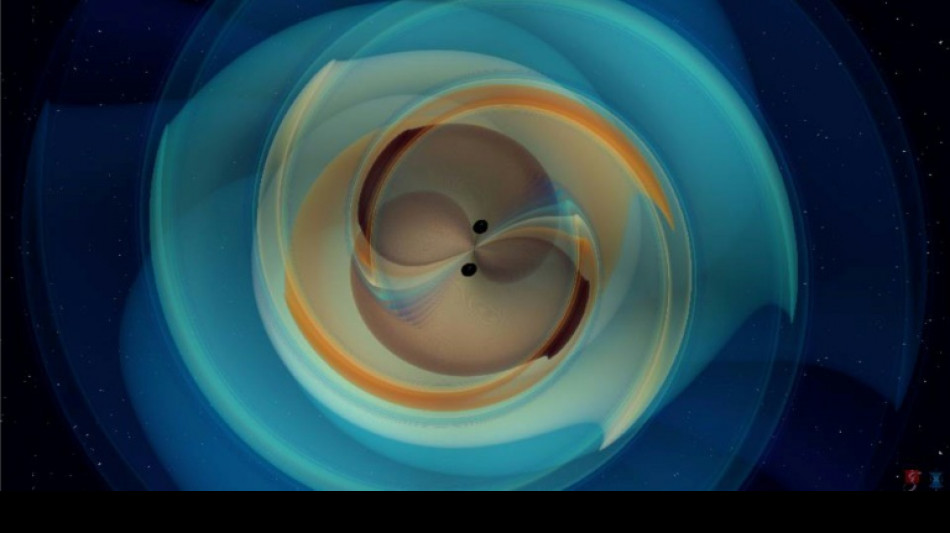
Rate of scientific breakthroughs slowing over time: study / Photo: N. Fischer, H. Pfeiffer, A. Buonanno - MAX PLANCK INSTISTUTE FOR GRAVITATIONAL PHYSICS/AFP/File

 World record prize winner Romantic Warrior retires from horse racing

 5,000 US sailors arrive in Thailand after months at sea

 Joshua Wong, Hong Kong's pro-democracy poster child

 Nepal tunnel rescuers seek trapped workers but hit dead ends

 Zverev wins wild five-setter, Rybakina and Gauff ease through at US Open

 US energy secretary arrives in Venezuela to discuss oil deal

 Meloni government becomes Italy's longest-lasting

 Funerals in Nepal for missing, a week after deadly floods

 US aircraft carrier arrives in Thailand after months at sea

 US aircraft carrier approaches Thai port after months at sea

 Nepal's young PM faces gravest test after flood catastrophe

 What rainbow? LGBTQ Indonesians on edge as hostility mounts

 O'Connor eyes Wallabies World Cup swansong after Force return

 Syria UXO causing death, injury every six hours: charity

 Tiger Woods set to change not guilty plea in DUI case: court documents

 Zelensky warns airlines Russian skies not safe due to Ukraine drones

 UK vows anti-settler measures as Israel warns of retaliation

 New pro Koivun among US Presidents Cup picks

 G20 finance leaders close talks marked by US welcoming Russia

 From Hollywood to big time tennis: teen makes US Open debut

 Man City secure Premier League record deal to sign Fernandez

 Kaepernick says NFL 'blackballing me' decade after protest

 Atletico loan David from Juve, send Lemar to Elche

 Chelsea 'keeper Sanchez makes deadline-day move to Como

 Kroenke to buy baseball's Los Angeles Angels: statement

The rate of ground-breaking scientific discoveries and technological innovation is slowing down despite an ever-growing amount of knowledge, according to an analysis released Wednesday of millions of research papers and patents.
While previous research has shown downturns in individual disciplines, the study is the first that "emphatically, convincingly documents this decline of disruptiveness across all major fields of science and technology," lead author Michael Park told AFP.
Park, a doctoral student at the University of Minnesota's Carlson School of Management, called disruptive discoveries those that "break away from existing ideas" and "push the whole scientific field into new territory."
The researchers gave a "disruptiveness score" to 45 million scientific papers dating from 1945 to 2010, and to 3.9 million US-based patents from 1976 to 2010.
From the start of those time ranges, research papers and patents have been increasingly likely to consolidate or build upon previous knowledge, according to results published in the journal Nature.
The ranking was based on how the papers were cited in other studies five years after publication, assuming that the more disruptive the research was, the less its predecessors would be cited.
The biggest decrease in disruptive research came in physical sciences such as physics and chemistry.
"The nature of research is shifting" as incremental innovations become more common, senior study author Russell Funk said.
- Burden of knowledge -
One theory for the decline is that all the "low-hanging fruit" of science has already been plucked.
If that were the case, disruptiveness in various scientific fields would have fallen at different speeds, Park said.
But instead "the declines are pretty consistent in their speeds and timing across all major fields," Park said, indicating that the low-hanging fruit theory is not likely to be the culprit.
Instead, the researchers pointed to what has been dubbed "the burden of research," which suggests there is now so much that scientists must learn to master a particular field they have little time left to push boundaries.
This causes scientists and inventors to "focus on a narrow slice of the existing knowledge, leading them to just come up with something more consolidating rather than disruptive," Park said.
Another reason could be that "there's increasing pressure in academia to publish, publish, publish, because that's the metric that academics are assessed on," he added.
The researchers called on universities and funding agencies to focus more on quality, rather than quantity, and consider full subsidies for year-long sabbaticals to allow academics to read and think more deeply.
"We're not getting any less innovative as a species," Park emphasised, pointing to recent breakthroughs such as the use of mRNA technology in Covid-19 vaccines, or the measurement of gravity waves in 2015.
Jerome Lamy, a historian and expert in the sociology of science at France's CNRS research agency, who was not involved in the research, said it showed that "ultra-specialisation" and the pressure to publish had increased over the years.
He blamed a global trend of academics being "forced to slice up their papers" to increase their number of publications, saying it had led to "a dulling of research."
F.Ferraz--PC