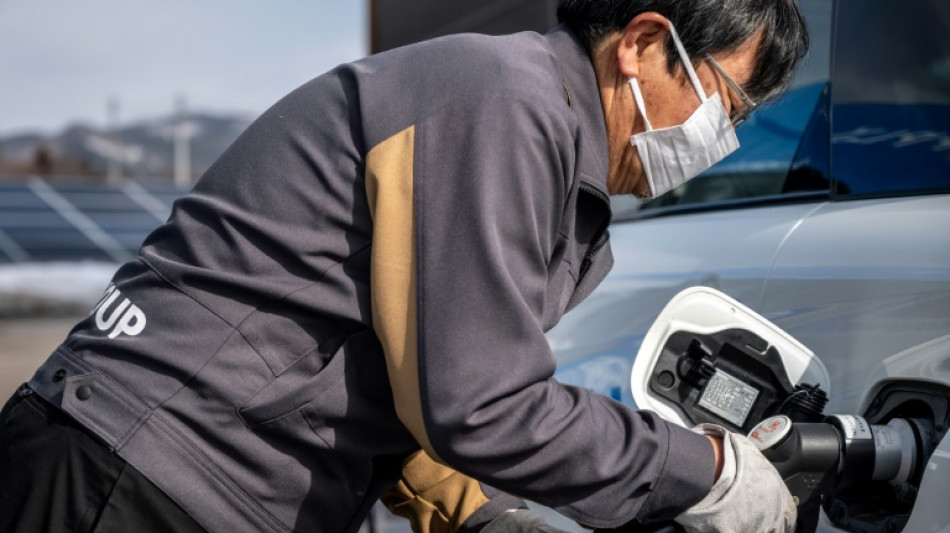
Sakhalin exception: the Russian energy Japan can't quit / Photo: Philip FONG - AFP/File

 UK vows anti-settler measures as Israel warns of retaliation

 New pro Koivun among US Presidents Cup picks
 G20 finance leaders close talks marked by US welcoming Russia

 From Hollywood to big time tennis: teen makes US Open debut

 Man City secure Premier League record deal to sign Fernandez

 Kaepernick says NFL 'blackballing me' decade after protest

 Atletico loan David from Juve, send Lemar to Elche

 Chelsea 'keeper Sanchez makes deadline-day move to Como
 Kroenke to buy baseball's Los Angeles Angels: statement

 US defends Trump's Venezuela oil deal

 OpenAI to launch new model with 'stronger safeguards' after hack
 Fans mourn 'bittersweet' final Ariana Grande gig in London

 Norway's King Haakon VIII swears allegiance to constitution

 Syria site infrastructure 'consistent with nuclear reactor': IAEA

 Juventus sign Woltemade, Sarr on loan from Premier League

 US strikes Iran in latest tit-for-tat attacks
 China's Xi arrives in Egypt as US sanctions threat looms over Iran links
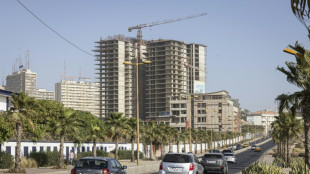
 Car bomb at Colombian police station kills one, injures 11
 Rain delays start of play on US Open
 Man City agree blockbuster deal to sign Chelsea star Fernandez: reports
 Alkemya Metacore Secures $50M via Tokenised Equity to Scale Nickel Energy and Security Tech

 Man City chase Fernandez, Arsenal sell Jesus on deadline day

 EU says Russian 'hybrid attacks' won't halt aid to Ukraine

 Explosives used in sabotage attack on German power lines
 Nepali families hold symbolic funerals for missing after floods
This year's Group of Seven president Japan has joined the bloc's condemnation of Russia's Ukraine invasion, imposing sanctions and agreeing on an oil price cap, with one exception: Moscow's Sakhalin energy projects.
Sakhalin-1 and 2 in Russia's far east are an anomaly in Tokyo's otherwise lockstep efforts with allies to reduce reliance on Moscow's hydrocarbons.
It's a contradiction that Japanese officials, and some experts, feel is unavoidable for a country that is by far the least energy self-sufficient in the G7.
But others warn the decision is a "vulnerability" for Tokyo, that "undermines" its diplomacy.
Last year, Japan pledged to phase out Russian coal imports and gradually decrease its energy dependence on Moscow.
Government data released on Thursday showed that oil imports from Russia fell around 56 percent last year, while coal imports were reduced by 41 percent.
But imports of Russian liquefied natural gas (LNG) were up more than four percent in 2022.
Sakhalin-1 produces oil, while Sakhalin-2 produces both crude and LNG, and experts say access to Russian gas is what Japan is most concerned about protecting.
Last year, 9.5 percent of Japan's total LNG imports came from Russia, up from 8.8 percent in 2021 -- most of it from Sakhalin-2.
So when Japan joined a price cap on Russian oil last year with its G7 allies, the European Union and Australia, it obtained an exemption for Sakhalin-2.
And while US and British firms ExxonMobil and Shell have relinquished their stakes in Sakhalin-1 and 2 respectively, Tokyo has stayed put, even complying with new Russian rules.
It's a purely pragmatic position, said Hiroshi Hashimoto, head of the gas group at the Institute of Energy Economics.
"They are geographically so close to the country and have significant energy resources," he told AFP. "The projects were developed to diversify energy sources."
- 'Notably contradictory' -
Japan has never forgotten the oil shock of the 1970s, and energy security threats "are ingrained in the mindset of the Japanese government", said James Brown, a political science professor at Temple University's Japan campus.
The country's energy supplies would be particularly at risk "in the case of a crisis in the Middle East or in the South China Sea, through which much of Japan's energy is shipped", he added.
Still, Japan got only 1.46 percent of its oil imports from Russia in 2022, and not all came from Sakhalin.
Its main interest is protecting access to Sakhalin-2's LNG, said Yuriy Humber, founder of Japan NRG, a platform analysing energy and electricity markets in Japan.
"If you put an embargo on the oil, but the project is still producing both oil and gas... you make it very difficult on an engineering and economic basis to keep the project going," he told AFP.
The war means competition for alternatives to Russian LNG has increased, along with prices, and Japan has little storage capacity, making Sakhalin's proximity key.
"The alternatives aren't really very easy and they are very expensive," he noted, with long-term contracts recently agreed with the United States and Oman unlikely to be delivered for years.
Japanese officials frame the continued use of Sakhalin as an energy security imperative, and warn that withdrawing could see China enter the projects.
But Brown believes the projects are a "vulnerability" that leave Japan at risk of retaliation from Moscow.
"The Russian government has been very clear that they view Japan as an 'unfriendly state'," he said.
"There is every reason to think that they could also manipulate exports from the Sakhalin projects to retaliate against Japan."
Several eastern European countries have secured exemptions to the bloc's oil ban and price cap, but as this year's G7 president, Japan's Sakhalin exception stands out.
"The decision to keep stakes in Sakhalin-1 and 2, and exempt its actions from the G7 oil price cap, is notably contradictory," Wrenn Yennie Lindgren, a researcher for the Norwegian and Swedish Institutes of International Affairs, told AFP.
It "undermines the moral and values-based diplomacy that it is pledging to strengthen during its (G7) presidency", she added.
But Japan NRG's Humber believes Japan has little alternative.
"You can only afford to be moral when you have a pragmatic solution."
F.Carias--PC