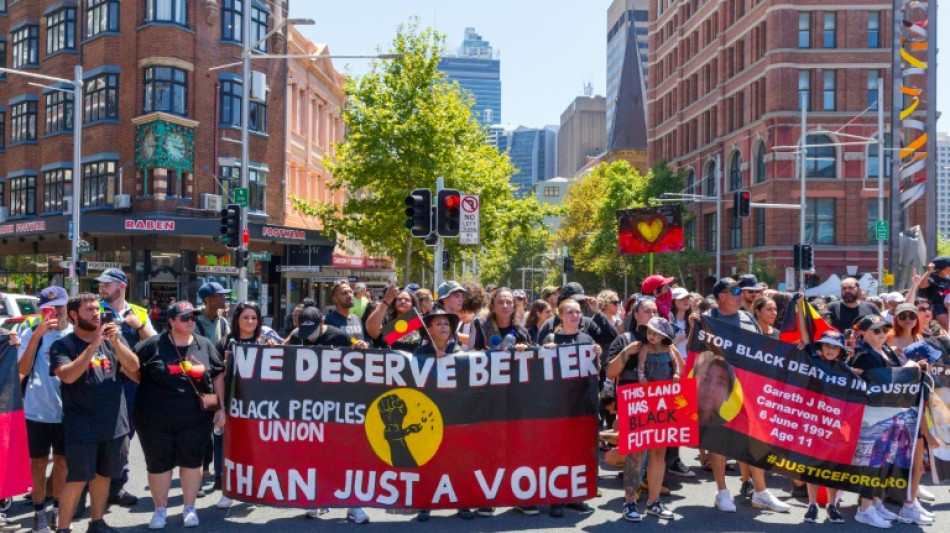
'Invasion Day' rallies mark divisive national holiday in Australia / Photo: Robert Wallace - AFP

 US defends Trump's Venezuela oil deal

 OpenAI to launch new model with 'stronger safeguards' after hack

 Fans mourn 'bittersweet' final Ariana Grande gig in London
 Norway's King Haakon VIII swears allegiance to constitution
 Syria site infrastructure 'consistent with nuclear reactor': IAEA

 Juventus sign Woltemade, Sarr on loan from Premier League
 US strikes Iran in latest tit-for-tat attacks

 China's Xi arrives in Egypt as US sanctions threat looms over Iran links
 Car bomb at Colombian police station kills one, injures 11

 Rain delays start of play on US Open

 Man City agree blockbuster deal to sign Chelsea star Fernandez: reports
 Alkemya Metacore Secures $50M via Tokenised Equity to Scale Nickel Energy and Security Tech

 Man City chase Fernandez, Arsenal sell Jesus on deadline day

 EU says Russian 'hybrid attacks' won't halt aid to Ukraine
 Explosives used in sabotage attack on German power lines
 Nepali families hold symbolic funerals for missing after floods

 Newcastle sign Lille forward Fernandez-Pardo

 Even at Elysee, phones are handed in, Macron tells French pupils
 Chelsea agree to sign Atalanta's Ahanor, with Palace loan for this season

 Chelsea sign Atalanta's Ahanor and loan him to Palace

 UK chalks up hottest summer on record for second year running
 China's Xi visits Egypt as US sanctions threat looms over Iran links

 RISE Robotics Awarded $100,000 MassVentures Grant to Accelerate Commercialization of Beltdraulic Technology

 Global bond sell-off deepens on inflation concerns
 Germany's far-right AfD promises 'boom' but economists fear worst
Thousands protested Australia's increasingly divisive national day Thursday as the public debates whether the country's Indigenous population should be recognised in the constitution.
Australia Day on January 26 has traditionally celebrated the arrival of European settlers at Sydney Harbour in 1788, and has typically been observed with beach parties and backyard barbecues.
But in recent years, it has also become a day of national protest, with some Australians calling it "Invasion Day" and saying it was the start of a cultural genocide by European colonisers.
Indigenous activist Paul Silva, speaking to a crowd of thousands at an Invasion Day rally in central Sydney, said the national holiday should be abolished.
"They invaded our lands, killing our extended families, turning our warriors into slaves," he said, as the crowd shouted "shame" in response.
"How can this day be celebrated?"
Indigenous poet Lizzie Jarrett said Sydney was "ground zero for a genocide of First Nations people".
"You think we're angry? Wouldn't you be angry?" she asked the crowd.
Ethan Lyons, 17, said he wanted to acknowledge the "beautiful land" of Indigenous Australians.
"We also have to acknowledge the almost 250 years of ongoing theft and destruction," he told the crowd.
Similar rallies took place in major cities across Australia.
At a lively protest in Hobart, the capital of the island state of Tasmania, demonstrators carried flags declaring "Stolen Land" and "We are still here".
The demonstrations have an added significance this year as Australia's centre-left government pushes to change the country's constitution to better recognise Indigenous Australians.
- 'Most important question' -
There is currently no mention of Indigenous Australians in the constitution, adopted in 1901.
They were banned from voting in some states and territories until the 1960s.
The public will vote on the change -- called the Indigenous Voice to Parliament -- in a binding referendum later this year.
It aims to give Indigenous Australians a greater say in national policy-making as they battle poorer health, lower incomes and higher barriers to education.
The Voice proposal has been politically divisive, with several conservative figures deriding it as unneeded and a waste of time.
But Indigenous lawyer Noel Pearson said the Voice was "the most important question" currently facing Australia.
"The question that will be put is: do we recognise Indigenous people in the constitution?" he told national broadcaster ABC.
"And if we say no to that, then I can't see how the future will be anything other than protest."
Indigenous Australians settled in the country an estimated 65,000 years ago but have suffered widespread discrimination and oppression since the arrival of the British more than two centuries ago.
Australian historian Lyndall Ryan has estimated that more than 10,000 Indigenous people were killed in 400 separate massacres since the British arrived.
The inequalities facing the Indigenous population remain stark -- they have life expectancies years shorter than other Australians and are far more likely to die in police custody.
J.Oliveira--PC