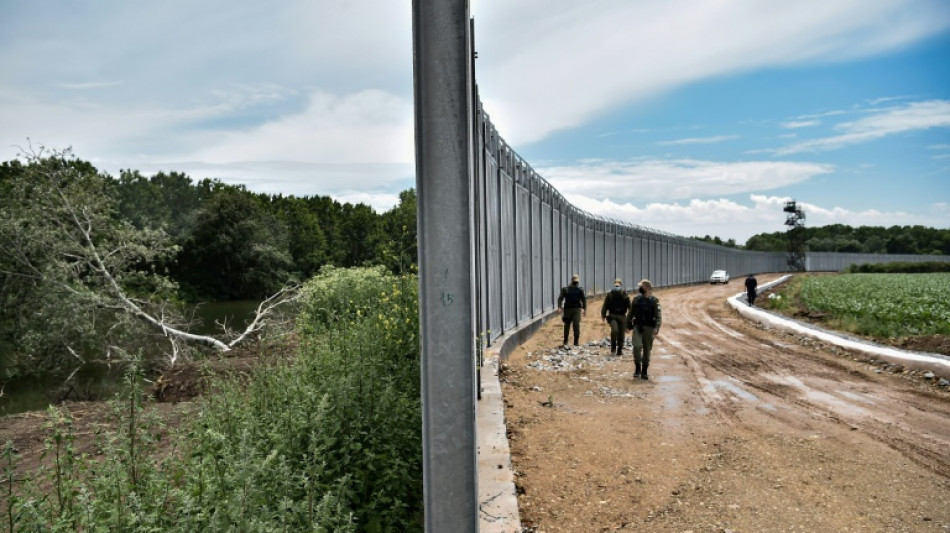
EU dangles visa threat over nations refusing to take back migrants / Photo: Sakis MITROLIDIS - AFP

 US defends Trump's Venezuela oil deal

 OpenAI to launch new model with 'stronger safeguards' after hack
 Fans mourn 'bittersweet' final Ariana Grande gig in London
 Norway's King Haakon VIII swears allegiance to constitution

 Syria site infrastructure 'consistent with nuclear reactor': IAEA

 Juventus sign Woltemade, Sarr on loan from Premier League

 US strikes Iran in latest tit-for-tat attacks
 China's Xi arrives in Egypt as US sanctions threat looms over Iran links

 Car bomb at Colombian police station kills one, injures 11
 Rain delays start of play on US Open

 Man City agree blockbuster deal to sign Chelsea star Fernandez: reports
 Alkemya Metacore Secures $50M via Tokenised Equity to Scale Nickel Energy and Security Tech

 Man City chase Fernandez, Arsenal sell Jesus on deadline day

 EU says Russian 'hybrid attacks' won't halt aid to Ukraine
 Explosives used in sabotage attack on German power lines
 Nepali families hold symbolic funerals for missing after floods

 Newcastle sign Lille forward Fernandez-Pardo

 Even at Elysee, phones are handed in, Macron tells French pupils

 Chelsea agree to sign Atalanta's Ahanor, with Palace loan for this season

 Chelsea sign Atalanta's Ahanor and loan him to Palace

 UK chalks up hottest summer on record for second year running
 China's Xi visits Egypt as US sanctions threat looms over Iran links

 RISE Robotics Awarded $100,000 MassVentures Grant to Accelerate Commercialization of Beltdraulic Technology

 Global bond sell-off deepens on inflation concerns

 Germany's far-right AfD promises 'boom' but economists fear worst

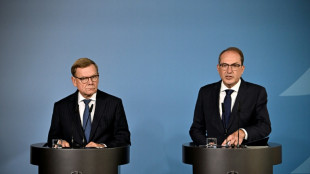
EU interior ministers reached "consensus" Thursday to warn outside countries refusing to take back irregular migrants they risked tighter visa restrictions to Europe, Sweden's migration minister said.
Ministers agreed that the tool, in place since 2020, "should be fully used" to boost the number of migrants returning to their home countries after their asylum applications failed, Maria Malmer Stenergard told journalists.
Sweden chaired the Stockholm meeting as it currently holds the EU presidency.
"Should intensified political and diplomatic efforts not produce the desired results, member states call on the (European) Commission to come back to the (European) Council with proposals on visa restrictions," Malmer Stenergard said.
That tougher line was reflected in a letter Commission chief Ursula von der Leyen sent to leaders of EU countries on Thursday, ahead of a February 9-10 summit that will discuss the issue.
Von der Leyen said EU member states could sign up to a pilot scheme over the first half of this year to speed up screening and asylum procedures for eligible migrants -- and "immediate return" for those not deemed to qualify.
She also said she wanted the EU to draw up a list of "safe countries of origin", and for the bloc to strengthen border monitoring on the Mediterranean and Western Balkans routes migrants use to get to Europe.
- 'Huge pressure' -
The EU planned to put in place migration deals with countries such as Bangladesh, Pakistan, Egypt, Morocco, Tunisia and Nigeria "to improve returns... and to prevent departures", said Von der Leyen.
In Stockholm, EU home affairs commissioner Ylva Johansson stressed that many European Union countries were under "huge pressure", receiving nearly one million asylum applications last year.
Capacity was further stretched by the EU hosting nearly four million Ukrainian refugees who had fled Russia's war in their country, she said.
European Commission statistics show a low rate of effective returns.
In 2021, out of 340,500 orders for migrants to be returned to their countries of origin, only 21 percent were carried out.
The EU funds various reintegration programmes in countries that readmit their citizens who have been denied asylum in Europe.
These are separate from deportations or forced returns based on a court or administrative order, which are often carried out under escort and typically do not include in-country assistance.
Sweden -- whose government relies on a far-right party, the Sweden Democrats, to stay in power -- wants EU countries to leverage visas, foreign policy and development aid to press outside countries on the returns issue.
- Harder stance -
So far, the EU has applied the visa-restriction tool against only one country: The Gambia, for whose citizens getting a Schengen visa is more difficult and costly.
The commission in 2021 proposed the mechanism be extended to Bangladesh and Iraq, but that has not happened.
Johansson said after a November visit to Bangladesh that the threat of the visa sanctions had prompted Dhaka to become more "politically open" to accepting irregular migrants back from Europe.
The overall tone on migration has hardened in Europe since 2015-2016, when it took in over a million asylum-seekers, most of them Syrians fleeing the war in their country.
The bloc in 2016 struck a deal with Turkey to prevent much of the onward passage of irregular migrants into Europe.
Austria backs the strengthening of a fence built along the border of EU member Bulgaria with Turkey to further reduce the flow of asylum-seekers.
Austrian Chancellor Karl Nehammer said on Monday, during a visit to that border region, that the fence would cost around two billion euros, and called on the European Commission to fund it.
The commission has been reluctant to do that, emphasising instead the role of Frontex, the bloc's border patrol agency, which EU member states can call on.
"It's about strengthening the fence that is there," Nehammer told reporters in Vienna on Thursday.
"The commission categorically says, 'No, there is no money for fences'. That can't be the final word" on this issue, he added.
The current system to manage asylum and the visa-free Schengen zone had failed, he insisted.
Johansson said she objected to the fence proposal on financial grounds, pointing out that the European Council representing member states had cut her department's budget for the 2021-2027 cycle.
A.Silveira--PC