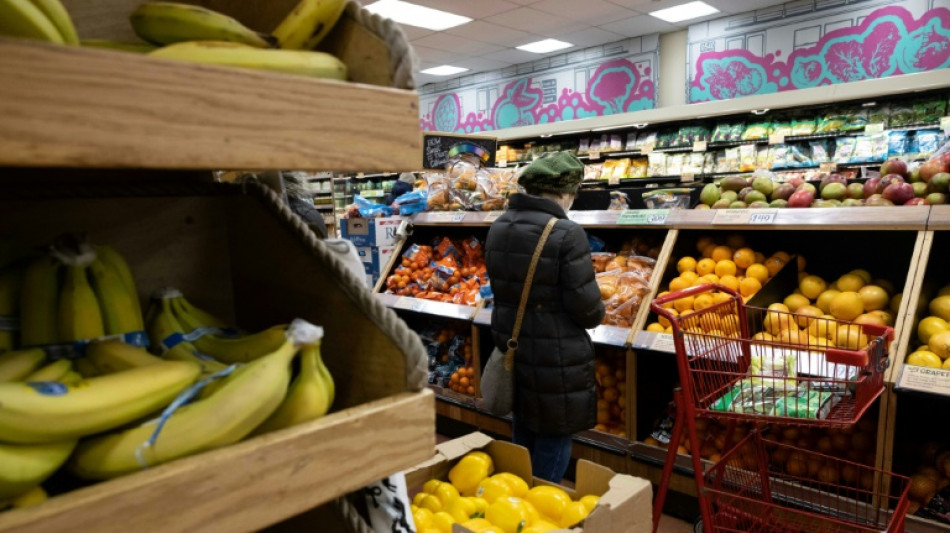
Key US inflation gauge slows in December while spending falls / Photo: Yuki IWAMURA - AFP/File

 Grattan Institute Releases Blueprint to Target Specialists Over Excessive Fees

 Arizona Science Center Hosts Girls in STEM Astro Adventures for Students

 New Turkish Cafe, Japanese BBQ, and Korean Restaurants Open Across East Bay

 Knowle Move Four Points Clear at Top After Histon Victory

 Physicians Urge Arizona to Ban Medical Gag Clauses and Enable Private Lawsuits

 New Campaign Highlights Knowledge Gaps on Carbon Monoxide Safety Among Americans

A key indicator of US inflation eased in December as spending dipped, according to government data released Friday, opening the door to smaller interest rate hikes as efforts to cool the economy ripple through sectors.
The Federal Reserve has hiked the benchmark lending rate seven times last year, with an aim to ease demand as inflation surged, while trying to avoid tipping the world's biggest economy into a recession.
And the tightening measures are showing effect, with the Fed's preferred inflation gauge, the personal consumption expenditures (PCE) price index rising 5.0 percent last month from a year ago, down from 5.5 percent in November, Commerce Department data showed on Friday.
This extends a downward trend since mid-2022, when American households found themselves increasingly squeezed by rising costs.
The central bank focuses on the PCE price index as it reflects actual consumer spending, including shifts to less expensive items, unlike the more well-known consumer price index.
The indicator ticked up 0.1 percent from November to December, as prices for goods decreased 0.7 percent and energy costs dropped 5.1 percent, said the report.
But services prices rose from the preceding month.
"The Fed views the job market as the primary battleground in its fight against inflation," said economist Bernard Yaros Jr of Moody's Analytics.
"As long as wage gains in labor-intensive services are robust, the Fed will be loath to declare victory," he added.
Household spending also dipped further 0.2 percent between November and December, the report said, adding that personal incomes rose 0.2 percent.
Analysts believe spending is set to slow further in the coming months.
"The latest data offer among the first tangible signs that the economy's main engine is slowing," said Oren Klachkin of Oxford Economics.
"Looking ahead, a cooling labor market, a depleted savings cushion, and less willingness to rely on credit cards in a high inflation environment will lead consumers to pull back," he added.
For now, consumer sentiment remains low from a historical perspective, according to a University of Michigan survey of consumers also released Friday.
Stripping out the volatile food and energy components, the PCE price index was up 4.4 percent from December 2021, signaling that there remains some way to go before the Fed pauses its aggressive battle to rein in inflation.
While the Fed's preferred inflation measures are moving in the right direction, they "remain well above target," said Economist Rubeela Farooqi of High Frequency Economics.
E.Raimundo--PC

