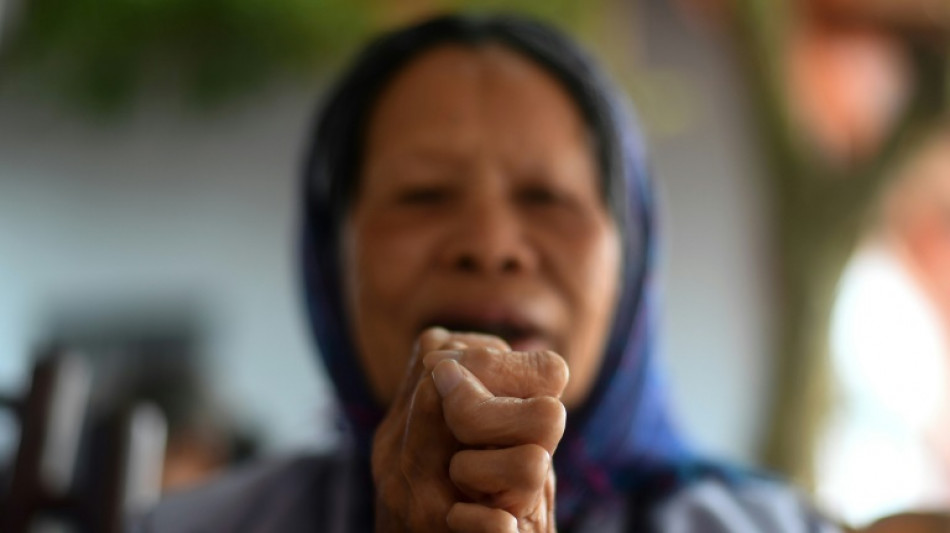
'Constant danger': Life after leprosy, a long neglected disease / Photo: Manan VATSYAYANA - AFP/File

 US defends Trump's Venezuela oil deal

 OpenAI to launch new model with 'stronger safeguards' after hack

 Fans mourn 'bittersweet' final Ariana Grande gig in London

 Norway's King Haakon VIII swears allegiance to constitution

 Syria site infrastructure 'consistent with nuclear reactor': IAEA

 Juventus sign Woltemade, Sarr on loan from Premier League

 US strikes Iran in latest tit-for-tat attacks

 China's Xi arrives in Egypt as US sanctions threat looms over Iran links

 Car bomb at Colombian police station kills one, injures 11

 Rain delays start of play on US Open

 Man City agree blockbuster deal to sign Chelsea star Fernandez: reports

 Alkemya Metacore Secures $50M via Tokenised Equity to Scale Nickel Energy and Security Tech

 Man City chase Fernandez, Arsenal sell Jesus on deadline day

 EU says Russian 'hybrid attacks' won't halt aid to Ukraine

 Explosives used in sabotage attack on German power lines

 Nepali families hold symbolic funerals for missing after floods

 Newcastle sign Lille forward Fernandez-Pardo

 Even at Elysee, phones are handed in, Macron tells French pupils
 Chelsea agree to sign Atalanta's Ahanor, with Palace loan for this season

 Chelsea sign Atalanta's Ahanor and loan him to Palace

 UK chalks up hottest summer on record for second year running

 China's Xi visits Egypt as US sanctions threat looms over Iran links

 RISE Robotics Awarded $100,000 MassVentures Grant to Accelerate Commercialization of Beltdraulic Technology

 Global bond sell-off deepens on inflation concerns

 Germany's far-right AfD promises 'boom' but economists fear worst

Dan Izzett has lived with leprosy's effects on his body for 70 years, and has lost much to what he calls an "ancient, fascinating, very unkind disease".
The Zimbabwean former civil engineering technician and pastor was diagnosed at the age of 25 in 1972, but first contracted the disease when he was just five.
That long incubation period gave the bacteria that causes leprosy, Mycobacterium leprae, lots of time to spread through his body.
His right leg was amputated in 1980 in Zimbabwe's capital Harare. Now 75, Izzett has no feeling above his elbows, below his knees or in 70 percent of his face.
That lack of feeling poses a "constant danger," Izzett told AFP in a phone call from his home in southwest England.
In October 2020, "I put my hands on a hot plate and hadn't noticed it until I could smell my flesh burning," he said, leading to the amputation of the middle finger of his right hand.
The following year, the little toe on his left foot was amputated. Last month, he lost another toe.
Izzett said he chose to speak out about his experience because millions of survivors who were less well off were unable to, partly because of the stigma and discrimination that still surrounds the disease.
- The 'forgotten' patients -
Leprosy, also known as Hansen's disease, has been haunting humanity for at least 4,000 years, often affecting the poorest communities.
It is a considered a neglected tropical disease by the World Health Organization, and remains under researched and little discussed compared to many other illnesses.
In 2021, more than 140,500 new cases were detected worldwide, nearly three quarters of them in Brazil, India and Indonesia, according to the WHO.
However pandemic-related disruptions have led to nearly 40 percent fewer cases being detected a year, with fears that tens of thousands have gone undiagnosed.
Even before the pandemic, the official numbers likely did not reflect reality.
"We know the number of patients who have been tested, but we do not count the forgotten, undetected patients," said Bertrand Cauchoix, a leprosy specialist at the Raoul Follereau Foundation in France.
This is in part because the disease's incubation period can last up to 20 years. Testing and diagnosis also takes time, during which patients could potentially infect their family members.
Before he received his diagnosis, said Izzett, "my wife got the disease from me".
Back in the 1970s, Izzett was given the antibiotic Dapsone, which was then a lifetime treatment.
In the mid-80s, a combination of drugs including Dapsone known as multidrug therapy (MDT) became available. It can cure leprosy over a 12-month course -- though nerve damage and other remnants of the disease remain.
Mathias Duck, a former chaplain in Paraguay's capital Asuncion, only needed six-months of MDT after being diagnosed with leprosy in 2010.
"I consider myself the luckiest person affected by leprosy because I was diagnosed and treated in time and so I have no impairments whatsoever," the 44-year-old told AFP.
The WHO provides MDT to patients worldwide for free, with Swiss pharmaceutical giant Novartis donating doses since 2000.
However there has been little progress for new treatments.
"There is no money for leprosy, only charitable donations," Cauchoix said.
- Don't use the 'L word' -
Alexandra Aubry, a specialist at the Centre for Immunology and Infectious Diseases in France, evaluates whether every new antibiotic developed for other illnesses could also be used for leprosy.
Her laboratory is one of the few in the world able to carry out tests on the leprosy bacteria, which does not survive in a petri dish.
They are trying to find a way to "simplify" treatment so it can take less than six months, she said.
There are also a couple of vaccines being developed, though they remain in early phases of human testing.
"It is very complex to get funding for this," Aubry said.
"To assess the effectiveness of a vaccine, you have to follow the vaccinated population for 10 to 15 years," with the timeframe extended further by the disease's long incubation period, she said.
In comparison to how swiftly the world responded to Covid, leprosy efforts are "a drop in the bucket," Duck said, calling for far more research and political action.
But he added that there is something everyone can do for World Leprosy Day on Sunday -- stop using the word "leper".
"We call it the 'L word'," Duck said, describing it as discriminatory.
"It's a little step that most people can do," he added, "to give people affected by leprosy "the dignity they deserve".
J.Oliveira--PC