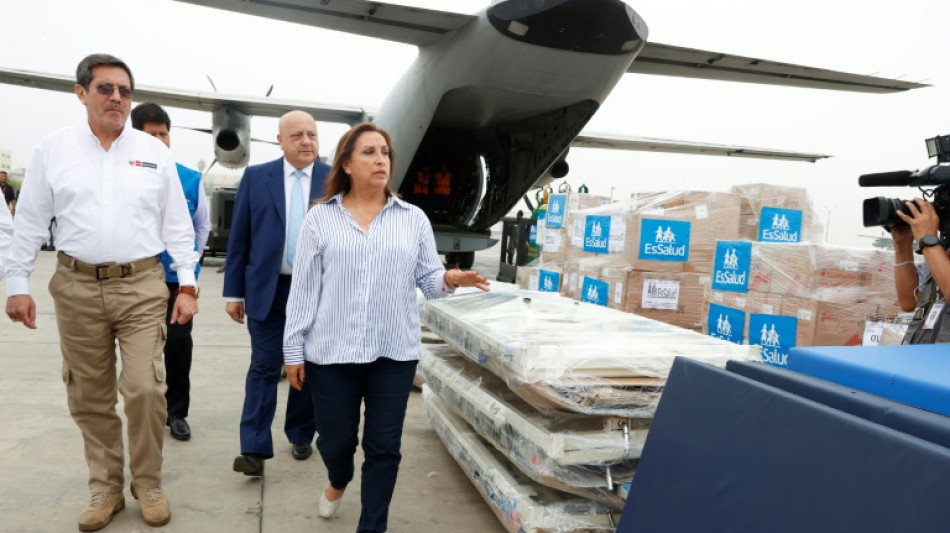
Peru Congress rejects president's plan for early elections / Photo: Melina Mejia - Peruvian Presidency/AFP

 Grattan Institute Releases Blueprint to Target Specialists Over Excessive Fees

 Arizona Science Center Hosts Girls in STEM Astro Adventures for Students

 New Turkish Cafe, Japanese BBQ, and Korean Restaurants Open Across East Bay

 Knowle Move Four Points Clear at Top After Histon Victory

 Physicians Urge Arizona to Ban Medical Gag Clauses and Enable Private Lawsuits

 New Campaign Highlights Knowledge Gaps on Carbon Monoxide Safety Among Americans

Peru's Congress rejected on Saturday a request by embattled President Dina Boluarte to bring forward elections to December 2023, as protests that have killed dozens rage on against her leadership.
The South American country has been embroiled in a political crisis with near-daily protests since December 7 when former president Pedro Castillo was arrested after attempting to dissolve Congress and rule by decree.
Demanding that Boluarte resign and call fresh elections, Castillo supporters have erected roadblocks on highways, causing shortages of food, fuel and other basic supplies. The government said it will soon deploy police and soldiers to clear the roadblocks.
Lawmakers already agreed last month to bring forward elections from 2026 to April 2024.
In the face of relentless protests, Boluarte on Friday urged Congress to call the vote for December, describing the political crisis as a "quagmire."
But in a plenary session held during Saturday's early hours, Congress rejected the proposal, with 45 votes in favor, 65 against and two abstentions.
Leftist parties had demanded that the advancement of elections be accompanied by a constitutional convention -- something protesters have repeatedly called for.
"With this vote, the constitutional reform proposal for the advancement of elections is rejected," Congress president Jose Williams said, after more than seven hours' debate.
Following the vote, Williams received a request for "reconsideration", which could be debated on Monday in a new session, though it would be difficult to reverse the decision.
Protesters have demanded immediate elections, as well as Boluarte's removal, the dissolution of Congress and a new constitution.
"Nobody has any interest in clinging to power," insisted Boluarte.
"I have no interest in remaining in the presidency. If I am here it is because I fulfilled my constitutional responsibility."
As Castillo's vice president, Boluarte was constitutionally mandated to replace him after he was impeached by Congress and arrested.
The US State Department said Friday it remained concerned about the violent demonstrations as it called "for calm dialogue and for all parties to exercise restraint and nonviolence," spokesman Vedant Patel told reporters.
- 'Everything is very expensive' -
In seven weeks of protests since Castillo's arrest, 47 people have been killed in clashes between security forces and protesters, according to the Ombudsman's Office of Peru.
The autonomous human rights office said another 10 civilians -- including two babies -- were collateral fatalities when they were unable to get medical treatment or medicine due to roadblocks.
In southern regions, weeks of roadblocks have resulted in shortages of food and fuel.
"There's no gas, there's no petrol. In grocery stores all you get is non-perishables and everything is very expensive, up to three times the normal price," marketing employee Guillermo Sandino told AFP in Ica, a city 200 kilometers (125 miles) south of Lima that connects the capital to the south.
On Thursday, the defense and interior ministries announced that police and the military would soon move to clear the roadblocks.
Authorities said on Thursday that traffic was blocked in eight of Peru's 25 regions, which has also complicated medical treatment in some areas, with doctors unable to access needed medicines.
Some of the worst violence and highest death tolls have come when protesters tried to storm airports in the country's south.
Those southern regions with large Indigenous populations have been the epicenter of the protest movement that has affected Peru's vital tourism industry.
As well as blocking dozens of roads and forcing the temporary closure of several airports, protesters have placed rocks on the train tracks that act as the only transport access to Machu Picchu, the former Inca citadel and jewel of Peruvian tourism.
That resulted in hundreds of tourists being left stranded at the archeological ruins and many of them were evacuated by helicopter.
G.Teles--PC

