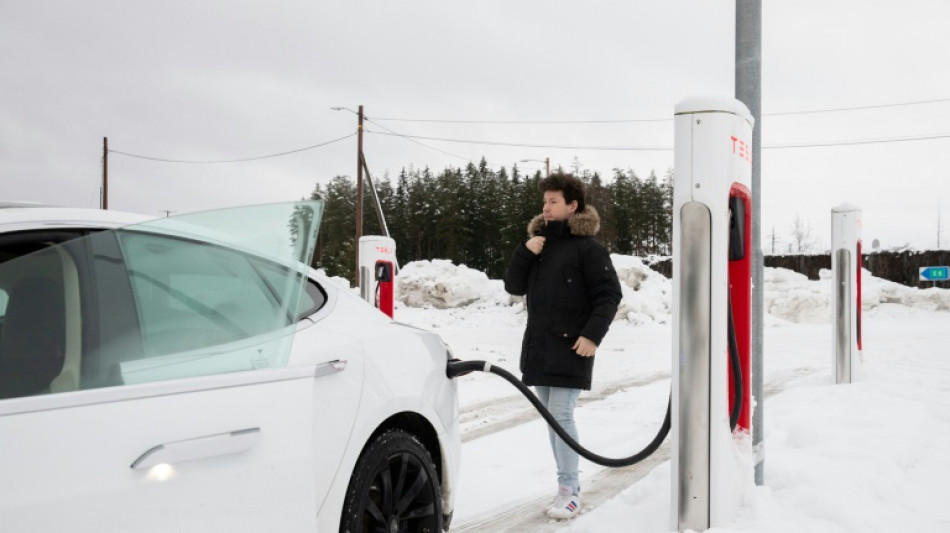
Arctic cold 'no sweat' for electric cars in Norway / Photo: Petter BERNTSEN - AFP

 Germany blames Russia for airport drone incident, hits back with sanctions
 Iran president urges return to truce, hails Russian support

 Aster and World Liberty Financial Launch USD1 RWA Boost: Phase 1, Offering 125M $WLFI + 6.25M USD1 in Rewards

 Tronchon sprints to Vuelta stage 10 win, Mas keeps red jersey

 Germany defender Rudiger announces international retirement

 Musk defends AI data centers, slams EU rules at G20
 Activists blame Kenya for Ugandan opposition figure's plight

 Iran president offers US olive branch, hails Russian support

 TrustFinance Community Choice Awards 2026 Opens Global Voting

 Nepal disaster a climate 'warning signal': foreign minister

 France winger Diaby returns to Leverkusen until 2031

 Barcelona confirm Jesus arrival from Arsenal

 EU official says it's not time to 'normalize' Russia at G20 finance talks

 RedHill Announces Transformational Acquisition of Commercialization Rights to Ferring’s Rebyota® and Clenpiq®
 TrendEadvisor Launches Global Multi-Asset Platform Combining Online Investing with Social Trading

 India's top court drops criminal cases against protesters

 Philippine couple married in hip-deep floodwaters

 Villa sign Senegal winger Mbaye from PSG

 Former Peru minister last-minute contender for UN labour agency helm

 Messi legacy will 'live forever', says Beckham
 'Literally tasting the smoke': Malaysians suffer as haze worsens

 Kyiv's defences, 'hybrid' threat from Moscow headline EU talks

 Oil extends gains, stocks mostly down as Trump issues fresh Iran warning

 ThinkMarkets Expands Weekend Trading Offering, Launches Weekend League Competition

 Tibet activists accuse China of downplaying floods

Norwegian electric car owners have a word for the way they feel when they look nervously at their battery indicators while driving in subfreezing weather: "rekkevideangst", or "range anxiety".
Tesla owner Philip Benassi has experienced it on cold winter days, but like other Norwegians, he has learned to cope with it.
With temperatures often falling below zero, rugged terrain and long stretches of remote roads, Norway may not seem like the most ideal place to drive an electric car, whose battery dies faster in cold weather.
Yet the country is the undisputed world champion when it comes to the zero-emission vehicles.
A record four out of five new autos sold in Norway last year were electric, in a major oil-producing country that aims to end the sale of new fossil fuel cars by 2025 -- a decade ahead of the European Union's planned ban.
Benassi took the plunge in 2018.
In his gleaming white Tesla S, the 38-year-old salesman for a cosmetics company clocks between 20,000 and 25,000 kilometres (12,400 and 15,500 miles) a year.
Like most new electric vehicle owners, he had moments of panic in the beginning when he saw the battery gauge drop quickly, with the prospect of it falling to zero on a deserted country road.
"I didn't know the car well enough. But after all these years, I have a pretty good idea of how many kilowatts it needs and I know that it varies a lot depending on whether the car has spent the night outdoors or in a garage," he told AFP.
The car uses much more battery when it is parked outside in temperatures that can reach minus 15 degrees Celsius (five degrees Fahrenheit), Benassi said.
"It takes quite a while for it to go back to normal consumption," he added.
In the cold season, how much range electric cars lose depends on the model and how low the temperature gets.
"But the following rules of thumb apply: a frost of around minus 10C will reduce the operating range by around a third compared to summer weather, and a severe one (minus 20C or more) by up to half," said Finnish consultant Vesa Linja-aho.
"By storing the car in a warm garage, this phenomenon can be mitigated somewhat," he added.
- Charging stations -
Drivers must plan their routes before long journeys, but car applications and Norway's vast network of more than 5,600 fast and superfast charging stations help make the process easier.
Electric cars accounted for 54 percent of new car registrations last year in Finnmark, Norway's northernmost region in the Arctic where the mercury has at times fallen to minus 51C -- a sign that the cold problem is not insurmountable.
Other Nordic countries that regularly experience chilly temperatures, such as Iceland and Sweden, also top world rankings for electric vehicles.
"Now more and more new electric cars have systems for pre-heating the batteries, which is very smart because you get more range and because if your car is heated before you charge, it will also charge faster," said Christina Bu, head of the Norwegian Electric Vehicle Association.
Electric car owners are not the only ones who have to worry about the cold.
"Actually, if it's very, very cold -- freezing temperatures -- sometimes diesel engine cars can't start and an electric car starts," she said.
- 'Everyone can do it' -
Norwegians are clearly sold: more than 20 percent of cars on Norway's roads are now electric -- and green, with the electricity they consume generated almost exclusively by hydro power.
Norway's longstanding policy of tax rebates for electric cars has facilitated the transition, although the government has begun to roll back some of the incentives to make up for a budget shortfall estimated at nearly 40 billion kroner ($4 billion) last year.
There is "a simple answer to why we have this success in Norway and that's green taxes", Bu said.
"We tax what we don't want, namely fossil fuel cars, and we promote what we do want, electric cars. It's as simple as that," she said.
"If Norway can do this, everyone else can do it as well."
P.Serra--PC