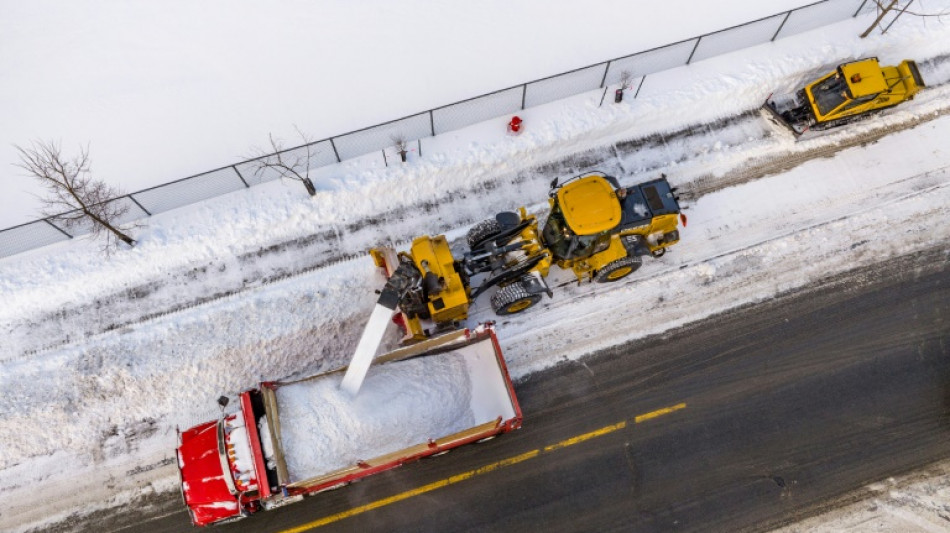
Montreal snow-clearing: good for traffic, bad for environment / Photo: Sebastien ST-JEAN - AFP

 Germany blames Russia for airport drone incident, hits back with sanctions
 Iran president urges return to truce, hails Russian support

 Aster and World Liberty Financial Launch USD1 RWA Boost: Phase 1, Offering 125M $WLFI + 6.25M USD1 in Rewards

 Tronchon sprints to Vuelta stage 10 win, Mas keeps red jersey

 Germany defender Rudiger announces international retirement
 Musk defends AI data centers, slams EU rules at G20
 Activists blame Kenya for Ugandan opposition figure's plight
 Iran president offers US olive branch, hails Russian support

 TrustFinance Community Choice Awards 2026 Opens Global Voting

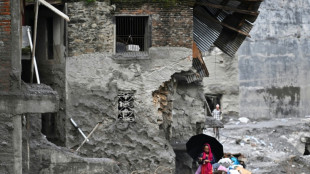
 Nepal disaster a climate 'warning signal': foreign minister

 France winger Diaby returns to Leverkusen until 2031

 Barcelona confirm Jesus arrival from Arsenal
 EU official says it's not time to 'normalize' Russia at G20 finance talks

 RedHill Announces Transformational Acquisition of Commercialization Rights to Ferring’s Rebyota® and Clenpiq®
 TrendEadvisor Launches Global Multi-Asset Platform Combining Online Investing with Social Trading

 India's top court drops criminal cases against protesters

 Philippine couple married in hip-deep floodwaters

 Villa sign Senegal winger Mbaye from PSG

 Former Peru minister last-minute contender for UN labour agency helm

 Messi legacy will 'live forever', says Beckham
 'Literally tasting the smoke': Malaysians suffer as haze worsens

 Kyiv's defences, 'hybrid' threat from Moscow headline EU talks
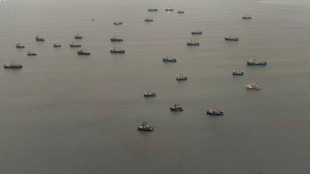
 Oil extends gains, stocks mostly down as Trump issues fresh Iran warning

 ThinkMarkets Expands Weekend Trading Offering, Launches Weekend League Competition

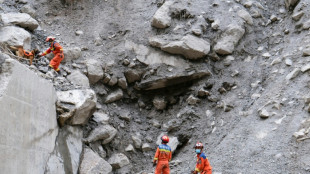 Tibet activists accuse China of downplaying floods
A choreographed ballet of massive trucks, snowplows and snowblowers takes over the streets of Montreal whenever it snows, an enormous logistical effort with a significant environmental cost.
Hundreds of snow-clearing vehicles are deployed across the frigid Canadian city for 100 or more days each year on average, dusting the road with salt and belching emissions into the air.
"The snow challenge in Montreal is colossal," says city spokesperson Philippe Sabourin.
If the city's streets and sidewalks were put end to end, they would total 10,000 kilometers (6,200 miles) or the equivalent of the distance from Montreal to Beijing, he said.
Some 3,000 employees and 2,200 vehicles go into action day and night every time it snows, helping make the streets passable.
In Montreal alone, the equivalent of 150,000 tons of salt is spread on roads and sidewalks over the winter.
"It has an impact on ecosystems," Florent Barbecot, a professor of hydrogeology at the University of Quebec in Montreal, told AFP.
"We have seen for a few years the level of salt which is rising a little bit everywhere in the environment."
Some of it stays on the roads, dries and evaporates when temperatures warm, "ending up in the atmosphere... which will affect future precipitation," he said.
The city recognizes that salt is bad for the environment, but despite ongoing research, no effective substitute has been found.
It is "a material that does us a great service," by lowering the freezing temperature of ice and melting icy patches, Sabourin explained.
With almost two meters (six feet) of snowfall in Montreal each year, the city simply cannot go without massive snow management.
- People 'not happy' -
As a substitute, "we tried coffee grinds, it smelled good, but it was not a success," Sabourin added.
Beetroot juice has also been tried, which is less corrosive than salt, "but it stained floors a lot, people were not happy," he said.
Until the late 1990s, snow soiled by waste and pollution was dumped directly into the St. Lawrence River, before the practice was banned.
Some of it is now poured into snow chutes connected to the sewer system.
But the majority (75 percent) is stored in quarries, where the snow is piled high. One mound on the city's south side stretches the width of several football fields and rises ten storeys high.
At the foot, trucks appear tiny in comparison as they dump snow, most of it looking more grey than white.
In a few months, the spring thaw will melt the snow, and waste and gravel will be separated from the water, which is treated before being discharged into the river.
- 'Societal choice' -
According to Barbecot, the city should simply use less salt, but that would require changing "the way we live" by limiting urban sprawl and driving less.
"That's a societal choice," he said.
In the streets, locals do not seem ready to embrace such a massive shift.
According to Charles Drolet, who was working behind the wheel of a city snowblower, residents mostly just want to see more frequent ploughing of streets.
For resident Francine Lalonde, salting roads and snow removal "is a necessary evil," despite the negative environmental impacts.
M.Carneiro--PC