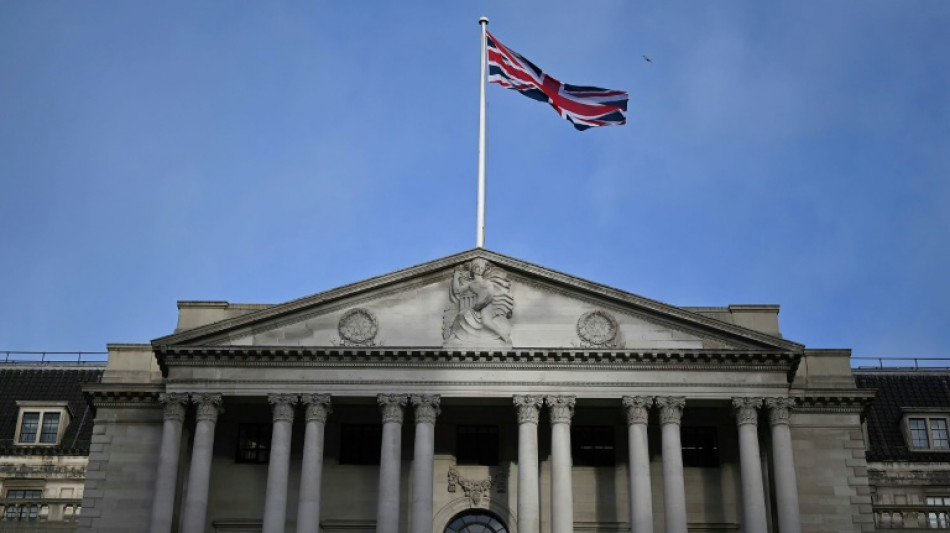
Bank of England hikes interest rate tenth time in row / Photo: JUSTIN TALLIS - AFP

 Grattan Institute Releases Blueprint to Target Specialists Over Excessive Fees

 Arizona Science Center Hosts Girls in STEM Astro Adventures for Students

 New Turkish Cafe, Japanese BBQ, and Korean Restaurants Open Across East Bay

 Knowle Move Four Points Clear at Top After Histon Victory

 Physicians Urge Arizona to Ban Medical Gag Clauses and Enable Private Lawsuits

 New Campaign Highlights Knowledge Gaps on Carbon Monoxide Safety Among Americans

The Bank of England on Thursday hiked its interest rate for a tenth time in a row as global authorities race to combat sky-high inflation.
It also forecast a shallower-than-expected UK recession this year as the country faces a cost-of-living crisis.
The BoE voted at a regular meeting to lift its key interest rate by a half-point to 4.0 percent, the highest level since late 2008.
The hike was double the lift announced by the US Federal Reserve on Wednesday, while the European Central Bank was also set to raise its rate again on Thursday.
"It's too soon to declare victory just yet -- inflationary pressure is still there," BoE governor Andrew Bailey told a press conference.
Policymakers voted 7-2 in favour of the rate increase, with a minority calling for no change, according to minutes from the gathering.
The BoE predicted that this year's UK economic downturn would be milder than it previously forecast, noting that inflation was "likely" to have peaked in many advanced economies.
UK inflation, which sits close to a 40-year peak, was expected to continue to decline "gradually" in the first half of 2023 but pressures persist.
"The squeeze on real incomes from high energy prices and the path of interest rates continue to weigh on demand," Bailey said.
"Economic output is therefore expected to fall slightly throughout 2023 and into 2024.
"This is nevertheless a much shallower decline than expected" in November, the governor added.
The BoE expects GDP to shrink 0.5 percent this year and by 0.25 percent next.
That compared with its prior forecasts for contractions of 1.5 percent and 1.0 percent, respectively.
- Cost-of-living crisis -
Central banks are seeking to cool high energy and food prices, fuelled by Russia's invasion of Ukraine one year ago.
Thursday's announcement will likely worsen Britain's cost-of-living crisis because commercial lenders will now ramp up their own interest rates on credit cards, mortgages and other loans.
That will further squeeze cash-strapped Britons who are buckling under rampant consumer prices alongside rising household bills and transport costs.
Britain was gripped by strikes this week as public and private sector workers protest over pay that has failed to keep pace with inflation.
Half a million people stopped work on Wednesday, leaving transport networks paralysed and thousands of classrooms empty in the country's largest walkout in more than a decade.
UK inflation slowed to 10.5 percent in December, but this is more than five times the BoE's official target-level of two percent.
The BoE began to tighten monetary policy in December 2021, when its rate stood at a record-low 0.1 percent.
G.M.Castelo--PC

