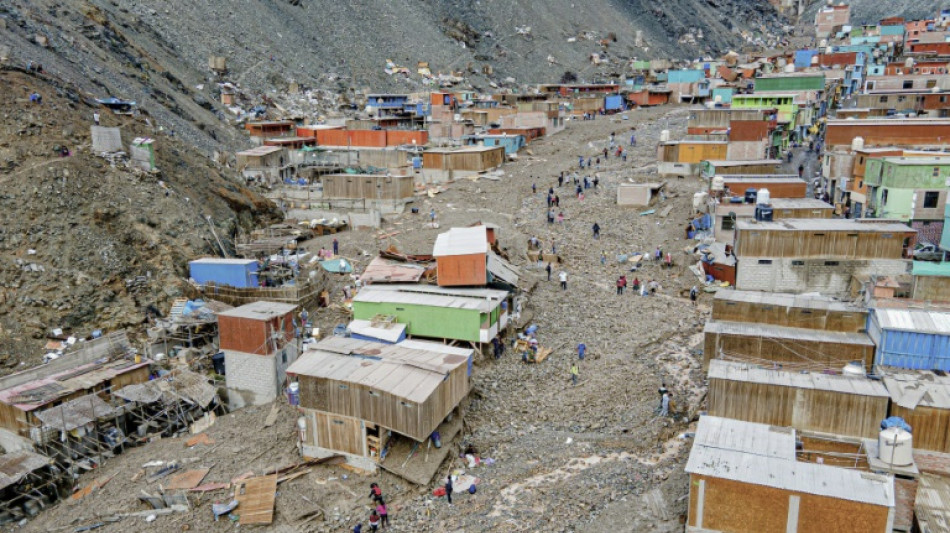
Peru mudslides leave villagers with 'nothing left' / Photo: Diego RAMOS - Police nationale péruvienne/AFP/File

 Grattan Institute Releases Blueprint to Target Specialists Over Excessive Fees

 Arizona Science Center Hosts Girls in STEM Astro Adventures for Students

 New Turkish Cafe, Japanese BBQ, and Korean Restaurants Open Across East Bay

 Knowle Move Four Points Clear at Top After Histon Victory

 Physicians Urge Arizona to Ban Medical Gag Clauses and Enable Private Lawsuits

 New Campaign Highlights Knowledge Gaps on Carbon Monoxide Safety Among Americans

Carmen Manchego looks down at the remnants of homes sticking out of the quagmire of mud that engulfed the Peruvian mining town of Pampaylima.
"I have nothing left, nothing at all," she moans.
Torrential rain late last week in Mariano Valcarel district of the southwestern Arequipa region provoked a mudslide on the San Martin mountain.
Several communes were buried under mud and rocks, leaving 18 dead and around 20 others missing.
"My home is there," Manchego, a home maker, tells AFP. "Everything was taken away by the water, it buried everything."
She is one of more than 4,300 people affected by the disaster.
Some Pampaylima residents attempt to recover belongings that were spared the widespread destruction amongst the rubble from prefabricated homes demolished by the mud.
The ground floors of several two-storey houses have effectively disappeared from view.
"My home is completely covered. We'll have to see if we can save something, something valuable. Machines, more than anything," said Eleuterio Condena, 55.
Like most of his neighbors, he works in a gold mine in this mountainous area, around 800-kilometers (500 miles) south of Peru's capital Lima.
The suspension of mining activity, coupled with the economic losses caused by the disaster, will have massive consequences on the locals.
Most Pampaylima residents come from neighboring regions such as Ica or Ayacucho and are only staying there temporarily for work.
With families relying on their wages, they cannot afford to sit idle.
Some work in the San Martin and Arapa mines, carrying 50-kilogram (110-pound) sacks on their backs that are full of minerals that require processing five kilometers away in Secocha.
That journey has to be taken on foot because part of the path linking the two towns has been destroyed by a landslide.
In Secocha, gold sells for around $31 per gram. Each miner earns around $30-$38 a day.
According to authorities, the mudslide damaged 40 percent of the electricity grid in Valcarcel and more than 500 homes have been destroyed or rendered uninhabitable.
Another thousand have been damaged.
"We are sleeping in tents brought by the Civil Defense and we're eating in the canteen where help is being delivered," said Manchego.
There are not enough tents for everyone, forcing some people to sleep outside at the top of the mountains.
"We hope to be rehoused after all this is finished," said Nelly Huillca, 35, a small-scale miner.
J.V.Jacinto--PC

