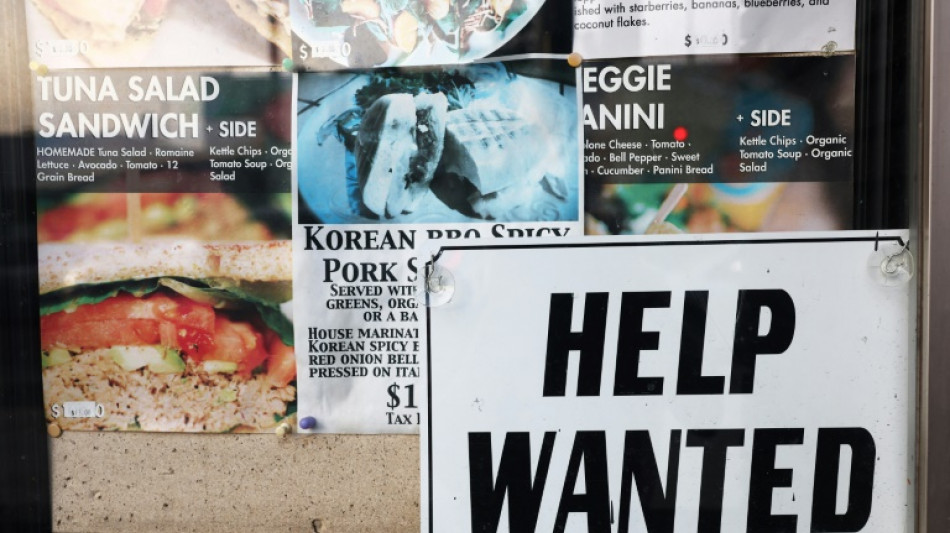
Rental costs, gasoline prices behind January US inflation: analysts / Photo: MARIO TAMA - GETTY IMAGES NORTH AMERICA/AFP/File

 Former Peru minister last-minute contender for UN labour agency helm

 Messi legacy will 'live forever', says Beckham
 'Literally tasting the smoke': Malaysians suffer as haze worsens

 Kyiv's defences, 'hybrid' threat from Moscow headline EU talks

 Oil extends gains, stocks mostly down as Trump issues fresh Iran warning

 ThinkMarkets Expands Weekend Trading Offering, Launches Weekend League Competition

 Tibet activists accuse China of downplaying floods

 Afghanistan war victims left 'without justice', UN says
 Iran president offers US olive branch before Putin meeting

 China-Nepal flood toll tops 1,000 as tunnel rescue offers last hope

 Japan to relax overtime regulation under workaholic PM

 Thwarted Niger mutiny exposes junta's Russia dependence

 Illegal mining ravages S.Africa's economic hub
 Nepal's wall of missing offers last hope after Himalayan flood

 US to press G20 on light-touch AI regulation

 2 die in Grand Canyon flash flood, only 1 person unaccounted for

 US Army Secretary Driscoll submits resignation: White House

 Oil extends gains, stocks drop as Trump issues fresh Iran warning

 Tsitsipas says Kyrgios's positive cocaine test 'kind of expected'

 In Japan's mountains, a different way to manage bears

 Middle East war a boon for UAE defence giant with global ambitions

 Former gang member found guilty of murdering Tupac Shakur

 Top-seeded Zverev opens US Open campaign

 US regulator, 22 states accuse Amazon of 'manipulating' ad auctions: lawsuit

 TRON Founder Justin Sun Shares Outlook on Bitcoin, Stablecoins and Global Finance at Bitcoin Asia 2026

Rising rents, a gasoline price rebound and vehicle costs helped keep US inflation elevated in January, analysts say, amid signs that policymakers have some way to go in bringing prices down.
The US central bank has hiked interest rates rapidly in the past year to raise borrowing costs and cool demand in the world's biggest economy, as inflation skyrocketed.
But even as the consumer price index (CPI), an important inflation gauge due to be released Tuesday, eases from last year's decades-high levels, analysts warn of some stickier areas.
Overall, the CPI rose 6.5 percent in December compared with a year ago, furthering a steady decline from June's blistering 9.1 percent reading.
The so-called core figure excluding the volatile food and energy components, however, has fluctuated over the same period. It fell to 5.9 percent in June, rose to 6.6 percent in September and then slipped again.
"The area that I'm concerned about is services inflation, which is more related to the strength of the domestic economy, particularly the labor market, and nominal wage growth," said Ryan Sweet, chief US economist at Oxford Economics.
Rental costs "won't peak until the second half of this year," while wage growth remains robust and there is still pent-up demand for services spending, he told AFP.
"During the pandemic, people shifted their spending away from services because they couldn't go out to restaurants, bars, sporting events," he said.
With Covid-19 restrictions easing, people are now turning back to services, which make up the bulk of consumer spending, Sweet said.
Economists expect overall inflation to have cooled further in January on an annual basis.
But they forecast the CPI to have risen 0.5 percent from December to January, picking up from a prior 0.1 percent pace.
- 'Uneven' -
"While overall prices have been slowing on a sustained basis, the easing in core inflation has been more uneven," said Rubeela Farooqi of High Frequency Economics in a recent note.
Prices of goods have eased as supply chains untangle but a strong labor market supports incomes and, in turn, demand.
"We're going to see a lot of goods disinflation over the next several months," said Sweet of Oxford Economics.
But it will take a significant amount of this to offset services inflation expected in the pipeline.
Farooqi told AFP the Federal Reserve is closely eying the cost of services excluding housing, food and energy.
"We do think inflation peaked in June. But getting back to two percent is not imminent," she said, referring to policymakers' long-term inflation target.
"From a policy perspective, the Fed's message on rates closely aligns with these developments; to lower inflation... rates will have to move higher and policy will have to remain restrictive for some time," she said.
Should inflation fail to cool between December and January, analysts expect the Fed will press on with further hikes to the benchmark lending rate.
On Monday, Fed Governor Michelle Bowman warned in a speech that it would likely be "necessary to further tighten monetary policy to bring inflation down toward our goal."
She added that, with the economic outlook remaining uncertain, "I expect that we will continue to be surprised by economic and geopolitical developments and by the incoming data."
V.F.Barreira--PC