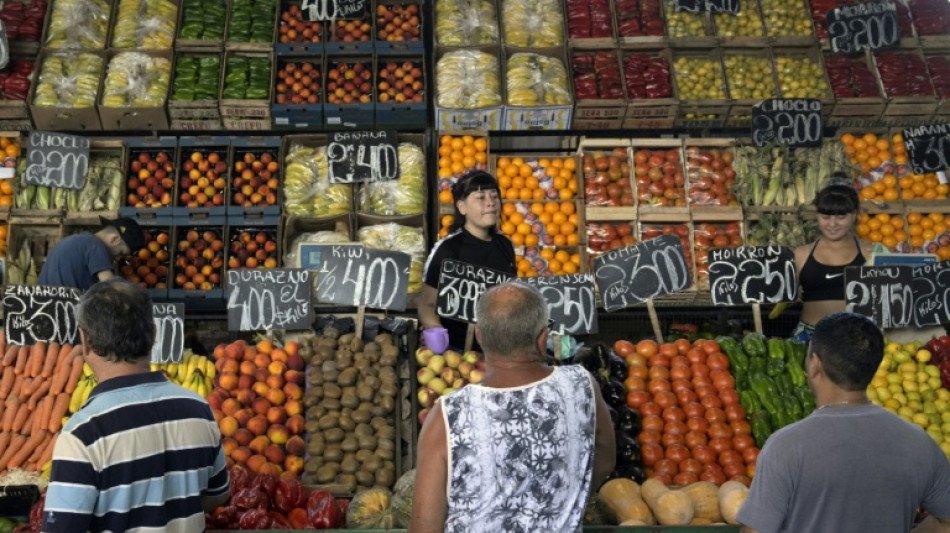
'Like James Bond,' Argentine price spies fight inflation / Photo: JUAN MABROMATA - AFP

 Oil extends gains, stocks mostly down as Trump issues fresh Iran warning

 ThinkMarkets Expands Weekend Trading Offering, Launches Weekend League Competition

 Tibet activists accuse China of downplaying floods
 Afghanistan war victims left 'without justice', UN says
 Iran president offers US olive branch before Putin meeting
 China-Nepal flood toll tops 1,000 as tunnel rescue offers last hope

 Japan to relax overtime regulation under workaholic PM

 Thwarted Niger mutiny exposes junta's Russia dependence

 Illegal mining ravages S.Africa's economic hub

 Nepal's wall of missing offers last hope after Himalayan flood

 US to press G20 on light-touch AI regulation

 2 die in Grand Canyon flash flood, only 1 person unaccounted for

 US Army Secretary Driscoll submits resignation: White House
 Oil extends gains, stocks drop as Trump issues fresh Iran warning

 Tsitsipas says Kyrgios's positive cocaine test 'kind of expected'

 In Japan's mountains, a different way to manage bears

 Middle East war a boon for UAE defence giant with global ambitions

 Former gang member found guilty of murdering Tupac Shakur

 Top-seeded Zverev opens US Open campaign
 US regulator, 22 states accuse Amazon of 'manipulating' ad auctions: lawsuit

 TRON Founder Justin Sun Shares Outlook on Bitcoin, Stablecoins and Global Finance at Bitcoin Asia 2026

 Tributes to 'eternal' Messi on Argentina retirement

 Arteta hails Arsenal's 'finishers' after Saka kills off Villa

 Yamal, Raphinha bag braces as Barcelona rout Rayo

 Alcaraz makes winning return at US Open, Sabalenka safely through
Like a veritable undercover agent, Monica Schenone tries to pass unnoticed through the aisles of a supermarket in Buenos Aires, sneaking photographs of price tags.
The 52-year-old homemaker is part of a group of ordinary Argentines who volunteer their time to police stores' adherence to price limits suggested by the government to curtail spiraling inflation.
She feels "like James Bond," Schenone says, as she tries to blend in with shoppers in the capital of Argentina -- which in 2022 recorded its highest inflation rate in three decades at 94.8 percent -- one of the highest in the world.
Prices for daily staples rose monthly, even weekly in 2022, with milk prices climbing more than four-fold and those for cooking oil and sugar more than five-fold, according to the Abeceb economic consultancy.
In a bid to rein in galloping price rises, the government's "Precios Justos" (Fair Prices) program applies a 3.2-percent monthly price hike limit to some 2,000 essential products including flour, rice, milk and sunflower oil.
"I am in shock," Schenone told AFP as she exited a supermarket in the San Cristobal neighborhood where she had executed a covert price check she said left her horrified.
"A bar of soap that went from 231.40 pesos to 496 pesos, that does not seem to me to be a three percent increase," she said.
"It seems to me that we are still being taken for fools."
Precios Justos runs from February to the end of June, and covers food and medicines but also soap, clothing, shoes, and school gear, among other items.
Joining is voluntary, but producers and vendors who do sign up to the price agreement risk fines for non-compliance of up to 71 million pesos (some $370,000 at Tuesday's exchange rate) from Argentina's ministry of commerce.
Precios Justos, states the government, "aims to reduce inflationary expectations and... recover the purchasing power of the population’s income."
All major supermarket chains as well as Argentina's massive COPAL food and drinks producers' group have signed up to the program.
But most smaller, independent stores which serve millions of Argentines remain outside of the framework, sometimes charging prices double the suggested rate, according to consulting firm Nielsen IQ.
- 'Impotence' -
Schenone and about two dozen others members of an activist group called "La Dignidad" (Dignity) have taken it upon themselves to check up on Precios Justos compliance in Buenos Aires.
She said they regularly observe serious breaches.
Most often, price-controlled products are simply not stocked, but there are also many cases of prices above the agreed limit, she said.
"What I feel is a lot of impotence, a lot of anger. I feel that, as always, those of us in the lower classes continue to be screwed," Schenone told AFP.
The price checker and her peers submit their findings to La Dignidad, which publishes periodic reports.
There is also a government-sponsored app for consumers to report violations.
But opponents of the government's plan question the efficacy of price freezes, calling instead for macroeconomic measures such as slashing money printing and public spending.
Argentina has been grappling with an economic crisis for years, registering double-digit inflation in each of the last 12 years.
The causes are multiple, including persistent deficit spending, constant currency devaluation, successive droughts and external factors like the war in Ukraine that affected energy and grain prices.
Economy Minister Sergio Massa has said inflation is the "biggest poverty factor" in Argentina and "one of the main issues to fight."
For the month of January, inflation came in at 6.0 percent from December, and at 98.8 percent compared to the same month a year ago, according to data released Tuesday by the INDEC statistics institute.
For food and non-alcoholic drinks, prices rose 6.8 percent from December to January, and by 98.4 percent from a year earlier.
S.Pimentel--PC