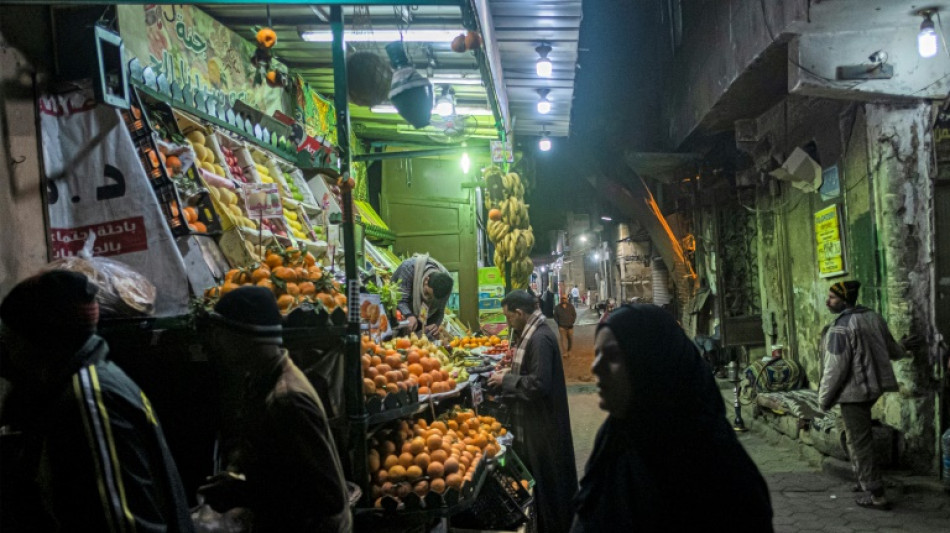
Cash-strapped Egypt sells state assets to Gulf nations / Photo: Khaled DESOUKI - AFP

 Oil extends gains, stocks mostly down as Trump issues fresh Iran warning
 ThinkMarkets Expands Weekend Trading Offering, Launches Weekend League Competition

 Tibet activists accuse China of downplaying floods
 Afghanistan war victims left 'without justice', UN says
 Iran president offers US olive branch before Putin meeting

 China-Nepal flood toll tops 1,000 as tunnel rescue offers last hope
 Japan to relax overtime regulation under workaholic PM
 Thwarted Niger mutiny exposes junta's Russia dependence
 Illegal mining ravages S.Africa's economic hub
 Nepal's wall of missing offers last hope after Himalayan flood
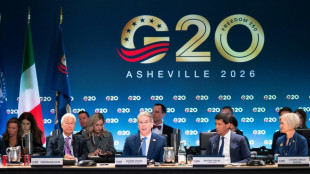
 US to press G20 on light-touch AI regulation

 2 die in Grand Canyon flash flood, only 1 person unaccounted for
 US Army Secretary Driscoll submits resignation: White House
 Oil extends gains, stocks drop as Trump issues fresh Iran warning

 Tsitsipas says Kyrgios's positive cocaine test 'kind of expected'
 In Japan's mountains, a different way to manage bears

 Middle East war a boon for UAE defence giant with global ambitions
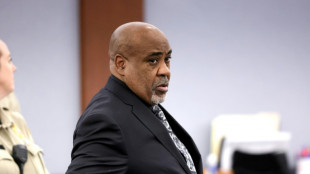 Former gang member found guilty of murdering Tupac Shakur
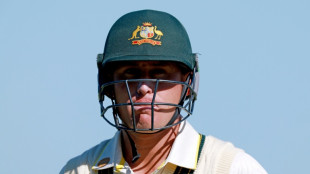
 Top-seeded Zverev opens US Open campaign

 US regulator, 22 states accuse Amazon of 'manipulating' ad auctions: lawsuit

 TRON Founder Justin Sun Shares Outlook on Bitcoin, Stablecoins and Global Finance at Bitcoin Asia 2026

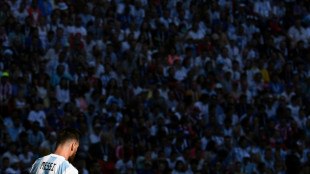 Tributes to 'eternal' Messi on Argentina retirement
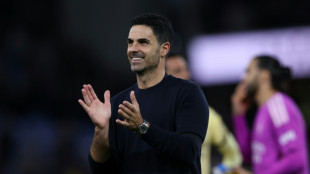 Arteta hails Arsenal's 'finishers' after Saka kills off Villa
 Yamal, Raphinha bag braces as Barcelona rout Rayo
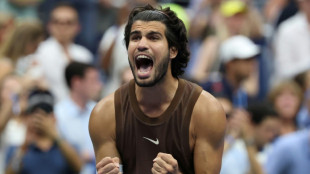 Alcaraz makes winning return at US Open, Sabalenka safely through
Egypt, sapped dry of dollars despite a $3 billion International Monetary Fund bailout loan, is seeking to boost its coffers by selling state assets to wealthy Gulf nations.
Experts say the deals could be a win-win for all sides, but unlike old Gulf largesse of unconditional aid, the new deals will require reforms.
Cairo hopes the cash injection will plug what the IMF warns is "a financing gap of about $17 billion over the next four years".
For Kuwait, Qatar, Saudi Arabia and the United Arab Emirates, eager to diversify their oil and gas-based economies, it provides a swift route to snap up assets, land and stakes in state enterprises in the North African nation.
"The investments by Gulf states into Egypt last year helped to alleviate some of the immediate financing concerns that Egypt encountered, prior to securing further funds from the IMF," said James Swanston, an emerging markets economist at Capital Economics in London.
"At the same time, it has allowed the Gulf states to continue to have a sphere of influence in the region."
For Gulf nations, a steep devaluation of Egypt's currency and incentives offered by President Abdel Fattah al-Sisi make it an attractive investment.
But Sisi's Gulf allies -- on whose support he relied after deposing Islamist president Mohamed Morsi in 2013 -- are done writing blank checks, and now demand economic reform and greater transparency.
- Gulf spending spree -
In under a year, the Egyptian pound has lost half of its value, propelling annual inflation in the import-dependent country to 26.5 percent in January.
Of the $34.2 billion in Cairo's foreign reserves -– a 20 percent drop from February 2022 –- some $28 billion are deposits from wealthy Gulf allies.
The country's foreign debt has more than tripled in a decade to $155 billion.
"A country like Egypt needs a trillion-dollar budget each year. Do we have that money? No. Do we have half of it? No. Do we have a quarter of it? No," Sisi said at the World Government Summit in Dubai this week, noting the importance of "help from friends, the UAE, Saudi Arabia and Kuwait".
But the days of unconditional aid are over, Saudi Finance Minister Mohammed al-Jaadan has warned.
"We used to give direct grants and deposits without strings attached, and we are changing that," Jaadan said at Davos in January, explaining the kingdom will be demanding "to see reforms".
As part of the IMF loan agreement, Cairo pledged to privatise key state assets, with a view to increase the private sector's share of the economy from 30 percent to 65 percent by 2025.
Gulf nations swooped in.
In 2022, 66 mergers and acquisitions were completed in Egypt, more than double the transactions in 2021, Egyptian business news publication Enterprise calculated in December.
- Military's powerful economic role -
With stakes in 40 deals, Emirati and Saudi companies had the bulk of transactions.
Abu Dhabi's sovereign wealth fund ADQ, and Saudi Arabia's Public Investment Fund "spent some $3.1 bn to acquire significant minority stakes" in some of the "strongest companies", Enterprise wrote in December.
They snapped up key shares of Egypt's two largest fertiliser producers -- 41.5 percent of Abu Qir Fertilizers Company, and 45 percent of MOPCO.
ADQ is also the largest private shareholder in Egypt's Commercial International Bank (CIB), purchasing a 17.5 percent stake for $911.5 million.
The Saudi fund now owns 25 percent of state-founded digital payments company eFinance, and is negotiating the purchase of United Bank of Egypt.
To encourage more deals, Cairo is slashing its notorious red tape, with Prime Minister Mostafa Madbouli earlier this month announcing stake sales in 32 public companies.
But the vast asset portfolio of Egypt's hugely powerful military -- which has played a key but secretive role in the economy for decades -- remains largely off the table for deals, the Carnegie Middle East Center's Yezid Sayigh said.
Military-owned companies are "so financially opaque they cannot be put on the market", Sayigh said.
Only two of the 32 up for sale are military companies. One of them is the army's Wataniya Petroleum, which Abu Dhabi National Oil Company (ADNOC) had in 2021 considered purchasing.
Sayigh said that deal stumbled "apparently because the internal financial management of the military company would scare off any serious investor from risking his capital".
R.Veloso--PC