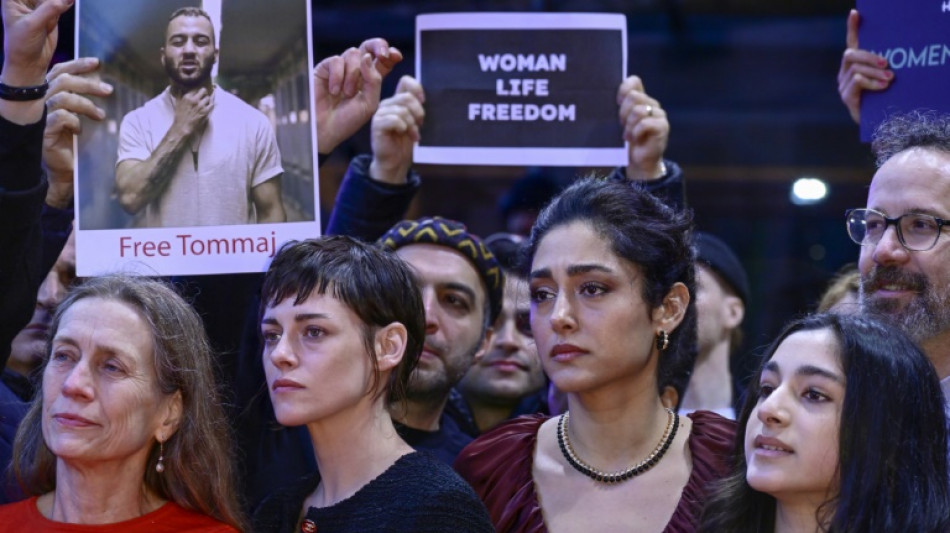
Iran freedom struggle stars at Berlin film fest / Photo: John MACDOUGALL - AFP

 Best Pet Advent Calendars for Christmas 2026: Dog Treats and Cat Toys

 Grattan Institute Releases Blueprint to Target Specialists Over Excessive Fees

 Arizona Science Center Hosts Girls in STEM Astro Adventures for Students

 New Turkish Cafe, Japanese BBQ, and Korean Restaurants Open Across East Bay

 Knowle Move Four Points Clear at Top After Histon Victory

 Physicians Urge Arizona to Ban Medical Gag Clauses and Enable Private Lawsuits

 New Campaign Highlights Knowledge Gaps on Carbon Monoxide Safety Among Americans

The Berlin film festival, long a champion of Iran's embattled independent directors, is spotlighting its citizens' fight for basic rights with a series of screenings, events and a red-carpet protest.
French-Iranian actor Golshifteh Farahani, who is serving on the jury for the top prizes with president Kristen Stewart, said as the festival kicked off Thursday that cinema was a crucial fuel for the freedom movement.
"In a country like Iran that is a dictatorship, art is not only an intellectual or philosophical thing, it's essential, it's like oxygen," she said.
Farahani made her name in Iranian movies and became an international star in productions such as Jim Jarmusch's "Paterson" opposite Adam Driver.
She and Stewart joined the red-carpet demonstration for women's rights in Iran on Saturday with festival chief Mariette Rissenbeek, who told AFP the Berlinale stood with Iranian directors who "weren't allowed to travel to the festival".
- 'Change something with cinema' -
The Berlinale, Europe's first major cinema showcase of the year, has awarded its Golden Bear top prize to many of the leading lights of Iranian cinema including Asghar Farhadi ("A Separation"), Jafar Panahi ("Taxi") and Mohammad Rasoulof ("There Is No Evil").
Iran, rocked by months of anti-government rallies, this month released Panahi and Rasoulof from prison along with several dozen other well-known detainees in an apparent attempt to appease critics.
This year, the festival is showing several documentaries, including Steffi Niederzoll's "Seven Winters in Tehran" and "My Worst Enemy" by Mehran Tamadon, which expose the brutal conditions in Iran's jails as well as rampant executions.
Niederzoll's harrowing film, which includes material smuggled out of Iran, tells the story of Reyhaneh Jabbari, who was hanged in 2014 at the age of 26 for killing a former intelligence officer she maintained had tried to rape her.
Featuring wrenching interviews with her family, who agitated for her freedom and appealed for mercy to the murdered man's son, the film recounts how an international campaign for Jabbari's life arose.
Zar Amir Ebrahimi, who won the best actress award at Cannes last year, narrates the film with letters, journals and text messages Jabbari wrote from jail, where she became a role model for many fellow prisoners.
"We hope that, hand in hand, we can change something with cinema," Amir Ebrahimi told AFP.
"My Worst Enemy" also examines state interrogations, as director Tamadon invites members of Paris's large Iranian exile community to question him using pressure techniques they themselves experienced in custody.
Half expose, half group therapy session, the film asks whether anyone can become an instrument of state oppression, given the chance.
Amir Ebrahimi appears as one of the interrogators and reveals that she was sexually assaulted while in custody by a female doctor during a purported medical exam.
"I couldn't walk for three days," she says.
- 'Shine a light' -
Tamadon told AFP it was "time to forget that the Islamic republic will reform itself".
He hailed the role of Western platforms such as the Berlinale to "shine a light on the violence perpetrated against the Iranian people".
"Iranians in Iran are exhausted -- this gives the energy and motivation to continue to hit the streets."
Milad Alami's drama "Opponent" stars Payman Maadi from "A Separation", as a closeted gay man seeking asylum with his wife and two daughters in northern Sweden.
Alami, who himself moved from Iran to Sweden as a child, said he aimed with his second feature to explore how official repression penetrates even the most intimate relationships, including a marriage.
"There are walls between them (the couple) that created this feeling of not being able to talk to each other," he said in notes for the film.
The wife Maryam senses her husband's inner conflict even as he keeps it under wraps for fear of reprisal. "That's a big thing in Iran," Alami said.
For those who have left Iran, the struggle to find out who they really are begins anew, he said.
"When you come to another country, when freedom is there, how difficult is it to take it?"
L.Henrique--PC

