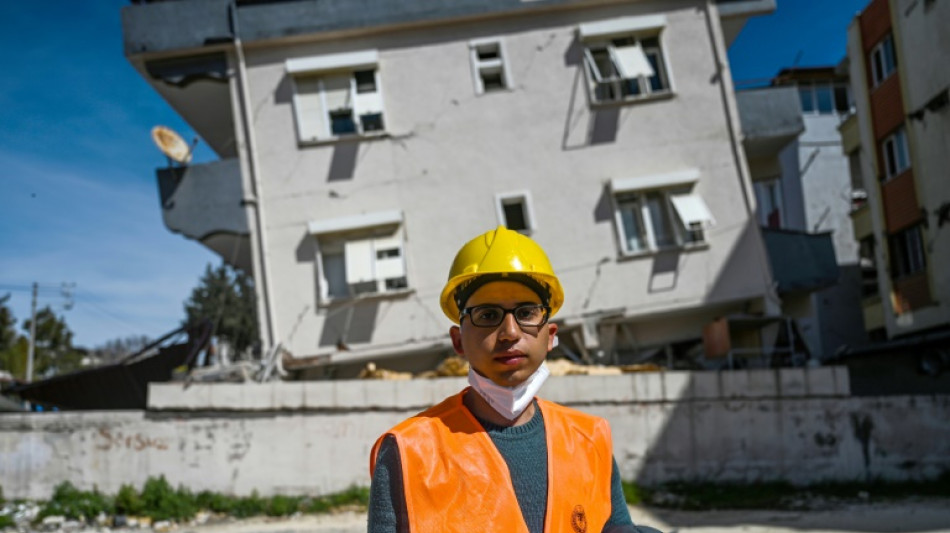
Lawyers search for justice in Turkish quake ruins / Photo: OZAN KOSE - AFP

 Best Pet Advent Calendars for Christmas 2026: Dog Treats and Cat Toys

 Grattan Institute Releases Blueprint to Target Specialists Over Excessive Fees

 Arizona Science Center Hosts Girls in STEM Astro Adventures for Students

 New Turkish Cafe, Japanese BBQ, and Korean Restaurants Open Across East Bay

 Knowle Move Four Points Clear at Top After Histon Victory

 Physicians Urge Arizona to Ban Medical Gag Clauses and Enable Private Lawsuits

 New Campaign Highlights Knowledge Gaps on Carbon Monoxide Safety Among Americans

The Turkish lawyer adjusts his helmet and steps a little deeper into the rubble in search of proof that last month's catastrophic earthquake did not need to claim so many lives.
Using pens and coins to measure the thickness of supporting columns, Ahmet Kandemir and dozens of other Turkish Bar Association members are trying to preserve evidence before it vanishes in cleanup work.
The 7.8-magnitude earthquake and its aftershocks killed more than 46,000 people in Turkey and nearly 6,000 in neighbouring Syria last month.
Turkish police have rounded up 269 suspects as part of a growing investigation into contractors who put up gleaming towers in one of the world's most active earthquake zones.
But critics worry about President Recep Tayyip Erdogan's close relations with the construction sector -- and what bearing that might have on his government's willingness to prosecute negligence.
This puts added pressure on Ahmet Kandemir and the other lawyers who volunteered to deliver justice for families who had thought they were moving into houses able to withstand a big quake.
"We are checking the construction material and the thickness of the steel," Kandemir told AFP.
"We take down the street number, record if there were any dead or wounded inside, the damage status, and send all data to the bar association," he said.
"We check the debris before it's lifted, so that the evidence does not disappear," fellow lawyer Firatcan Kaliz said.
- 'Garden of heaven'-
The Turkish Bar Association has difficult relations with Erdogan's government, which rights groups accuse of rolling back democratic freedoms and getting mired in corruption.
Many of its members have come under investigation themselves. But the lawyers are greeted with hope on the streets of Antakya.
"I am uneducated," Omer Unsaldi, a 67-year-old who lost 14 family members, said through tears.
"I don't know where I can go. But they are educated. They will help and guide us," he said, pointing to the lawyers.
Despite their efforts, some of the most crucial evidence already appears to be gone.
Ronesans Residence, a luxury complex whose list of celebrity residents included former Ghana international footballer Christian Atsu, became a symbol of building malpractice when it crumbled like a house of cards.
Atsu was one of hundreds who died under the rubble of the 12-storey block of flats, built in 2013.
The date is significant because Turkey by then had updated its building standards, modelling them on those of quake-prone California.
AFP journalists who visited the site this week saw that almost all the debris had been cleared away.
In sharp contrast, suitcases, family photos and toys remained mixed into the soil.
Kandemir said the bar association had received scores of appeals from victims' families who had been told that their building was earthquake-proof.
"They call and say the flats were advertised to them as a 'garden of heaven' that could withstand even a 9.0-magnitude earthquake," he said.
"So many were killed. The injured had their arms and legs amputated. There are major grievances."
- 'We are all responsible' -
The main contractor involved with the Ronesans Residence was detained at Istanbul Airport while trying to leave the country last month.
His arrest made headlines across Turkey, where nearly all the media are under the government's direct or indirect control, sparking speculation that officials were looking for scapegoats for the disaster.
Rustu Kanli, another local contractor, said building developers, municipalities and the government all shared blame for the high death toll.
"Municipalities have allowed five or eight extra floors to be built on top of what should have been a three-storey building," Kanli told AFP.
"Ministries have been slow to respond. There should have been proper reviews," he said.
"We can't be the only ones getting the blame here," said the contractor. "We are all responsible."
L.Mesquita--PC

