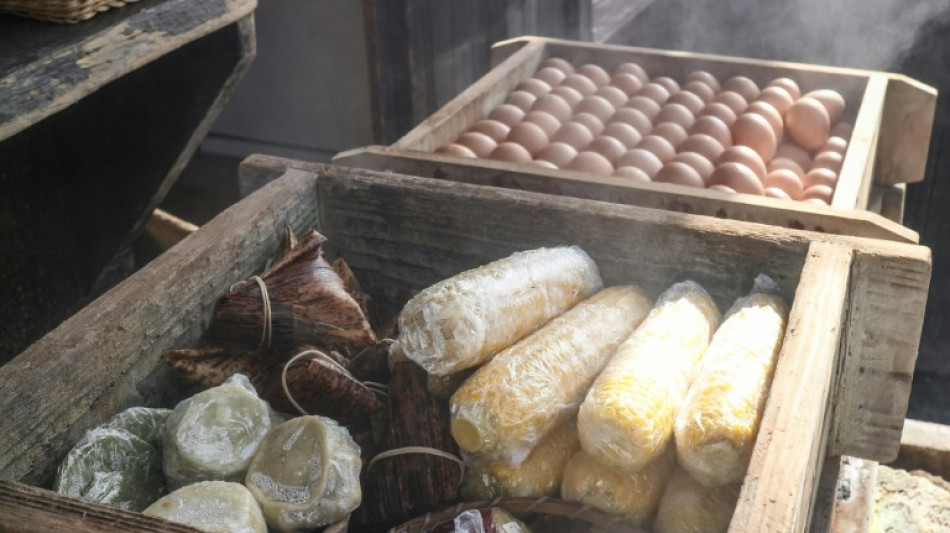
Steam cuisine: cooking in Japan's hot springs / Photo: Etienne BALMER - AFP

 Six defining moments of Lionel Messi's Argentina career

 Trump blasts US backlash against data centers
 It 'hurts' says Messi of decision to retire from international football
 Benzema ends brief stint with Al Hilal in Saudi league

 Djokovic's Grand Slam future uncertain after brutal US Open defeat

 Turkey says regional defence pact not against any country

 US vows to keep economic pressure on Iran as G20 finance talks begin

 Shein valued at $26.3 bn in Hong Kong market debut

 Crude prices rise above $90 per barrel on US-Iran strikes

 Liverpool sign Barcola from PSG for reported £124 million

 Putin, Xi, Iran's Pezeshkian in Kyrgyzstan for summit

 Fully Permitted Tanzanian Gold Project Clears Path to Construction as Financing, EPCM Fall in Place (LVGLF)

 EdWealth Announces MoneyBench Benchmark Comparing AI Money Answers From Ed, ChatGPT and Gemini

 Root says new balls behind batsmen's struggles in England

 Swollen rivers, washed-out roads hamper Nepal rescue effort

 In France's north, winegrowers bet on a warmer future

 Deadly virus stalks South Africa's sardines
 South Korea women's football body probes 'period' insult
 Transitional Fashion Essentials for Autumn: Key Pieces from M&S and Joe Browns

 China's Xi and Iran's Pezeshkian in Kyrgyzstan, Putin expected

 Rescuers hunt for missing after deadly N.Cyprus ferry accident
 Ethiopia's Abiy could consolidate power as 'executive president'

 Crude prices rise on US-Iran strikes, equities mixed after Warsh remarks

 South Korea court gives Unification Church leader 2 years prison
 US hosts G20 finance talks with growth, Iran pressure on agenda

Using geothermal resources to generate electricity is a divisive prospect in Japan, but there is little disagreement about another use for it: natural steam for cooking.
The geothermal sources that make Japan a haven for hot springs or onsen are also used to produce a range of delicacies.
There's the "onsen tamago" -- eggs cooked in geothermally heated water at around 65 degrees (149 degrees Fahrenheit) to produce a relatively firm yolk with a creamy soft white.
And then there are small round cakes called "onsen manju", a popular snack sold at the approximately 2,900 hot spring locations across Japan.
Stuffed with red bean paste, they are cooked with the steam that rises from onsen water.
In Beppu, a small coastal town in Japan's southwestern Kyushu, an abundance of natural hot springs has given rise to a local speciality: "jigoku mushi" or "hell steaming".
Customers can buy meat, fish and vegetables on site at an onsen, and cook them in containers connected directly to the steam emanating from a nearby natural hot spring.
"This method of cooking was already being mentioned in local historical documents as far back as 200 years ago," Hitoshi Tanaka, president of Hyotan Onsen -- which offers "jigoku mushi" to its customers -- told AFP.
With steam at temperatures of 100-110 degrees Celsius (212-230 Fahrenheit), cooking generally takes no more than five to 10 minutes, "so the food retains its original colour", Tanaka explains.
The sulfur present in the steam imparts an "umami" to the meal, a flavour enhancer considered key to Japanese cuisine, and it contains iron, a trace element important for health, he added.
"You savour it with your eyes, you smell the steam, you hear the sound of the source of the hot spring: so you appreciate the food here with your whole body."
The technique has another benefit: no need for electricity or gas at a time when Japan, like many other countries, is dealing with soaring energy prices.
E.Raimundo--PC