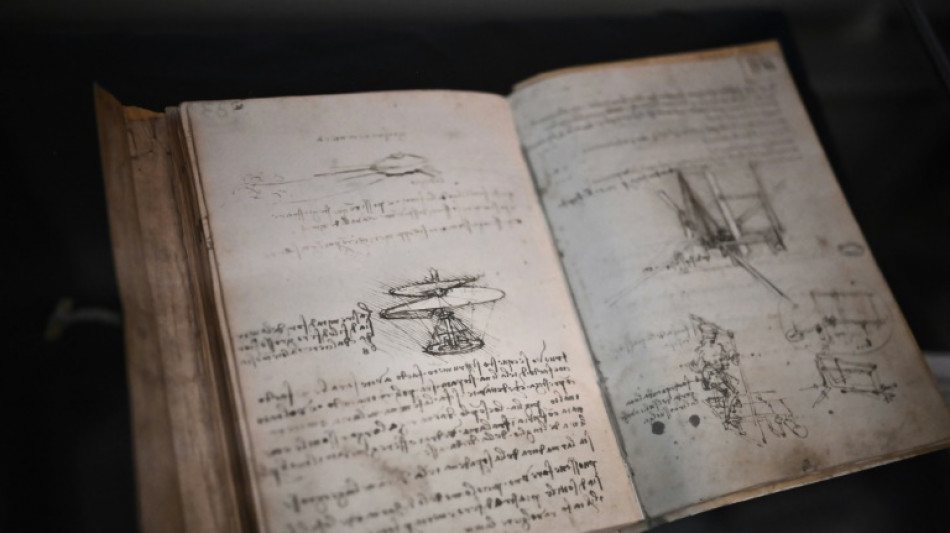
New research claims Leonardo da Vinci was son of a slave / Photo: MARCO BERTORELLO - AFP

 Six defining moments of Lionel Messi's Argentina career
 Trump blasts US backlash against data centers
 It 'hurts' says Messi of decision to retire from international football
 Benzema ends brief stint with Al Hilal in Saudi league
 Djokovic's Grand Slam future uncertain after brutal US Open defeat
 Turkey says regional defence pact not against any country
 US vows to keep economic pressure on Iran as G20 finance talks begin
 Shein valued at $26.3 bn in Hong Kong market debut
 Crude prices rise above $90 per barrel on US-Iran strikes

 Liverpool sign Barcola from PSG for reported £124 million
 Putin, Xi, Iran's Pezeshkian in Kyrgyzstan for summit
 Fully Permitted Tanzanian Gold Project Clears Path to Construction as Financing, EPCM Fall in Place (LVGLF)
 EdWealth Announces MoneyBench Benchmark Comparing AI Money Answers From Ed, ChatGPT and Gemini

 Root says new balls behind batsmen's struggles in England
 Swollen rivers, washed-out roads hamper Nepal rescue effort

 In France's north, winegrowers bet on a warmer future
 Deadly virus stalks South Africa's sardines
 South Korea women's football body probes 'period' insult
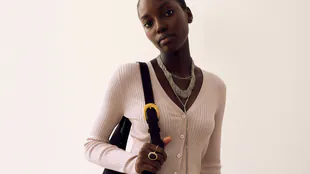 Transitional Fashion Essentials for Autumn: Key Pieces from M&S and Joe Browns
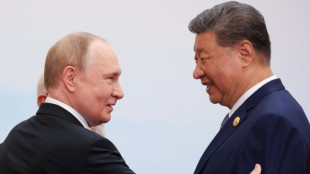 China's Xi and Iran's Pezeshkian in Kyrgyzstan, Putin expected
 Rescuers hunt for missing after deadly N.Cyprus ferry accident
 Ethiopia's Abiy could consolidate power as 'executive president'
 Crude prices rise on US-Iran strikes, equities mixed after Warsh remarks
 South Korea court gives Unification Church leader 2 years prison
 US hosts G20 finance talks with growth, Iran pressure on agenda
Leonardo da Vinci, the painter of the "Mona Lisa" and a symbol of the Renaissance, was only half-Italian, his mother a slave from the Caucasus, new research revealed on Tuesday.
Da Vinci's mother had long been thought a Tuscan peasant, but University of Naples professor Carlo Vecce, a specialist in the Old Master, believes the truth is more complicated.
"Leonardo's mother was a Circassian slave... taken from her home in the Caucasus Mountains, sold and resold several times in Constantinople, then Venice, before arriving in Florence," he told AFP at the launch of a new book.
In the Italian city, she met a young notary, Piero (Peter) da Vinci, "and their son was called Leonardo".
The findings of Vecce, who has spent decades studying da Vinci and curating his works, are based on Florence city archives.
They have formed the basis of a new novel -- "The Smile of Caterina, the mother of Leonardo" -- while also shedding new light on the artist himself.
Any new discovery about da Vinci is hotly contested by the small world of experts who study him, but Vecce insists the evidence is there.
Among the documents he found is one written by da Vinci's father himself, a legal document of emancipation for Caterina, "to recover her freedom and recover her human dignity".
- 'Spirit of freedom' -
This document is dated 1452, and was presented Tuesday at a press conference at the headquarters of publishing house Giunti in Florence.
It was written by "the man who loved Caterina when she was still a slave, who gave her this child named Leonardo and (was) also the person who helped to free her", Vecce said.
His assertion offers a radical change of perspective on da Vinci, who was believed to have been the product of an affair between Peter da Vinci and a different woman, young Tuscan peasant Caterina di Meo Lippi.
Born in 1452 in the countryside outside Florence, da Vinci spent his life travelling around Italy before dying in Amboise, France in 1519, at the court of King Francis 1.
Vecce believes the difficult life of his "migrant" mother had an impact on the work of her brilliant son.
"Caterina left Leonardo a great legacy, certainly, the spirit of freedom," he said, "which inspires all of his intellectual scientific work".
Da Vinci was a polymath, an artist who mastered several disciplines including sculpture, drawing, music and painting, but also engineering, anatomy, botany and architecture.
"He doesn't let anything stop him," Vecce said.
Some may consider the idea that this epitome of a "Renaissance man" was the product of such a union too good to be true.
But Paolo Galluzzi, a da Vinci historian and member of the prestigious Lincei scientific academy in Rome, said it is "by far the most convincing".
Speaking to AFP, he highlighted the quality of the documents discovered by his colleague, adding that there "must remain a minimum of doubt, because we cannot do a DNA test".
Galluzzi said he was also not surprised.
The period into which da Vinci was born marks "the beginning of modernity, the exchanges between people, cultures and civilisations which gave birth to the modern world", he said.
P.Serra--PC