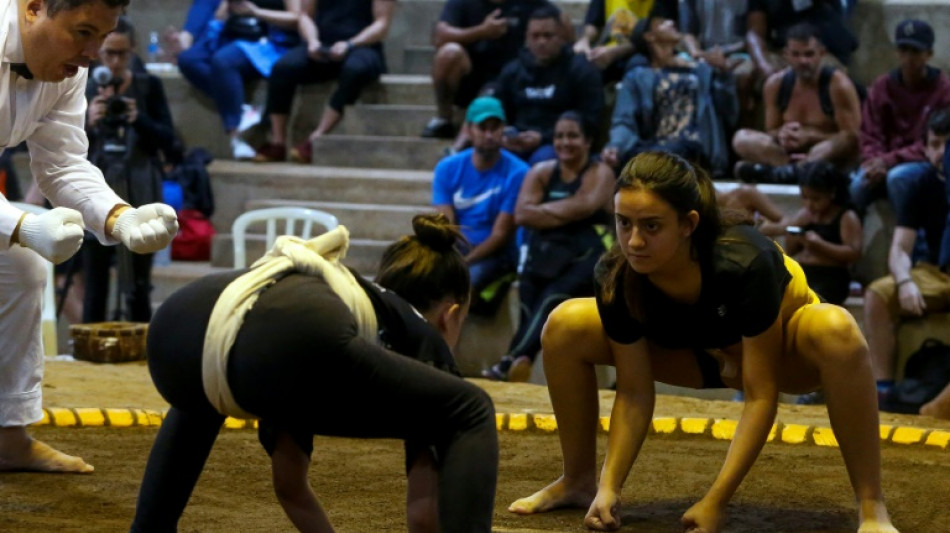
Women sumo wrestlers 'breaking prejudice' in Brazil / Photo: Miguel SCHINCARIOL - AFP

 US vows to keep economic pressure on Iran as G20 finance talks begin

 Shein valued at $26.3 bn in Hong Kong market debut
 Crude prices rise above $90 per barrel on US-Iran strikes

 Liverpool sign Barcola from PSG for reported £124 million

 Putin, Xi, Iran's Pezeshkian in Kyrgyzstan for summit

 Fully Permitted Tanzanian Gold Project Clears Path to Construction as Financing, EPCM Fall in Place (LVGLF)

 EdWealth Announces MoneyBench Benchmark Comparing AI Money Answers From Ed, ChatGPT and Gemini

 Root says new balls behind batsmen's struggles in England

 Swollen rivers, washed-out roads hamper Nepal rescue effort

 In France's north, winegrowers bet on a warmer future

 Deadly virus stalks South Africa's sardines

 South Korea women's football body probes 'period' insult

 Transitional Fashion Essentials for Autumn: Key Pieces from M&S and Joe Browns

 China's Xi and Iran's Pezeshkian in Kyrgyzstan, Putin expected

 Rescuers hunt for missing after deadly N.Cyprus ferry accident
 Ethiopia's Abiy could consolidate power as 'executive president'

 Crude prices rise on US-Iran strikes, equities mixed after Warsh remarks

 South Korea court gives Unification Church leader 2 years prison

 US hosts G20 finance talks with growth, Iran pressure on agenda

 African players in Europe: Wissa flick seals Newcastle victory

 Venice film preview: Clooney, Oasis and Musk

 Poorly Djokovic crashes out of US Open first round

 Djokovic falls in US Open first round, earliest Grand Slam exit in 20 years

 Chinese guitar capital's stairway to export heaven

 Stocks drop as Warsh fans US rate hike bets, crude up on US-Iran strikes
If the phrase "sumo wrestler" calls to mind a hefty Asian man in a loincloth, Valeria and Diana Dall'Olio, a mother-daughter sumo wrestling team from Brazil, have a message: think again.
The Dall'Olios are used to people saying they are too small, too fragile or too female to practice a sport typically associated with hulking Japanese men.
But they say that is just fuel for their fighting spirit when they get in the "dojo," or ring.
"There's a lot of prejudice. When you say you practice sumo, some people think you have to be fat," Valeria, 39, tells AFP, as she prepares for a competition at a public gym in Sao Paulo.
"Women are always under a microscope in the martial arts, because they're sports that have generally been restricted to male fighters."
She got into martial arts as a girl, studying judo and jiu-jitsu.
In 2016, she fell in love with sumo, which was brought to Brazil by Japanese immigrants in the early 20th century.
Soon, she was winning bouts -- all the way up to the Brazilian national title, which she won three times (2018, 2019 and 2021) in the middleweight category (65 to 73 kilograms, 143 to 161 pounds).
She added the South American championship to her trophy case in 2021.
- 'More fighting spirit' -
"I try to balance my different lives: homemaker, mother of two. I don't have much free time," Valeria says.
Women are banned from professional sumo in Japan.
In its birthplace, the highly ritualized sport has been linked for more than 1,500 years to the Shinto religion, whose believers have traditionally seen women as impure or bad luck for sumo.
In the past, women were banned from attending bouts or even touching sumo wrestlers.
But an international amateur women's sumo championship has been held since 2001. Organizers hope to one day turn it into an Olympic sport.
Being allowed to compete "is a real victory for us," says Valeria.
"We've got more fighting spirit than men, who usually aren't used to battling on as many fronts as we are."
Diana, 18, says she never had much interest in wrestling -- until she was attracted to sumo by its speed.
The bouts, in which wrestlers compete to fell or push one another from a circular, dirt-floor ring, rarely last more than 30 seconds.
Strength, strategy and technique are everything.
Diana put on a "mawashi," or sumo loincloth, for the first time in 2019.
She now competes as a lightweight (under 65 kilograms).
"You can feel the prejudice," she says of people's reactions to her choice of sport.
"A lot of people say, 'Women are fragile, they get injured and quit,'" she says.
"That's one of the things we're learning to fight against. My generation is rising up."
- Battle for respect -
Sumo is growing fast in Brazil, mainly thanks to women, says Oscar Morio Tsuchiya, president of the Brazilian Sumo Confederation.
Women make up around half the country's 600 sumo wrestlers, he says.
"Because of the Shinto rituals, in which women couldn't even go to the ring, a lot of traditionalists were horrified when they started to compete. But those barriers are being broken," he says.
At their Sao Paulo gym, the Dall'Olios brush off the dojo's dirt after a tough day, in which Diana won one of her three bouts and Valeria lost her only one, against 18-time Brazilian middleweight champion Luciana Watanabe.
Watanabe, 37, is the public face of sumo in Brazil.
She shares her passion for the sport by teaching it to children in Suzano, a small city with a large Japanese-Brazilian population 50 kilometers (31 miles) outside Sao Paulo.
"Men are usually the ones who teach sumo," she says.
"But I think I inspire the kids when I show them my titles."
She, too, says her goal is to "break prejudice."
"I want people to respect this sport more," she says.
"So many people still think it's just a sport for fat men. Sumo is for everyone."
L.Carrico--PC