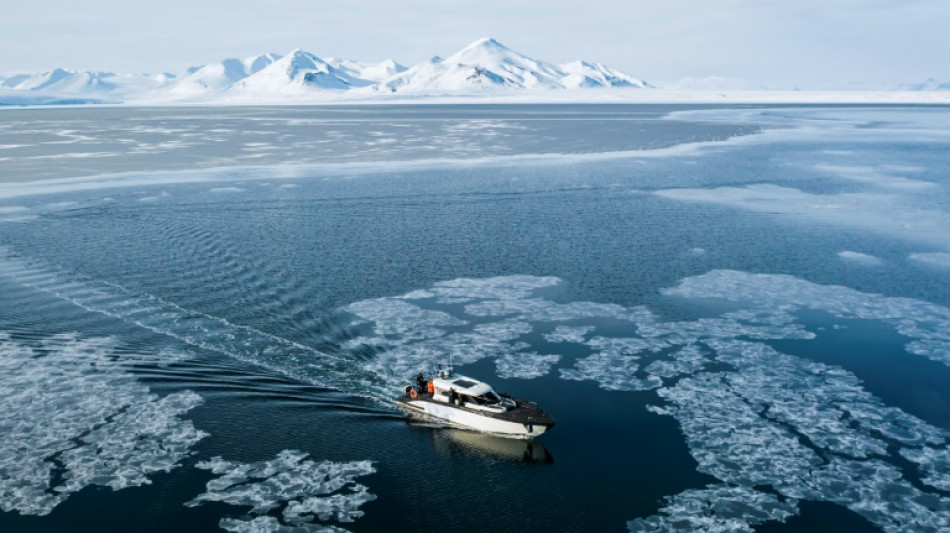
Norway's high court confirms its control of Arctic resources / Photo: Jonathan NACKSTRAND - AFP/File

 Best Pet Advent Calendars for Christmas 2026: Dog Treats and Cat Toys

 Grattan Institute Releases Blueprint to Target Specialists Over Excessive Fees

 Arizona Science Center Hosts Girls in STEM Astro Adventures for Students

 New Turkish Cafe, Japanese BBQ, and Korean Restaurants Open Across East Bay

 Knowle Move Four Points Clear at Top After Histon Victory

 Physicians Urge Arizona to Ban Medical Gag Clauses and Enable Private Lawsuits

 New Campaign Highlights Knowledge Gaps on Carbon Monoxide Safety Among Americans

Norway's highest court confirmed on Monday the Norwegian state's exclusive right to natural resources on the continental shelf around the strategically important Svalbard archipelago in the Arctic.
The case sets a precedent with major potential repercussions.
The 15 judges of the Supreme Court unanimously rejected a lawsuit brought by the Latvian fishing company SIA North STAR, which had demanded the right to fish for snow crab on the continental shelf around Svalbard.
At the heart of the dispute are different interpretations of the Spitsbergen Treaty, the 1920 legal document governing the Svalbard archipelago.
Beyond the question of snow crab -- considered a delicacy in Asia -- the case was seen as an important test to determine who would control other lucrative resources thought to lie beneath the continental shelf, like oil and gas or minerals.
Norway has long insisted it has exclusive rights.
The Spitsbergen Treaty recognises "the full and absolute sovereignty of Norway" over Svalbard, but also allows nationals from other signatory countries to "enjoy equally the rights of fishing and hunting in the territories".
As a result, Russia is able to maintain a mining community in the archipelago, located halfway between Europe's mainland and the North Pole, in a region its Northern Fleet transits en route to the Atlantic.
But the wording of the treaty limits its geographic scope to the archipelago's land and "territorial waters" -- a concept that today denotes a maritime zone of 12 nautical miles but which was not specifically defined in 1920.
- Treaty interpretation -
According to SIA North STAR, the spirit of the treaty indicates that equal rights should apply to the entire continental shelf, a much wider zone, and a concept that also did not exist legally when the treaty was drawn up.
The Supreme Court found in favour of the Norwegian state, ruling that the wording of the treaty could not be subjected to an "extensible interpretation".
"There has been no development in international law which would result in the notion of 'territorial waters' today including areas beyond territorial waters," it wrote in its verdict.
Contrary to most other treaty signatories -- more than 40 states, including Latvia, France, Russia, the United Kingdom and the United States -- Norway is almost the only one that uses a restrictive interpretation of the treaty.
The issue has never been brought before an international court.
"We are disappointed but we are not really surprised by the verdict, this case has a lot of legal and political aspects," the lawyer for the Latvian company, Hallvard Ostgard, told AFP.
He said he would like to see the case brought before the International Court of Justice, which only reviews cases brought by states.
The Norwegian state said it was "satisfied" with the ruling.
"It's an important national clarification for a question that has been raised on several occasions in Norwegian courts," Foreign Minister Anniken Huitfeldt told AFP.
L.Carrico--PC

