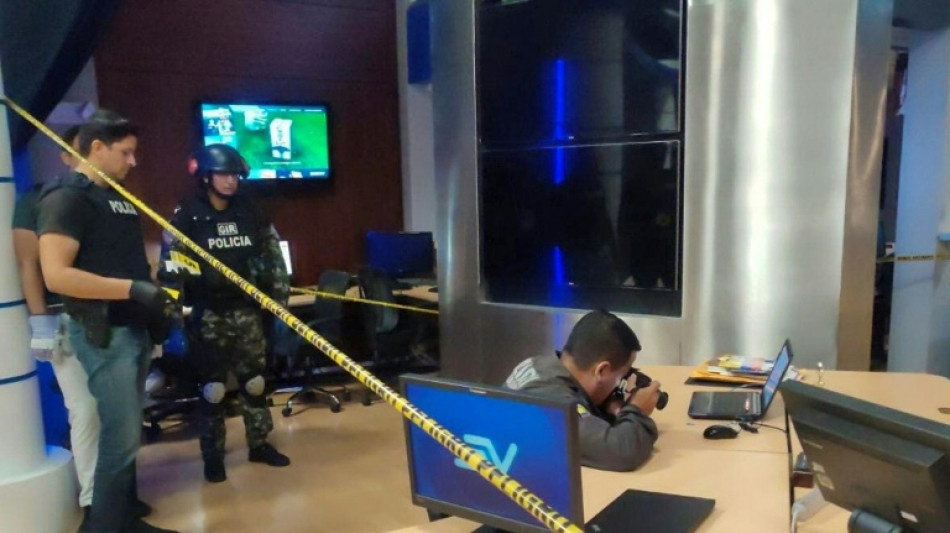
Letter bomb explodes at Ecuador TV station, other media get envelopes / Photo: Handout - Ecuador´s National Police/AFP

 Best Pet Advent Calendars for Christmas 2026: Dog Treats and Cat Toys

 Grattan Institute Releases Blueprint to Target Specialists Over Excessive Fees

 Arizona Science Center Hosts Girls in STEM Astro Adventures for Students

 New Turkish Cafe, Japanese BBQ, and Korean Restaurants Open Across East Bay

 Knowle Move Four Points Clear at Top After Histon Victory

 Physicians Urge Arizona to Ban Medical Gag Clauses and Enable Private Lawsuits

 New Campaign Highlights Knowledge Gaps on Carbon Monoxide Safety Among Americans

Two letter bombs were sent to TV stations in violence-plagued Ecuador on Monday, one of which exploded without causing casualties as other media also received suspect envelopes, officials and media reported.
A bomb sent to journalist Lenin Artieda exploded at his workplace in the port city of Guayaquil, the Ecuavisa private network said on its website.
Artieda received an envelope containing a pen drive which exploded when he inserted it into a computer.
He sustained light injuries to a hand and his face, said police official Xavier Chango. No-one else was hurt.
Elsewhere in Guayaquil in Ecuador's southwest, the prosecutor's office said a letter bomb was also sent to another channel, TC Television.
"Bomb crews will carry out a controlled detonation," the office said in a statement.
Chango said the USB drive sent to Artieda could have been loaded with RDX, "a military-type explosive."
He added police were also investigating envelopes sent to two other media outlets in Ecuador's capital, Quito.
The government said in a statement it "categorically rejects any form of violence perpetrated against journalists and media outlets."
Any attempt to "intimidate journalism and freedom of expression are repugnant," it added.
Ecuador's CDH human rights watchdog also condemned the attacks on media "in the context of growing insecurity in Ecuador."
Ecuador is sandwiched between Colombia and Peru, the world's two largest cocaine producers, and has itself become a hub for the global drug trade in recent years.
Guayaquil is one of its most violent cities, with frequent clashes between criminal gangs disputing drug trafficking routes.
President Guillermo Lasso has declared war on gangs who control the drug trade from prisons engulfed by extreme violence and riots that have left more than 400 inmates dead since 2021.
Ecuador has seen its murder rate jump from 14 per 100,000 inhabitants in 2021 to 25 per 100,000 in 2022.
Last year, the RTS TV station came under gunfire attack, and in 2020 a bomb exploded at Teleamazonas.
P.Queiroz--PC

