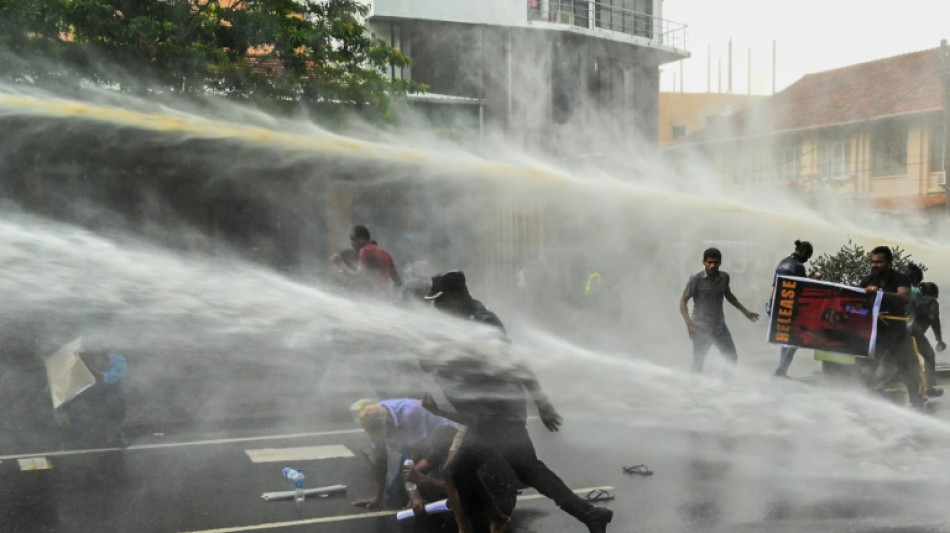
Sri Lanka: timeline of a crisis / Photo: ISHARA S. KODIKARA - AFP

 In France's north, winegrowers bet on a warmer future

 Deadly virus stalks South Africa's sardines
 South Korea women's football body probes 'period' insult
 Transitional Fashion Essentials for Autumn: Key Pieces from M&S and Joe Browns

 China's Xi and Iran's Pezeshkian in Kyrgyzstan, Putin expected

 Rescuers hunt for missing after deadly N.Cyprus ferry accident
 Ethiopia's Abiy could consolidate power as 'executive president'
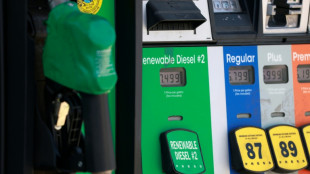 Crude prices rise on US-Iran strikes, equities mixed after Warsh remarks
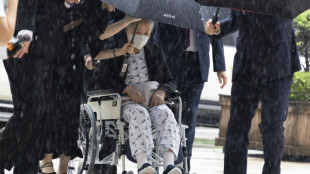 South Korea court gives Unification Church leader 2 years prison
 US hosts G20 finance talks with growth, Iran pressure on agenda

 African players in Europe: Wissa flick seals Newcastle victory

 Venice film preview: Clooney, Oasis and Musk

 Poorly Djokovic crashes out of US Open first round
 Djokovic falls in US Open first round, earliest Grand Slam exit in 20 years

 Chinese guitar capital's stairway to export heaven
 Stocks drop as Warsh fans US rate hike bets, crude up on US-Iran strikes
 Injuries cloud tennis as US Open gets under way
 Iran retaliates after first US strikes in a month
 Itauma says 'I'll be back' after bruising heavyweight title loss

 Brilliant Palou clinches fourth straight IndyCar crown
 US strikes Iran for first time in a month, Tehran retaliates

 Yin holds off Kim to win sixth LPGA title, end title drought

 Top-ranked Scheffler storms to PGA Tour Championship win

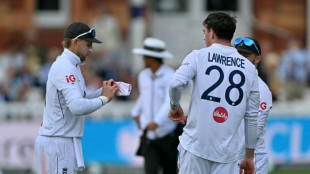 Root urges England to be 'grown-ups' after Pakistan series win

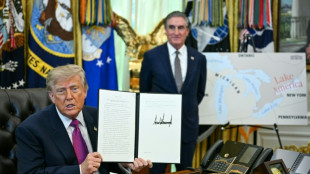 Google Maps renames Lake Ontario 'Lake America' in US -- but not Canada

The International Monetary Fund approved a $2.9 billion bailout deal for Sri Lanka on Monday, raising hopes for an easing of the island nation's dire economic crisis.
The South Asian country of 22 million people has suffered months of blackouts as well as acute food, fuel and medicine shortages.
Tens of thousands of people have protested against the government's handling of the crisis, aggravated by the loss of tourist revenue during the Covid-19 pandemic.
At the peak of the demonstrations, an angry crowd stormed former leader Gotabaya Rajapaksa's house and forced the then-president to flee the country.
His successor Ranil Wickremesinghe has cracked down hard on demonstrations and introduced sweeping economic reforms in an effort to repair the nation's shattered finances.
AFP looks at how the crisis unfolded:
- April 1: State of emergency -
President Gotabaya Rajapaksa declares a state of emergency after clashes between police and hundreds of demonstrators demanding his resignation outside his residence in the capital Colombo.
- April 3: Cabinet resigns -
Most of the cabinet resigns at a late-night meeting two days later, leaving Rajapaksa and his brother Mahinda -- the prime minister -- isolated.
The central bank governor quits a day later.
- April 5: President loses majority -
Finance minister Ali Sabry resigns just a day after being appointed.
The president then loses his parliamentary majority as former allies urge him to quit. He lifts the state of emergency.
- April 12: Foreign debt default -
The government announces it is defaulting on its foreign debt of $51 billion.
- April 19: First casualty -
Police kill a protester, the first casualty after several weeks of anti-government protests.
The next day, the IMF says it has asked Sri Lanka to restructure its colossal external debt before a rescue package can be agreed.
- May 9: Day of violence -
A mob of government loyalists bussed in from the countryside attacks peaceful protesters camped outside the president's office.
Nine people are killed and hundreds more injured in reprisal attacks.
Mahinda Rajapaksa resigns as prime minister and has to be rescued by troops after thousands of protesters storm his official residence in Colombo.
He is replaced by Ranil Wickremesinghe, a political veteran also deeply unpopular among the protesters.
- June 10: Humanitarian crisis -
The United Nations warns that Sri Lanka is facing a dire humanitarian crisis, with millions already in need of aid.
More than three-quarters of the population had reduced their food intake due to severe food shortages, it says.
- July 9: President's home stormed -
Rajapaksa flees his official residence with the assistance of troops, shortly before demonstrators storm the compound.
Wickremesinghe's home is torched by protesters.
- July 13: President flees country -
Rajapaksa flies to the Maldives on a military aircraft, accompanied by his wife and two bodyguards.
Six-time premier Wickremesinghe is appointed as acting president.
The government declares a state of emergency.
- July 14: Rajapaksa resigns -
Rajapaksa leaves the Maldives for Singapore.
On arrival, he emails his resignation as president to the parliamentary speaker.
- July 20: Wickremesinghe elected president -
Wickremesinghe beats two opponents to be elected president by parliament for the remainder of Rajapaksa's term, which expires in November 2024.
The 73-year-old begins a crackdown on demonstrators and embarks on a reform programme to meet IMF conditions for a bailout, raising taxes and hiking the cost of fuel and utilities.
- September 1: Bailout deal -
The IMF announces a four-year, $2.9 billion bailout package, conditional on a deal between the government and its creditors to restructure its borrowings.
The agreement still needs approval by the lender's board and the sum is lower than the $3-4 billion sought by Sri Lanka, but it is an important first step.
Peter Breuer, the IMF's head of mission, urges creditors to cut a deal with the island nation or risk deepening the ongoing crisis.
- March 7: China comes through -
China, Sri Lanka's largest bilateral creditor, agrees to restructure its loans to the country, clearing the final obstacle to the bailout.
- March 15: Strikes -
Sri Lanka deploys armed troops as trade unions cripple hospitals, ports and banks to protest against high income taxes imposed as a precondition for the bailout.
- March 20: IMF board approves bailout -
The IMF board finally approves the bailout, clearing the way for the release of funds and kicking off a four-year programme shoring up the country's economy.
But its managing director Kristalina Georgieva warns that Colombo must continue pursuing tax reform and greater social safety nets for the poor -- and rein in the corruption that has been partly blamed for the crisis.
burs-st/sw
A.Magalhes--PC