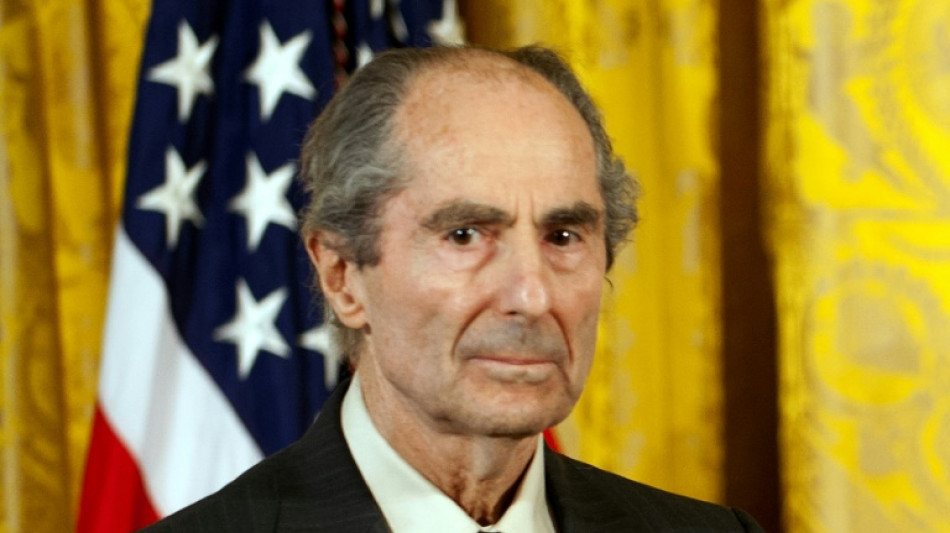
Five years after his death, Philip Roth's concern for US democracy lives on / Photo: Jim WATSON - AFP/File

 Best Pet Advent Calendars for Christmas 2026: Dog Treats and Cat Toys

 Grattan Institute Releases Blueprint to Target Specialists Over Excessive Fees

 Arizona Science Center Hosts Girls in STEM Astro Adventures for Students

 New Turkish Cafe, Japanese BBQ, and Korean Restaurants Open Across East Bay

 Knowle Move Four Points Clear at Top After Histon Victory

 Physicians Urge Arizona to Ban Medical Gag Clauses and Enable Private Lawsuits

 New Campaign Highlights Knowledge Gaps on Carbon Monoxide Safety Among Americans

Five years after his death, Philip Roth's concern for the state of American democracy lives on, evidenced during a sprawling celebration and debate of the writer's legacy on what would have been his 90th birthday.
Dozens of actors, authors and academics descended on Newark, the multicultural industrial city neighboring New York where Roth was born and raised, for a three-day Roth-fest bringing stagings and readings of his work to hundreds of spectators.
Born March 19, 1933 to a middle-class Jewish family, Roth died on May 22, 2018, leaving behind a storied, much-discussed and sometimes controversial career.
Roth often receives credit for predicting the dark chaos of Donald Trump's presidency with his 2004 novel "The Plot Against America," which jumped in popularity once again following the Republican's election, and was adapted into an HBO limited series put out in 2020.
Told through the eyes of a Jewish family living in Newark, the alternate history paints a version of America that gives in to its extremist and anti-Semitic vices, with Jews deported to the Midwest and fleeing to Canada.
A year-and-a-half before Roth's death, "I remember I got an email from him, just after Trump got elected saying 'Yes, he will suspend the Constitution,'' recalled historian Sean Wilentz during the "Philip Roth Unbound" festival, held in partnership with the New Jersey Performing Arts Center.
- 'Historical consciousness' -
Philip Gourevitch, a New Yorker writer, said however that Roth insisted in the wake of Trump's victory that he had not foretold it.
"He was very clear about, like that sense of... 'here is the unforeseen with Trump,' said Gourevitch, "even though of course, he had written a roadmap to it in some way."
As early as 2017 Roth denied a parallel between his novel and the course of Trump, calling the 45th president "a massive fraud, the evil sum of his deficiencies, devoid of everything but the hollow ideology of a megalomaniac."
In comparison, Charles Lindbergh -- an aviator with pro-Nazi leanings, who in Roth's book defeats Franklin D. Roosevelt in 1940 -- "may have been a genuine racist and an anti-Semite and a white supremacist sympathetic to fascism, but he was also... an authentic American hero."
In "The Plot Against America" as well as in his novels "American Pastoral" and "I Married a Communist," Roth, armed with a "historical consciousness," expressed "concern about the fragility of our democracy," said publishing editor Cary Goldstein, who co-produced the festival.
These concerns are as relevant today as they were then, festival organizers said -- a notion indicated by the packed crowds at events including a five-hour minimalist staging of the "Plot Against America," with actors including Cynthia Nixon and Tony Shalhoub -- respectively of "Sex and the City" and "Mrs Maisel" fame.
For the author Francine Prose, Roth's powerful description of the insidious fear in Jewish Americans shows the "recurring patterns" of anti-Semitism.
- 'Culture wars' -
The number of anti-Semitic offenses has risen sharply in recent years, according to data from US officials and Jewish associations, in a country riven by ideological strife.
It's a political climate polarized to the extreme, driven not just by Trump partisans but also over a return to "culture wars."
Conservatives including the high-profile governor of Florida, Ron DeSantis, have stoked tensions with controversial policies regarding gender identity and multiculturalism -- the kind of identity politics Roth criticized more than two decades ago, in 2000's "The Human Stain."
For all the praise lavished on him Roth is far from without detractors. The literary giant's death reopened a decades-old debate about his treatment of women, in work and life.
His personal life was notorious for being quite messy, with one ex, the British actress Claire Bloom, painting a grim picture of her life with him in the 1996 memoir "Leaving a Doll's House."
Critics have called his leading male characters "sexist" and "narcissistic," while the women he wrote had "no souls" and were "mere mirrors to men."
But for author Prose, Roth was "not defaming women or feminism" in rooting his stories within a male perspective -- provocative and often satirical tales that reflected on the weight of history, Jewish identity, sexuality, aging and death.
Ultimately for many fans -- as evidenced by the crowds who flocked to Newark from liberal New York -- Roth brought lucid clarity to the failings of the United States, creating a legacy still worth celebrating half a decade on.
L.Torres--PC

