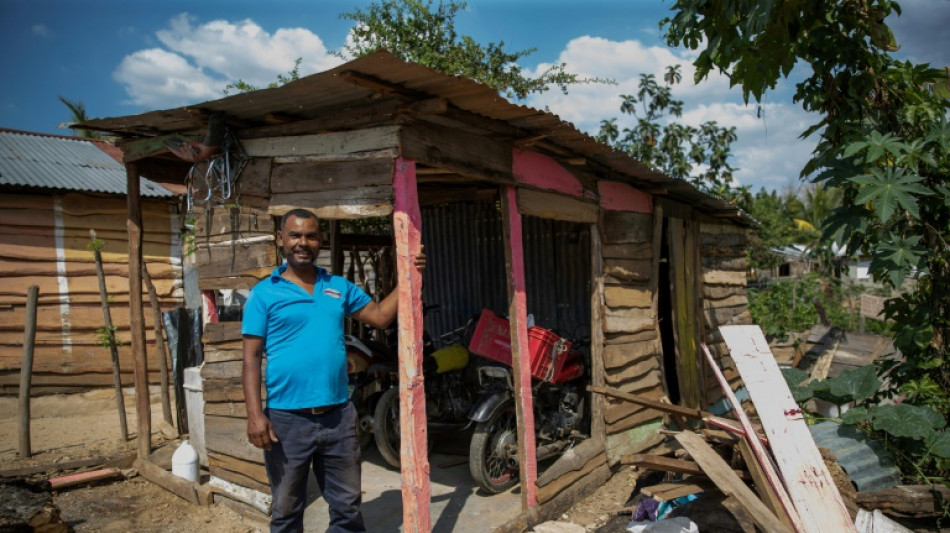
Dominican government razes homes to erect wall on Haiti border / Photo: Erika SANTELICES - AFP

 Best Pet Advent Calendars for Christmas 2026: Dog Treats and Cat Toys

 Grattan Institute Releases Blueprint to Target Specialists Over Excessive Fees

 Arizona Science Center Hosts Girls in STEM Astro Adventures for Students

 New Turkish Cafe, Japanese BBQ, and Korean Restaurants Open Across East Bay

 Knowle Move Four Points Clear at Top After Histon Victory

 Physicians Urge Arizona to Ban Medical Gag Clauses and Enable Private Lawsuits

 New Campaign Highlights Knowledge Gaps on Carbon Monoxide Safety Among Americans

Leocadio Guzman is one of dozens of residents of La Mara in the Dominican Republic whose house was torn down by the military.
Like many others in this impoverished neighborhood, his house stood in the way of an anti-migrant wall his government is erecting along the border with Haiti -- a country with which the Dominican Republic shares an island but very little else.
Where Guzman's house once stood there is now only a wooden plank on the ground with the code "MF 011-5" painted on it in red.
Locals presume the MF stands for "muro fronterizo" or border wall -- it is an abbreviation spray painted onto dozens of homes still in the crossfire of a mass demolition that started last November.
"When the military came, I was at work. I returned and found the house marked," the 41-year-old told AFP.
Guzman packed up his belongings, took his pregnant wife, and rapidly got out of the way -- moving to a small wooden shack he had built himself in preparation for this very day.
Like Guzman, about 30 families of the La Mara and La Bomba neighborhoods of Dajabon province have been uprooted by the state.
Another 50-odd households in the neighboring province of Monte Cristi are next in line to make way for the wall that is President Luis Abinader's signature project.
Abinader was elected in 2020 on a promise to curb immigration from Haiti -- a problem-laden neighbor with whom the Dominican Republic has a complicated relationship also tainted by xenophobia.
Some half-a-million Haitians live in the Dominican Republic, a nation of some 11 million.
- 'By the grace of God' -
The cross-border migrant flow has increased with criminal gangs increasingly taking control of neighborhoods in the Haitian capital Port-au-Prince.
On Abinader's watch, the Dominican Republic deported 171,000 Haitians in 2022 -- up from 85,000 a year earlier, according to the Support Group for Returnees and Refugees (GARR).
Seeking to stem the flow altogether, the government is now building a wall that will run along nearly half of the 380-kilometer (236-mile) border between the two nations on the island of Hispaniola.
The defense ministry, put in charge of the operation, announced in November that 79 million pesos (some $1.4 million) was available for compensation for people who had their homes or farmland expropriated in Dajabon and Monte Cristi.
"The money they gave me is not enough to get another house," Lidna Dorfinis, a 38-year-old Haitian who lives in La Mara, told AFP.
"Now I live by the grace of God," Dorfinis, who has a 12-month-old daughter, said through a translator.
She said she received the equivalent of about $4,500 for her house -- which was barely enough to buy a piece of land.
With no money left to buy materials for a new house, Dorfinis now has to pay rent of $60 a month to someone else -- a heavy blow for someone living in poverty.
- 'Had to accept it' -
Guzman, for his part, said he received about $4,200 from the government, which he used to build his new wooden shack.
"At least I had a place to lay my head," he told AFP.
The mayor of Dajabon city, Santiago Riveron, insisted the government had negotiated compensation with affected residents and "it was not traumatic."
People like Guzman disagree.
"I wasn't very happy, but I had to accept it," he said.
The house of a nearby neighbor, Quisqueya Estevez, also carries the dreaded "MF" marking.
For now, the house still stands. Part of it, anyway.
Estevez, 36, claims the section that used to contain her bathroom gave way due to landslides caused by the demolition work.
"We now poop in a bucket. It is not nice," she said.
In the working class sector of Pepillo Salcedo in Monte Cristi, the house Dominga Castillo shares with her mother and two children, is also in the crosshairs.
But the 41-year-old's concerns are not only about the money.
"I came here as a baby, still crawling," she recounted. "Starting all over again is very hard."
F.Ferraz--PC

