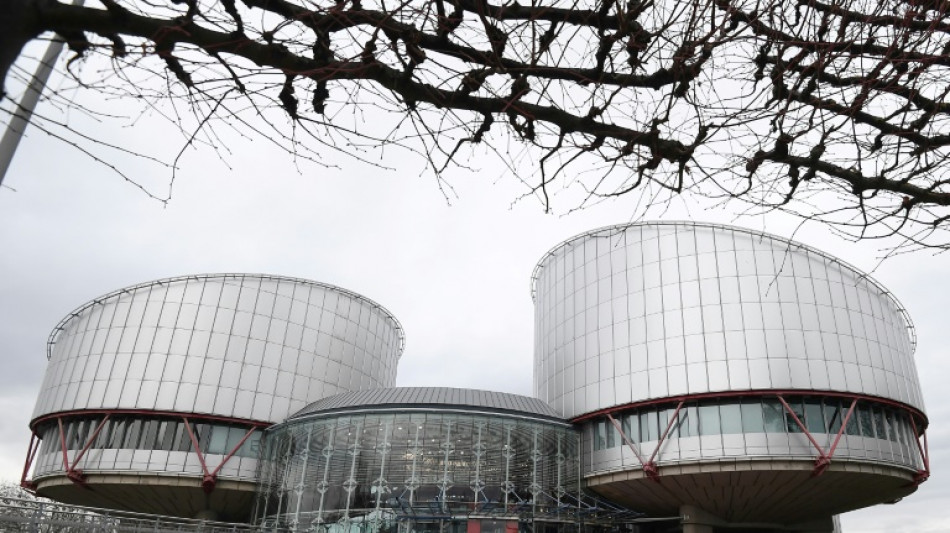
'Historic': Europe rights court hears climate cases against governments / Photo: FREDERICK FLORIN - AFP

 Best Pet Advent Calendars for Christmas 2026: Dog Treats and Cat Toys

 Grattan Institute Releases Blueprint to Target Specialists Over Excessive Fees

 Arizona Science Center Hosts Girls in STEM Astro Adventures for Students

 New Turkish Cafe, Japanese BBQ, and Korean Restaurants Open Across East Bay

 Knowle Move Four Points Clear at Top After Histon Victory

 Physicians Urge Arizona to Ban Medical Gag Clauses and Enable Private Lawsuits

 New Campaign Highlights Knowledge Gaps on Carbon Monoxide Safety Among Americans
The European Court of Human Rights will hear cases against France and Switzerland over alleged failings to protect the environment Wednesday, the first time governments are in the court's dock for alleged climate change inaction.
The case against Switzerland is based on a complaint by an association of elderly people -- who call themselves the "Club of Climate Seniors" -- concerned with the consequences of global warming on their living conditions and health, the ECHR said.
They accuse the Swiss authorities of various climate change failings which they say amount to a violation of the government's obligation to protect life and citizens' homes and families.
"This is a historic event," said Anne Mahrer, 64, a member of the Swiss club, backed by Greenpeace Switzerland, where the average age is 73.
Around 50 of its 2,000 members will travel to Strasbourg for the hearing, Mahrer told AFP.
All reports on global warming over the past 20 years show that "everybody is affected", but the elderly more than others, especially older women because of cardiovascular and respiratory risks, she said.
All attempts to get the Swiss authorities to act on their behalf had failed, she said.
The case against France was brought by Damien Careme, a former mayor of Grande-Synthe, a suburb of Dunkirk in northern France, who also argues that the central government has failed to meet its obligation to protect life by taking insufficient steps to prevent climate change.
When he was mayor, Careme brought his case to the French judiciary on behalf of his town but also on his own behalf, saying climate change was raising the risk of his home being flooded.
- 'Stakes are extremely high' -
France's highest administrative court found in favour of the town against the central government in 2021, but threw out the individual case brought by Careme, which he then took to the ECHR.
"The stakes are extremely high," said Corinne Lepage, a former French ecology minister and one of Careme's lawyers in the case.
"If the European court recognises that climate failings violate the rights of individuals to life and a normal family life, then that becomes precedent in all of the council's member states and potentially in the whole world," she told AFP.
The European Court of Human Rights -- whose members are the 46 states belonging to the Council of Europe -- acknowledged in a statement ahead of the hearings that the European Convention on Human Rights, on which it must base its judgements, does not actually include a right to a healthy environment.
But its decision to take the cases to be heard Wednesday was based on the fact that the exercise of the Convention's existing rights could be undermined by harm to the environment, or exposure to environmental risks.
A third pending case, without a date for a hearing so far, was brought by young Portuguese applicants claiming that climate inaction by dozens of states had contributed to heatwaves in Portugal which they said was affecting their rights.
Although the cases are a first for the ECHR, governments have in the past been taken to court in their national jurisdictions.
In 2019, the Dutch Supreme Court ordered the government to cut greenhouse gas emissions following a complaint by an environmental organisation.
Two years later, a court in Paris found the French government guilty of climate inaction and ordered it to pay for resulting damages after four NGOs filed a case.
Wednesday's hearings are only the start of proceedings that are likely to take several months before the Court hands down its verdicts.
C.Amaral--PC

