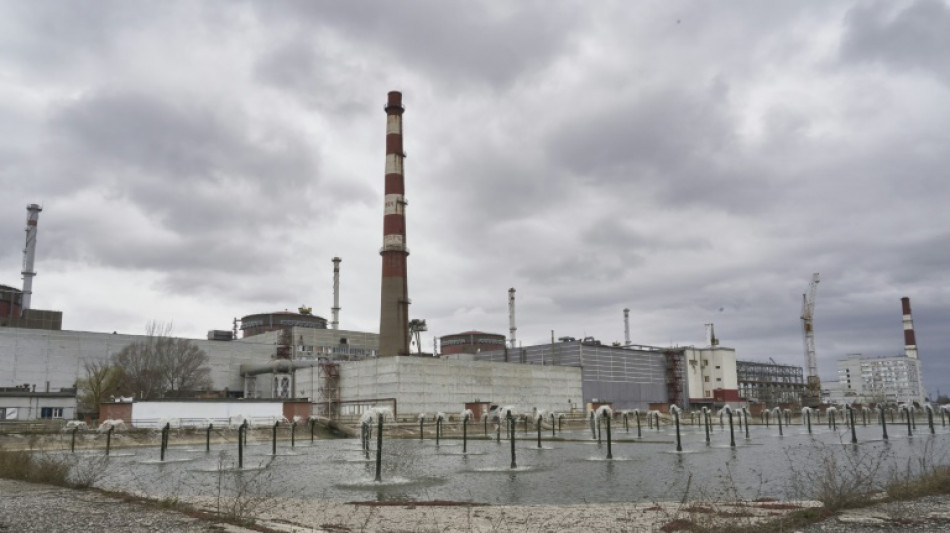
At Ukraine's captured nuclear plant, Russian troops say 'ensuring security' / Photo: Andrey BORODULIN - AFP

 Best Pet Advent Calendars for Christmas 2026: Dog Treats and Cat Toys

 Grattan Institute Releases Blueprint to Target Specialists Over Excessive Fees

 Arizona Science Center Hosts Girls in STEM Astro Adventures for Students

 New Turkish Cafe, Japanese BBQ, and Korean Restaurants Open Across East Bay

 Knowle Move Four Points Clear at Top After Histon Victory

 Physicians Urge Arizona to Ban Medical Gag Clauses and Enable Private Lawsuits

 New Campaign Highlights Knowledge Gaps on Carbon Monoxide Safety Among Americans
A Russian armoured personnel carrier marked with the letter V and equipped with a radiation detector stands guard on the premises of the Zaporizhzhia nuclear power plant.
Next to the vehicle at the Moscow-controlled facility in the southeastern Ukrainian region of Zaporizhzhia is a soldier with the call sign Liquidator, a possible reference to staff who were called upon to deal with the consequences of the 1986 Chernobyl disaster.
Liquidator says that in the event of an attack on the Zaporizhzhia nuclear plant he is ready to "evacuate employees".
On Wednesday, the chief of the UN atomic watchdog, Rafael Grossi, made a rare visit to the embattled nuclear plant, Europe's largest.
AFP journalists covered his visit as part of a press tour supervised by the Russian military.
The Russian forces took control of the six-reactor plant last March, days after Russian President Vladimir Putin sent troops across the border.
Since then Moscow and Kyiv's forces have accused each other of shelling the facility, increasing fears of a disaster.
On Wednesday, Russian soldiers stationed at the Zaporizhzhia plant said they have been preparing for a possible attack from Kyiv and added that they were ready to ensure security. Ukraine denies any such plans.
"The units of the National Guard fulfil the objective of ensuring the security of the plant," a Russian soldier told reporters.
Their main task, he said, is "to prevent an armed takeover" of the site by Ukrainian "saboteurs".
During the visit AFP journalists saw at least five military vehicles.
It was not possible to establish if any vehicles had been removed from the plant before the press visit.
Ukraine has accused Russia of stationing at least 1,000 troops as well as military equipment at the plant, using the complex as a "shield" from strikes.
The Zaporizhzhia plant used to produce 20 percent of Ukraine's electricity and continued to operate in the first months of Moscow's offensive despite frequent shelling.
Now, its reactors no longer generate power.
- 'Fed up with shelling' -
On a visit to the site, Grossi, the head of the International Atomic Energy Agency, said he was working on a compromise security plan that would suit both Moscow and Kyiv.
"I am trying to prepare and propose realistic measures that will be approved by all parties," Grossi told reporters during his second visit to the plant since the start of Moscow's assault on Ukraine.
The Moscow-installed director of the plant, Yury Chernichuk, showed reporters damage -- including blown-out windows -- that the plant sustained during the hostilities.
"We are fed up with the shelling," said Tatyana, who was introduced to reporters as an employee at the site.
The plant has also faced staffing issues after many of its workers fled to territory controlled by Ukraine.
But Chernichuk sought to stress that "all safety recommendations" have been followed.
Russia's state nuclear energy company Rosatom says it has sent experts to reinforce staff at the site.
The plant remains connected to the Ukrainian power grid but only consumes electricity to help cool the reactors and avoid dangerous overheating.
The power supply is not stable, however.
It was cut on several occasions, notably after air strikes, forcing employees to rely on emergency generators.
During the most recent outage, which lasted for several hours in early March, Kyiv accused Russia of causing a blackout by damaging the only power line still connecting the site to the Ukrainian grid.
Moscow denies the accusations.
"As soon as Russia fires on military infrastructure, (the Ukrainians) cut power and say that it is the result of Russian strikes," Renat Karchaa, adviser to the director of Rosenergoatom, Russia's nuclear power operator, told AFP.
T.Resende--PC

