How Russia will benefit from fresh oil production cuts / Photo: Patricio ARANA - AFP

 Injuries cloud tennis as US Open gets under way

 Iran retaliates after first US strikes in a month
 Itauma says 'I'll be back' after bruising heavyweight title loss

 Brilliant Palou clinches fourth straight IndyCar crown
 US strikes Iran for first time in a month, Tehran retaliates

 Yin holds off Kim to win sixth LPGA title, end title drought

 Top-ranked Scheffler storms to PGA Tour Championship win

 Root urges England to be 'grown-ups' after Pakistan series win

 Google Maps renames Lake Ontario 'Lake America' in US -- but not Canada

 Aaron Donald ends retirement to rejoin Rams: team
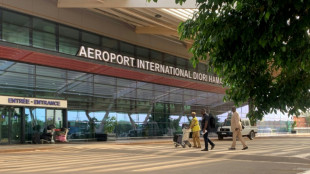 Niamey back to normal after soldiers' mutiny

 Niger mutiny suppressed, but questions remain over junta's cohesion

 Como spoil Allegri's Napoli home debut

 Cruz Beckham Performs at Leeds Festival Following Family Support at Reading

 Fernandes hat-trick inspires Man Utd rout of Ipswich

 Suzuki sends 'perfect' Freiburg past Bremen, Schalke lose

 Instagram offers three routes to two-factor authentication

 September smartphone calendar spans Apple, Poco, Vivo and Xiaomi

 Forest defender Tyler Bindon joins Charlton on loan

 Google Maps adopts Lake America label for US users

 WIRED tests label makers for home organisation

 CERN creates quark-gluon plasma with smaller atomic nuclei

 South West Water ranks worst in environmental comparison

 Russell Hobbs dual air fryer discounted to £99

 UK clocks return to GMT on October 25

The shock announcement by several OPEC+ members to voluntarily cut their oil production by more than a million barrels per day from May has sent world oil prices soaring, in a move widely seen as the tightening of the bond between Russia and Saudi Arabia.
This is what you need to know about Sunday's decision by some members of the Organization of the Petroleum Exporting Countries (OPEC) and their allies:
- Why cut oil production further? -
Independent of the broader OPEC+ output policy, eight members of the bloc led by heavyweight Saudi Arabia announced they would cut a further 1.16 million barrels per day of production until the end of the year.
It came on top of a decision from Russia -- also an OPEC+ member -- to extend a cut of 500,000 barrels per day.
Unlike two previous cuts, several members preferred to act independently on Sunday, without going through the formal framework of the alliance that requires the agreement of the 13 countries of the OPEC cartel and its 11 partners (OPEC+).
"What we are witnessing is an adaptive and agile OPEC+ group which is able and willing to act ahead of the curve," SEB analyst Bjarne Schieldrop said, of the surprise move.
Established in 1960, Vienna-based OPEC aims to "coordinate and unify petroleum policies" of its members to ensure "fair and stable prices for producers".
To form the OPEC+ alliance, the organisation in 2016 included non-OPEC oil-producing countries led by Russia.
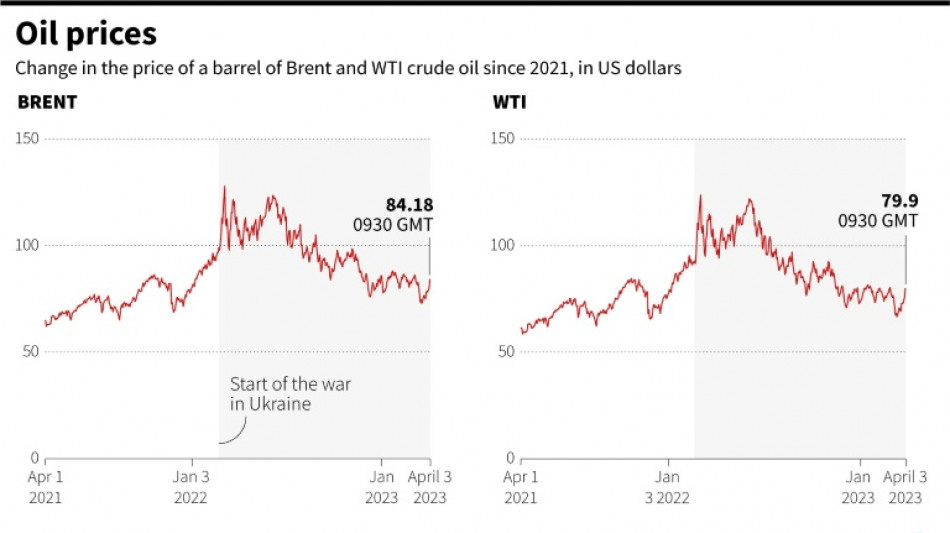
Oil prices have suffered greatly from the recent banking crisis in the United States and Europe, with fears of a global recession resurfacing and investors shifting away from riskier assets such as commodities.
"To the dismay of global leaders, OPEC has decided to draw a hard line at Brent $80 per barrel for self-serving economic interests," said SPI AM analyst Stephen Innes.
- How will Moscow profit from the decision? -
The rise in crude oil prices particularly benefits Russia, which "needs oil-money for its expensive war in Ukraine", said Schieldrop.
The cuts "will tighten up the oil market and thus help Russia to secure better prices for the crude oil it sells", he added.
Targeted by numerous Western sanctions over its invasion of Ukraine, Russia has seen its revenues from crude exports capped and the markets where it can sell limited.
According to Schieldrop, the new cuts also confirm "that Russia is still an integral and important part of the group".
The consequences of Sunday's decision are all the greater because, unlike the cuts previously made by the group at the height of the pandemic or last October, "the momentum for global oil demand is up, not down" with a strong recovery of China expected, said Innes.
Prices were immediately impacted by the decision, with the two global crude references jumping by about eight percent in early Monday trading.
The surprise reduction further consolidates the Saudi-Russian marriage of convenience, by aligning their production levels, thus placing them on equal footing.
- A slap in the face for Washington? -
Despite calls from the United States to raise production as consumption rises, the announced cuts represent "a provocation for the oil consuming nations, which are struggling with increasing interest rates and high inflation numbers," DNB analysts said.
For Finalto analyst Neil Wilson, they also signal a new era, in which "the Saudis are not afraid of the US" as OPEC "leverage" is on Riyadh's side.
"The Saudis are doing what they need to do and the White House has no say," he noted, adding that "a recasting of regional and global dynamics" has been set in motion.
"OPEC+ has sent a firm signal that... it does not see shale oil production growth as a threat to its market share," DNB analysts said.
With US shale oil production growth muted, production cuts by the alliance will not lead to any market share losses.
While "more political wrangling between US and OPEC is likely", the Biden administration won't use "the SPR (strategic petroleum reserve) inventories to counter the OPEC cuts", DNB analysts added.
A.Seabra--PC