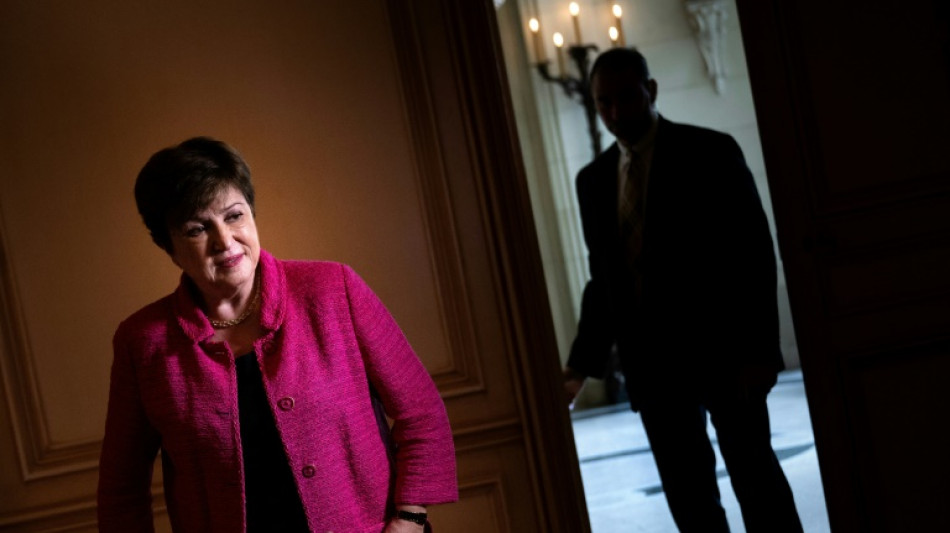
IMF chief calls on central banks to continue inflation fight / Photo: Brendan Smialowski - AFP

 Brilliant Palou clinches fourth straight IndyCar crown
 US strikes Iran for first time in a month, Tehran retaliates

 Yin holds off Kim to win sixth LPGA title, end title drought

 Top-ranked Scheffler storms to PGA Tour Championship win

 Root urges England to be 'grown-ups' after Pakistan series win

 Google Maps renames Lake Ontario 'Lake America' in US -- but not Canada

 Aaron Donald ends retirement to rejoin Rams: team
 Niamey back to normal after soldiers' mutiny

 Niger mutiny suppressed, but questions remain over junta's cohesion

 Como spoil Allegri's Napoli home debut

 Cruz Beckham Performs at Leeds Festival Following Family Support at Reading

 Fernandes hat-trick inspires Man Utd rout of Ipswich

 Suzuki sends 'perfect' Freiburg past Bremen, Schalke lose

 Instagram offers three routes to two-factor authentication

 September smartphone calendar spans Apple, Poco, Vivo and Xiaomi

 Forest defender Tyler Bindon joins Charlton on loan

 Forest linked with Liverpool goalkeeper Mamardashvili

 Former Nottingham hospital chief linked to NHS training firm

 UK clocks return to GMT on October 25

 South West Water ranks worst in environmental comparison

 CERN creates quark-gluon plasma with smaller atomic nuclei

 WIRED tests label makers for home organisation

 Google Maps adopts Lake America label for US users

 Bellingham, Mbappe fire as Real Madrid ease to Malaga win

 Mas wins Vuelta 9th stage to extend lead

Central banks around the world should keep battling inflation by hiking interest rates despite ongoing concerns about financial stability, the head of the International Monetary Fund told AFP on Thursday.
Since last year, central banks have been raising their benchmark lending rates to tackle inflation, which rose to levels not seen for decades in many countries including the United States.
But their fight has been complicated by the recent collapse of Silicon Valley Bank after taking on too much interest-rate risk, setting off a period of turbulence in the banking sector on both sides of the Atlantic.
"We don't envisage, at this point, central banks stepping back from fighting inflation," IMF managing director Kristalina Georgieva said in an interview ahead of the fund's spring meeting next week.
"They have to stay the course in a much more difficult, more complex environment," she said.
The biggest casualty so far has been Swiss banking giant Credit Suisse, which was pushed by regulators to merge with regional rival UBS on concerns about its long-term financial health.
But Georgieva said: "Central banks still have to prioritize fighting inflation and then supporting, through different instruments, financial stability."
- US-China tensions weigh on growth -
Georgieva added that US-China trade tensions -- part of a broader realignment of the global economy -- was also having a detrimental impact on world growth.
While there has been a long period in which decisions on production were guided by costs, "this is no more," she said.
"Today, the US, but also other countries, are saying I want to have security of supplies and I want to protect national security," she added.
"The question is how far they should go," she asked, adding that it was possible to guard both aspects "without completely undermining the foundation for growth."
Left unchecked, the long-term cost of trade fragmentation could be as high as seven percent of global economic output, she said in a speech earlier on Thursday to ambassadors and officials in Washington.
- 'Elusive' recovery -
In the same speech, she warned that a continued slowdown in almost all the world's advanced economies is expected to drag global growth below three percent this year.
"With rising geopolitical tensions, with inflation still running high, a robust recovery remains elusive," she said. "That harms the prospects of everyone, especially for the most vulnerable people and most vulnerable countries."
Global growth almost halved last year to 3.4 percent as the impact of Russia's invasion of Ukraine rippled through the world economy, abruptly halting the recovery from the Covid-19 pandemic.
While Asia's emerging markets are expected to see substantial increases in economic output -- with India and China predicted to account for half of all growth this year -- the good news will be outweighed by a slowdown expected for 90 percent of the world's advanced economies.
"Growth remains historically weak -— now and in the medium term," said Georgieva.
She added that global growth will likely remain at roughly three percent for the next half-decade, the lowest medium-term forecast since the 1990s.
Low-income countries are expected to suffer a double shock from high borrowing costs and a decline in demand for their exports, which Georgieva said could cause poverty and hunger to increase.
T.Vitorino--PC