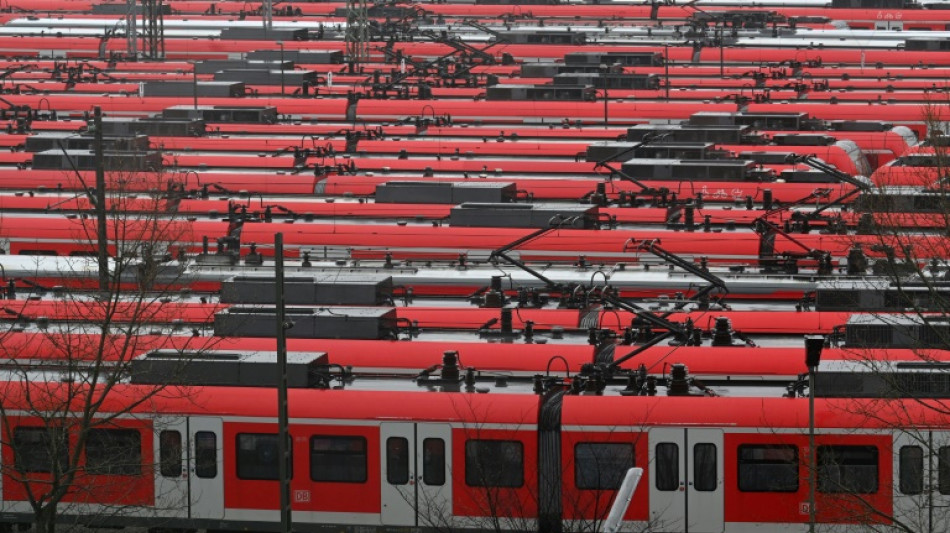
German union calls for new rail strike Friday / Photo: Christof STACHE - AFP/File

 Best Pet Advent Calendars for Christmas 2026: Dog Treats and Cat Toys

 Grattan Institute Releases Blueprint to Target Specialists Over Excessive Fees

 Arizona Science Center Hosts Girls in STEM Astro Adventures for Students

 New Turkish Cafe, Japanese BBQ, and Korean Restaurants Open Across East Bay

 Knowle Move Four Points Clear at Top After Histon Victory

 Physicians Urge Arizona to Ban Medical Gag Clauses and Enable Private Lawsuits

 New Campaign Highlights Knowledge Gaps on Carbon Monoxide Safety Among Americans
German transport union EVG on Wednesday called for a rail strike as workers demand higher wages to cope with high rates of inflation, the latest industrial action in Europe's largest economy.
Rail workers across the country will walk out on Friday between 3:00 am (0100 GMT) and 11:00 am, the EVG said in a statement.
The short "warning strike" was intended to "encourage employers to bring reasonable offers" to pay talks, EVG's deputy chairwoman Cosima Ingenschay told journalists outside Berlin's main station.
"If that does not happen then we will have to think about even bigger strikes," she said.
The industrial action will heap on more transport woes for travellers.
Separately, Germany's second largest union Verdi had on Tuesday called on employees working in security at the airports in Duesseldorf, Cologne-Bonn and Hamburg to strike through Thursday and Friday.
EVG represents 230,000 workers across some 50 transport companies, including national rail operator Deutsche Bahn.
The industrial action would have a "massive" impact across the rail network, Deutsche Bahn said in a statement, with the repercussions likely to be felt most strongly in long-distance services.
The strike was "completely useless, completely unnecessary", Deutsche Bahn's human resources chief Martin Seiler told journalists.
The disruption to services would affect "hundreds of thousands" of commuters ahead of the weekend, Seiler said, accusing EVG of losing all "proportion".
- Inflation pressure -
"It is now about finding solutions at the negotiating table and not just wantonly announcing strikes," Seiler said.
Negotiations between the EVG and Deutsche Bahn will continue next week.
EVG is demanding a 12-percent pay rise over one year for the workers it represents, with a minimum increase of 650 euros ($712) a month.
The union rejected Deutsche Bahn's first offer of a five percent increase in two steps, covering 27 months, plus an "inflation bonus" of 2,500 euros.
The pay increase demanded by the union would help employees cope with "financial burdens that have increased sharply", EVG said in a statement.
Inflation in Germany stood at 7.4 percent in March, remaining very elevated despite having fallen from a peak of 8.8 percent in October.
The strong increases in consumer prices has been driven by rising costs of energy in the wake of the Russian invasion of Ukraine at the beginning of 2022.
Over the last months, workers in different sectors including healthcare, childcare and transport have gone on strike to demand better conditions.
The rail system was largely brought to a halt in a major strike at the end of March led by EVG and Verdi.
E.Paulino--PC

