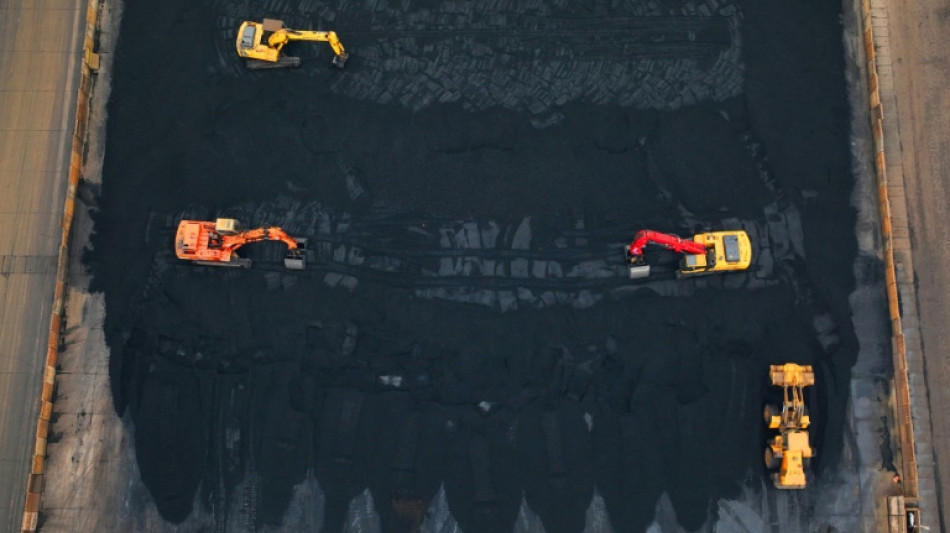
China approves coal power surge despite emissions pledge: Greenpeace / Photo: STR - AFP/File

 Best Pet Advent Calendars for Christmas 2026: Dog Treats and Cat Toys

 Grattan Institute Releases Blueprint to Target Specialists Over Excessive Fees

 Arizona Science Center Hosts Girls in STEM Astro Adventures for Students

 New Turkish Cafe, Japanese BBQ, and Korean Restaurants Open Across East Bay

 Knowle Move Four Points Clear at Top After Histon Victory

 Physicians Urge Arizona to Ban Medical Gag Clauses and Enable Private Lawsuits

 New Campaign Highlights Knowledge Gaps on Carbon Monoxide Safety Among Americans
China has approved a major surge in coal power so far this year, prioritising energy supply over its pledge to reduce emissions from fossil fuels, Greenpeace said Monday.
The world's second-largest economy is also its biggest emitter of the greenhouse gases driving climate change, such as carbon dioxide (CO2), and China's emissions pledges are seen as essential to keeping global temperature rise well below two degrees Celsius.
The jump in approvals for coal-fired power plants, however, has fuelled concerns that China will backtrack on its goals to peak emissions between 2026 and 2030 and become carbon-neutral by 2060.
Local governments in energy-hungry Chinese provinces approved at least 20.45 gigawatts (GW) of coal-fired power in the first three months of 2023, Greenpeace said.
That is more than double the 8.63 GW Greenpeace reported for the same period last year, and greater than the 18.55 GW that got the green light for the whole of 2021.
China relied on coal for nearly 60 percent of its electricity last year.
The push for more coal plants "risks climate disasters... and locking us into a high-carbon pathway," Greenpeace campaigner Xie Wenwen said.
"The 2022 coal boom has clearly continued into this year."
A study released in February by Global Energy Monitor (GEM) said China last year approved the largest expansion of coal-fired power plants since 2015.
- Vicious cycle -
Most of the new coal projects approved in the January-March period this year were in provinces that have suffered punishing power shortages due to record heatwaves in the last two years, Greenpeace said.
Several others were in southwest China, where a record drought last year slashed hydropower output and forced factories to shut down.
It was unclear how many of the coal power plants approved this year will begin construction.
Greenpeace analysts warned that investing in more fossil-fuel plants to prepare for the spike in air conditioning will create a vicious cycle: increased greenhouse gas emissions from the coal plants will accelerate climate change, resulting in more frequent extreme weather such as heat waves.
"China's power sector can still peak emissions by 2025," Greenpeace's Xie said, but added that emissions released today will linger in the atmosphere for decades.
China is also the world's largest and fastest-growing producer of renewable energy.
Wind, solar, hydro and nuclear sources are expected to supply a third of its electricity demand by 2025, up from 28.8 per cent in 2020, according to estimates by the National Energy Administration.
But Greenpeace said the rise in approvals for coal power projects shows how the need for short-term economic growth is diverting investment away from renewable energy projects such as grid upgrades that can supply surplus wind and solar power to regions that need it.
With an average lifespan of about 40 to 50 years, China's coal plants will be operating at minimum capacity and at a loss if the country delivers on its emissions pledge, according to the report.
The China Electricity Council said more than half of the country's large coal-fired power companies made losses in the first half of 2022.
A.Santos--PC

