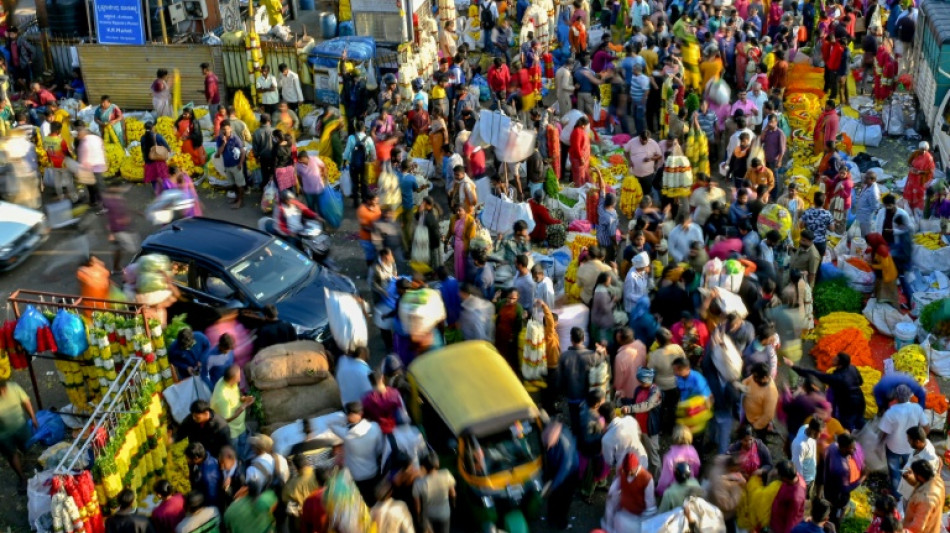
India to pass China this week as world's most populous nation: UN / Photo: Manjunath KIRAN - AFP/File

 Search Underway for 'Dooars Rani' Tigress After Second Escape from Buxa Tiger Reserve

 IIM Indore Announces IPMAT 2027 Exam Date for April 24

 The Dilemma of Recording Live Music: Preserving Memories vs. Being Present

 ANC’s Renewal Rhetoric Fades as Voters Reject Party in 2026 Local Elections

 Foreign Investors Return to Indian Markets After 10-Month Selloff

 Honda CR-V and Toyota RAV4 Lead Canada’s Most Stolen Vehicles List for 2025

 China Extends Tariff Suspension on US Imports to Stabilize Trade Ties
India will overtake China as the world's most populous country in the coming week, hitting almost 1.43 billion people, the United Nations said Monday.
"By the end of this month, India's population is expected to reach 1,425,775,850 people, matching and then surpassing the population of mainland China," the UN Department of Economic and Social Affairs said.
Last week the UN's annual State of World Population report had said the milestone would come by midyear 2023.
India is topping China due to both rapid growth in its own population and a decline in China's after hitting 1.426 billion last year.
Regarded as the world's most heavily populated country since the fall of the Roman Empire in the 5th Century CE, China is expected to decline steadily to around one billion people by the end of this century, according to UN projections.
China's fall is heavily tied to decades of maintaining a strict one-child policy for married couples, which ended in 2016.
In addition, its falling birth rates are also attributed to the rising cost of living and the growing number of Chinese women going into the workforce and seeking higher education.
Meanwhile, India's population "is virtually certain" to continue to grow in the coming decades, according to the United Nations.
Last year, China's fertility rate fell to one of the lower levels in the world at 1.2 births per woman.
For India, which has taken much longer than China to get population growth under control, the fertility rate was 2.0 births per woman, just below the 2.1 replacement level.
"India's lower human capital investment and slower economic growth during the 1970s and 1980s contributed to a more gradual fertility decline than in China," the UN said.
Both countries must confront rapidly ageing populations, China more so than India.
India faces huge challenges providing electricity, food and housing for its growing population, with many of its massive cities already struggling with water shortages, air and water pollution, and packed slums.
Surpassing China shines a spotlight on the challenge facing Prime Minister Narendra Modi to provide jobs for the millions of young people entering the job market every year.
Meanwhile China's economy is increasingly challenged to fill positions due to its ageing population.
Beijing said last week that its national strategy is designed "to actively respond to population ageing, promotes the three-child birth policy and supporting measures, and actively responds to changes in population development."
"China's demographic dividend has not disappeared. The talent dividend is taking shape, and development momentum remains strong," said foreign ministry spokesman Wang Wenbin.
G.Teles--PC

