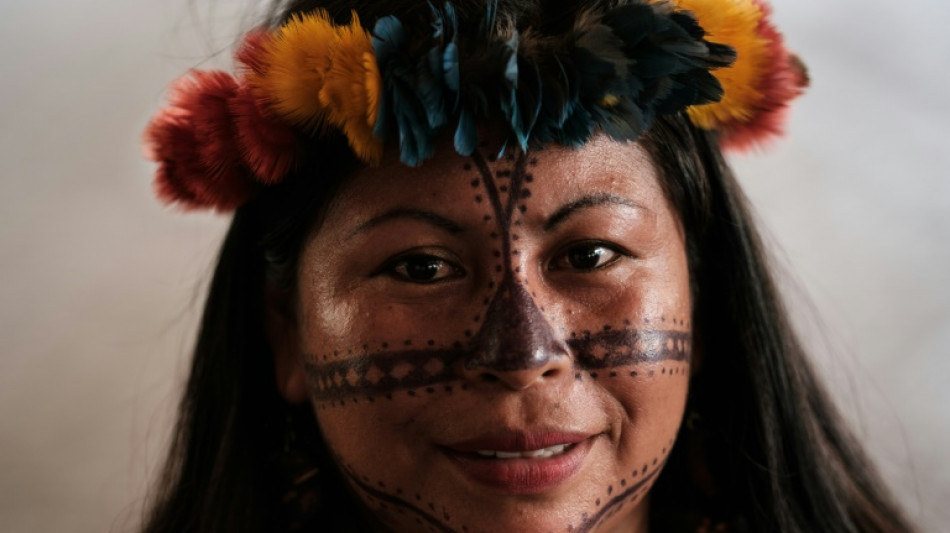
Brazil Indigenous leader awarded for fight against mining / Photo: Yasuyoshi Chiba - AFP/File

 Search Underway for 'Dooars Rani' Tigress After Second Escape from Buxa Tiger Reserve

 IIM Indore Announces IPMAT 2027 Exam Date for April 24

 The Dilemma of Recording Live Music: Preserving Memories vs. Being Present

 ANC’s Renewal Rhetoric Fades as Voters Reject Party in 2026 Local Elections

 Foreign Investors Return to Indian Markets After 10-Month Selloff

 Honda CR-V and Toyota RAV4 Lead Canada’s Most Stolen Vehicles List for 2025

 China Extends Tariff Suspension on US Imports to Stabilize Trade Ties
Alessandra Korap Munduruku first turned to activism as she watched advancing agriculture devastate her Indigenous territory in Brazil, but it was her battle to drive out mining giant Anglo American that landed her in the spotlight.
On Monday, the 38-year-old will be one of six people in the world presented with a Goldman Environmental Prize for efforts against the British multinational's efforts to set up in Indigenous territories in the Amazon.
"We ran campaigns, wrote letters ... until they arrived in their hands and we told them that we would not accept any mining in our territory," Korap Munduruku told AFP in a video call.
In May 2021, after months of pressure, Anglo American withdrew 27 mining projects approved by authorities in Indigenous lands, including her territory of Sawre Muybu, which contains more than 160,000 hectares (400,000 acres) of rainforest.
"We are going to defend our territory tooth and nail," added Korap Munduruku.
"Alessandra's successful campaign represents a significant shift in private sector accountability around destructive mining in Brazil," said the Goldman Foundation, which was due to present its prizes at a ceremony in San Francisco.
Soon after Anglo American, Brazilian giant Vale also announced the withdrawal of all of its exploitation permits in Indigenous territories in Brazil.
"I realized that if I stayed at home alone, no one would listen to me," said Korap Munduruku, who said she also had to overcome the "patriarchy" within her community to establish herself as a leader.
Like most Indigenous activists, she said she was relieved when far-right former president Jair Bolsonaro, who removed protections from Indigenous territories, was defeated at the polls last year.
However, she is not entirely convinced with his leftist successor Luiz Inacio Lula da Silva, despite the veteran leader's promises.
"Lula is trying to demarcate (Indigenous) territories... but he's signing deals with China and Mercosur, and that is worrying," she said, referring to the South American trade bloc.
"China is very interested in developing agribusiness."
She is also worried about China potentially financing railways and gas pipelines that would run through Indigenous territory.
Sonia Guajajara, a former longtime activist who now heads the Ministry of Indigenous Peoples, a position created by Lula, recently announced that 14 new territories covering 1.5 million hectares would be protected.
Ferreira--PC

