
EU to revamp budget rules to spur growth / Photo: PETER MUHLY - AFP/File

 Zambia's opposition leader charged with treason

 Marc Marquez wins Aragon MotoGP Grand Prix

 Robinson rocks Pakistan again as England eye series win at Lord's

 Nepal rescuers advance towards trapped tunnel workers

 Grisly search for missing as Nepal morgues overflow, burials begin

 Barcelona's Yamal getting back to 'top level': Flick

 Dutch federation calls for football summit without Infantino

 Ron’s Honky Tonk Residency Revives UK Country Music in Bermondsey

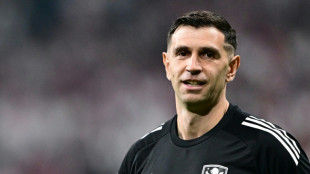 Chelsea sign Argentina 'stopper Martinez from Villa

 Norway's churches hold services to late King Harald

 Walmart Agrees to $50 Million Settlement Over Opioid Prescription Allegations

 Soundcore Liberty 5 Pro Review: Call Quality Redefines Value in Wireless Earbuds

 Lexus ES Review: Electric ES 350e Falls Short in Luxury Saloon Segment

 Vietnamese coffee farmers ride China's durian wave

 Venezuela says retains 'sovereignty' in US oil deal

 NASA's Roman telescope set to launch on cosmic mapping mission

 Data center backlash scrambles US midterm politics

 Emotional Federer inducted into tennis Hall of Fame

 Hovland takes solo lead as McIlroy surges at Tour Championship

 Djokovic 'prepared' for US Open bid for history

 Atletico down Sevilla to go top of La Liga

 US deports right-wing provocateur Milo Yiannopoulos

 Niger junta says it is back in control after soldiers' mutiny

 Erasmus calls Rennie barbs over Springbok scrumming 'nonsense'

 Lawrence's fifty leaves Pakistan facing record chase to level England series

The EU will unveil an overhaul of its fiscal rules on Wednesday, a long-awaited reform that has bitterly divided member states over how to encourage investment while strengthening scrutiny of government spending.
The European Commission, the EU's executive arm, wants to reform the rules, known as the Stability and Growth Pact, that limit how much the bloc's 27 member states can borrow.
But the proposals have split the bloc between the more frugal northern countries, including Germany, and the southern states like Italy.
Germany, a staunch defender of fiscal discipline, fears Brussels will overly relax the EU's budgetary straitjacket and undermine fairness within the bloc. Italy and others argue the rules constrain their ability to invest.
The pact currently stipulates that states' public deficits should not go above three percent of gross domestic product, and debt should stay below 60 percent of GDP.
The European Union suspended the rules in 2020 to allow member states to pour money into their economies during the coronavirus pandemic.
That was extended last year to let states raise spending to protect households and businesses from sky-high energy prices from Russia's war in Ukraine, and to avoid recession.
EU member states' debts have since rocketed, and the only thing every country agrees on is the need to reform the pact.
The rules were due to come back into force again next year but last month, Brussels said there would be a gradual return as it told members to rein in spending in 2024.
When the commission first announced plans for reform in November 2022, it said the three-percent deficit and 60-percent debt targets would stay, but there would be more flexibility through individual plans for debt reduction tailor-made for each country.
- Greater leeway -
The EU wants to give wiggle room for countries to invest in digital and green transitions as Brussels tackles the challenge from the United States and China, where energy costs are cheaper and lavish subsidies risk luring businesses away from Europe.
The commission will likely allow countries more leeway in budget recovery and give them more time to reduce their debt in exchange for reforms and investments.
The pact currently says any debt level above 60 percent must be reduced by one-twentieth each year, but that measure is considered unworkable as it could force painful austerity on indebted countries. In fact, it has never been applied.
EU countries' debt soared after the 2008 financial crisis and following the Covid pandemic. Today, Italy's debt is almost 150 percent, while France's is around 110 percent, well above the bloc's limits.
After the proposals are presented Wednesday there will ensue months of likely rancorous negotiations between member states and the European Parliament because different countries want changes for different reasons.
Andreas Eisl, a researcher at Jacques Delors Institute, pointed to several reasons for the divisions, including significant differences in the members' economic models.
"Some countries, such as Germany, function very much according to an export-oriented model, while others, such as France, have long achieved growth more through domestic consumption. These different models have different demands for the role of fiscal policy-making," he told AFP.
B.Godinho--PC