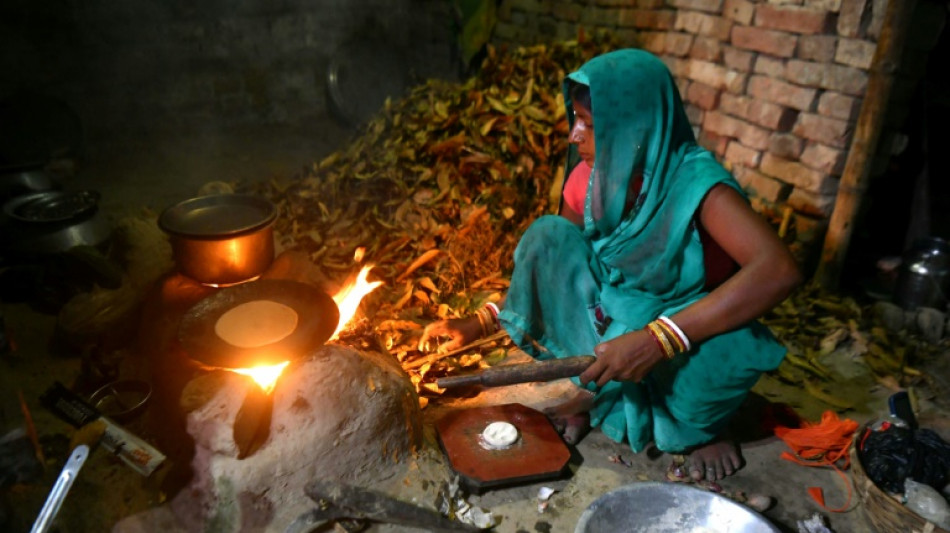
India's growing population a burden for struggling mothers / Photo: Sachin KUMAR - AFP

 'No' camp seen winning Iceland's EU referendum
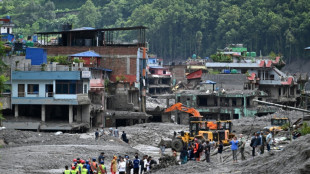 Nepal flood survivors return to ruins to salvage memories

 Killing of Palestinian children and teens by Israel surges in West Bank

 Educators keep 9/11 memory alive for next generation, 25 years on

 Venezuelans view US oil deal with doubt, hope

 Gobena and Jepchirchir power to Sydney Marathon victories

 Iceland in suspense after close EU vote

 Wallabies hold on for victory in Argentina

 Juve notch second straight win, Fiorentina's centenary party falls flat

 Rybakina eases injury fears ahead of US Open
 Djokovic kicks off latest Grand Slam quest under US Open lights

 'Sorry' De Zerbi won't panic after Spurs shambles

 UN, Nepal warn of climate threat after deadly floods

 USTA boss says structure of new player council not yet set

 Tiny Elversberg stun Leverkusen on Bundesliga debut, Dortmund beat Hamburg

 Ankle ligament tear ends Neeraj Chopra’s 2026 season

 Police appeal for footage after life-threatening Stratford assault

 Family searches for Boston engineer missing after Nepal-Tibet floods

 Dolly Parton’s Imagination Library leaves global children’s reading legacy

 Five college football games that could shape the 2026 season

 New finds strengthen case for Bethsaida at Sea of Galilee site

 Felony assaults on older New Yorkers rise sharply, police data show

 Three Texas Tech softball players hurt in jet ski collision
 Tambaram civic groups seek action on eight long-pending issues

 Chennai councillors unite across parties to demand ward development funds

Married off by her parents at 14, Indian mother-of-seven Jaimala Devi kept having children because her husband insisted she could only stop once she had given birth to two sons.
Devi's story is common across Bihar, the poorest state in the world's most populous country and also its fastest-growing: with around 127 million people, it already has roughly as many people as Mexico.
India's overall birthrate has fallen in tandem with its rising economy, but poverty and a deep-rooted bias for male heirs have kept Bihar an engine room of national population growth.
"Having seven kids and managing everything on my own really drives me crazy at times," said Devi, who at 30 has never left her home village.
"I thought we'd be comfortable with one or two kids," she told AFP. "But we had girls first, and because of that we have seven."
Devi, her five daughters and two sons live in a ramshackle one-room hut, unadorned except for a small television, an old fan and some posters of Hindu deities on its unplastered walls.
Bihar has scarce opportunities for well-paid employment and Devi's husband Subhash is gone for most of the year, sending back his meagre earnings as an unskilled storehand in the capital New Delhi.
Many fathers leave the state to find work elsewhere but consider long absences from home and the struggle to feed their children a worthy sacrifice for the chance of future prosperity.
"Having more children is still considered a way to get more earning members for the family," Parimal Chandra, the state head of the non-profit Population Foundation of India (PFI), told AFP.
- 'Respect and pride' -
The insistence by many men on having sons reflects cultural expectations that they will support their parents even after marrying and having their own children.
"Giving birth to a boy means respect and pride for the family and the mother," Chandra said.
Daughters by contrast are commonly seen as burdensome and costly due to the tradition of wedding dowries paid by the parents of brides.
Parents in poorer households often seek to relieve themselves of the responsibility of girls by marrying them off early, as was the case in Devi's wedding as a teenager.
This is especially true in Bihar, where the early departure of girls from school has left only 55 percent of women in the state able to read and write -- India's lowest female literacy rate, according to the National Family Health Survey.
Chandra said this "abysmal" statistic undergirded the state's high birthrate, leaving mothers without access to knowledge on contraception or agency over the size of their families.
Bihar's situation was once replicated across India, a country formerly synonymous with grinding poverty but which in recent decades has seen phenomenal economic growth.
The average woman in India now gives birth to just two children, down from a 1960 peak of six, in concert with better maternal healthcare and rising living standards.
But Bihar has long been an economic laggard and its much higher birthrate -- around three children per mother on average -- reflects some of India's worst rates of malnutrition, child mortality, education and access to medical care.
Raj Kumar Sada, 55, has outlived four of his five children and often tells his only surviving son to have at least four kids of his own.
That way "if something happens to one or two of them, he'd still have someone left," he told AFP.
"You will find people with four, five, six, seven or eight children, and it is very normal here."
- 'A big challenge' -
Government healthcare worker Indira Kumari attends to around 400 women in rural Bihar each month, many of whom she says do not get to choose how many children they have.
"Even if a woman wants to use family planning, her in-laws or husband don't support her view," Kumari told AFP.
The state government has offered cash incentives for girls to finish their schooling and distributed free condoms in an effort to encourage women to start families later, and have fewer children.
These and other efforts have helped change some parents' attitudes in Bihar, when "even raising the topic was a big challenge" a few years ago, PFI programme officer Ritu Singh told AFP.
Among the women whose perspective has shifted is Poonam Devi, 26, and no relation to Jaimala, a daily wage labourer who opted for tubal ligation after delivering her fourth child.
"Our people say that a woman is useless if she can't produce kids after marriage," she told AFP.
"But I told my husband after our fourth that we have enough and should focus on feeding and educating them, and he agreed."
Nogueira--PC