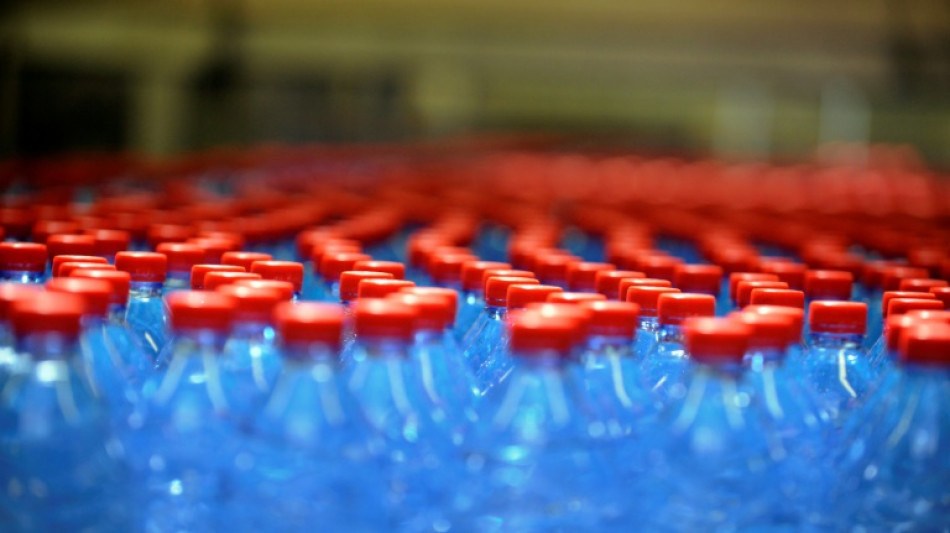
Nestle faces mineral water problems in drought-hit France / Photo: Jean-Christophe VERHAEGEN - AFP/File

 Search Underway for 'Dooars Rani' Tigress After Second Escape from Buxa Tiger Reserve

 IIM Indore Announces IPMAT 2027 Exam Date for April 24

 The Dilemma of Recording Live Music: Preserving Memories vs. Being Present

 ANC’s Renewal Rhetoric Fades as Voters Reject Party in 2026 Local Elections

 Foreign Investors Return to Indian Markets After 10-Month Selloff

 Honda CR-V and Toyota RAV4 Lead Canada’s Most Stolen Vehicles List for 2025

 China Extends Tariff Suspension on US Imports to Stabilize Trade Ties
Global food and beverage giant Nestle said Thursday that it would stop extracting from two mineral water wells in eastern France due to drought and increasingly unpredictable weather conditions.
The group's mineral water subsidiary, Nestle Waters, which owns brands such as Vittel and Perrier, said it had suspended operations at two wells used to produce its Hepar water in the Vosges region of eastern France.
Another four wells will continue to be used for the brand, which is coveted for its high levels of magnesium.
"Like the whole of the industry, Nestle Waters faces worsening climatic conditions, with more intense and frequent events, such as regular droughts followed by heavy rain, which affect operating conditions at some wells on its site in the Vosges," the group told AFP.
The two Hepar wells were identified as "particularly vulnerable" because of their shallow depth which means it is "very difficult to maintain the stability of the essential characteristics of a natural mineral water."
France as a whole saw 32 days without significant rainfall in January and February, a winter drought that followed record heat last summer that saw emergency water measures put in place for most of the country.
An estimated 75 percent of French groundwater sources were at moderately low or very low levels in April, according to the state-run French Geological Survey (BRGM).
Water restrictions are currently in place for 20 out of 96 departments on the mainland, with three judged to be in crisis in the southeast of the country.
Other French mineral waters are also affected by the increasing scarcity of water, including the famed Volvic brand which is extracted from the formerly volcanic hills of central France.
Authorities in the Puy-de-Dome area widened water restrictions on Tuesday this week.
The owner of Volvic, French multinational Danone, is set to decrease its monthly water extraction by five percent in May and June, the company told AFP.
L.Carrico--PC

