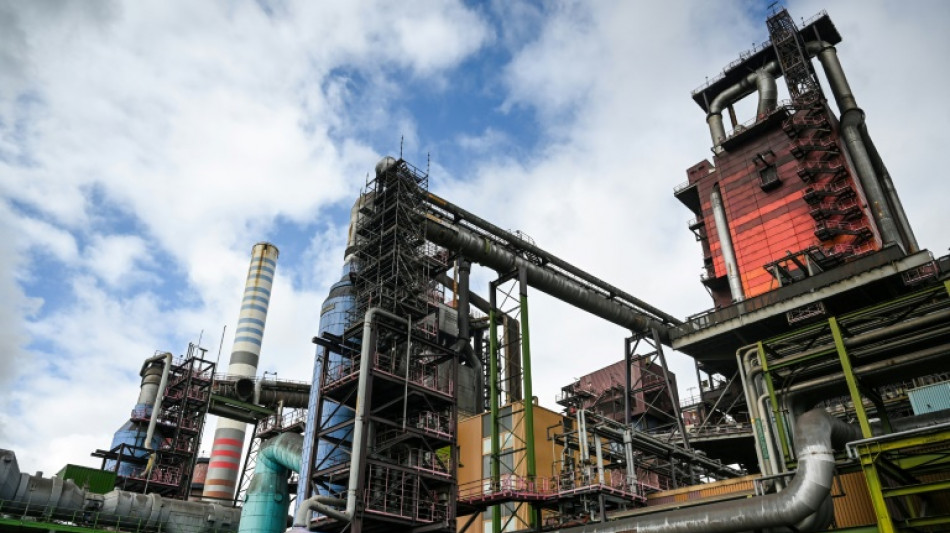
German recession fears rise as factory orders plummet / Photo: Ina FASSBENDER - AFP

 'No' camp seen winning Iceland's EU referendum

 Nepal flood survivors return to ruins to salvage memories

 Killing of Palestinian children and teens by Israel surges in West Bank

 Educators keep 9/11 memory alive for next generation, 25 years on
 Venezuelans view US oil deal with doubt, hope

 Gobena and Jepchirchir power to Sydney Marathon victories

 Iceland in suspense after close EU vote

 Wallabies hold on for victory in Argentina

 Juve notch second straight win, Fiorentina's centenary party falls flat

 Rybakina eases injury fears ahead of US Open

 Djokovic kicks off latest Grand Slam quest under US Open lights

 'Sorry' De Zerbi won't panic after Spurs shambles

 UN, Nepal warn of climate threat after deadly floods

 USTA boss says structure of new player council not yet set

 Tiny Elversberg stun Leverkusen on Bundesliga debut, Dortmund beat Hamburg

 Ankle ligament tear ends Neeraj Chopra’s 2026 season

 Police appeal for footage after life-threatening Stratford assault

 Family searches for Boston engineer missing after Nepal-Tibet floods

 Dolly Parton’s Imagination Library leaves global children’s reading legacy

 Five college football games that could shape the 2026 season

 New finds strengthen case for Bethsaida at Sea of Galilee site

 Felony assaults on older New Yorkers rise sharply, police data show

 Three Texas Tech softball players hurt in jet ski collision

 Tambaram civic groups seek action on eight long-pending issues

 Chennai councillors unite across parties to demand ward development funds

Industrial orders at German factories saw their biggest fall in March since the outbreak of the Covid pandemic in 2020, data showed Friday, the latest sign that Europe's biggest economy is facing a steep downturn.
New orders, which give a foretaste of industrial output, dropped a surprise 10.7 percent from the previous month, according to provisional figures from federal statistics authority Destatis.
It was the biggest decline since April 2020, when the coronavirus pandemic snarled the global economy amid lockdowns and border closures.
The fall was far steeper than the 2.8 percent decline forecast by analysts surveyed by the financial data firm FactSet.
Orders had been rising in recent months, bolstering hopes that Germany was weathering the fallout from the Ukraine war and resulting energy crisis better than feared.
But the latest data rang alarm bells anew about the state of the economy, with LBBW bank economist Jens-Oliver Niklasch calling the plunge a warning for investors.
"This figure destroys what had been a good start to the year for German industry, and is a real recession signal," he said in a research note.
The decline was reported across most areas of the manufacturing sector, Destatis said, with foreign orders dropping by 13.3 percent and domestic orders by 6.8 percent.
- 'Very mixed' picture -
Berenberg Bank economist Holger Schmieding said that "seen in isolation", the drop in orders "clouds the outlook for German manufacturing".
But he cautioned that the picture was "very mixed" and that factory orders for the first quarter as a whole actually showed a slight increase from the end of 2022.
The economy ministry also noted that new orders had been "very volatile" recently, and that key business sentiment indicators remained on an upward trend that started late last year.
Several economic indicators had started rebounding after falling last year in the wake of Russia's invasion of Ukraine and the resulting surge in energy prices, lifting hopes that Germany could avoid a recession.
However the picture has been darkening again recently, with the economy narrowly dodging a recession in the first quarter, against expectations for a rebound, while exports also dropped in March.
Adding to the cautious outlook, French industrial production fell 1.1 percent in March, reversing a rebound of 1.4 percent the previous month, statistics office INSEE said.
It expects GDP growth of 0.2 percent for the second quarter, held back by weak consumer spending -- the main driver of France's economy.
The French government is tabling that growth for 2023 as a whole will slow to one percent after 2.6 percent last year -- but the Bank of France and the International Monetary Fund are predicting expansions of just 0.6-0.7 percent.
On Thursday, the European Central Bank raised its benchmark interest rates further, making loans for companies more expensive, as it tries to cool inflation without crimping economic growth too severely across the eurozone.
H.Silva--PC