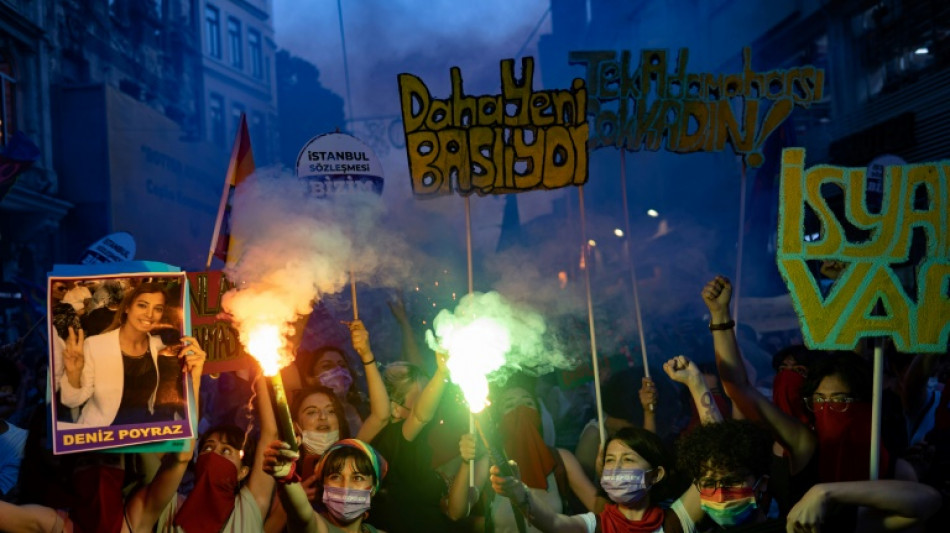
Women's struggles under Erdogan's conservative rule / Photo: Yasin AKGUL - AFP

 Vietnamese coffee farmers ride China's durian wave

 Venezuela says retains 'sovereignty' in US oil deal
 NASA's Roman telescope set to launch on cosmic mapping mission

 Data center backlash scrambles US midterm politics

 Emotional Federer inducted into tennis Hall of Fame
 Hovland takes solo lead as McIlroy surges at Tour Championship
 Djokovic 'prepared' for US Open bid for history
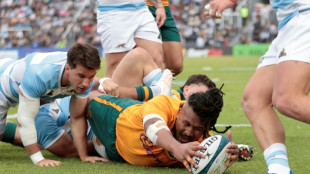
 Atletico down Sevilla to go top of La Liga

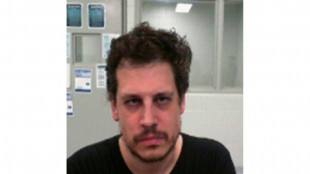 US deports right-wing provocateur Milo Yiannopoulos

 Niger junta says it is back in control after soldiers' mutiny

 Erasmus calls Rennie barbs over Springbok scrumming 'nonsense'

 Lawrence's fifty leaves Pakistan facing record chase to level England series

 Netanyahu condemns settler attack in flashpoint West Bank village
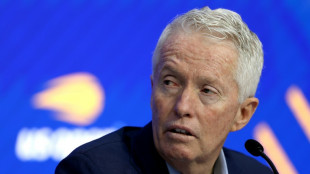
 Munoz saves Iraola in Liverpool draw, big-spending Spurs lose again

 Newcastle condemn dismal Spurs to second successive defeat

 James Cleverly leaves shadow cabinet to seek London mayoralty

 Baladi Map app turns Lebanon’s local problems into a public record

 Thirty-seven Mumbai pilgrims return after Nepal flood disruption

 Ankle ligament tear ends Neeraj Chopra’s 2026 season

 Five college football games that could shape the 2026 season

 New finds strengthen case for Bethsaida at Sea of Galilee site

 Felony assaults on older New Yorkers rise sharply, police data show

 Three Texas Tech softball players hurt in jet ski collision

 Tambaram civic groups seek action on eight long-pending issues

 Cyberabad civic body demolishes 19 unauthorised structures

Turkish women have fought hard to protect their rights during two decades of socially conservative policies overseen by President Recep Tayyip Erdogan's Islamic-rooted party.
AFP looks back at some of their battles ahead of next Sunday's election in the mostly Muslim but officially secular nation of 85 million people.
- Violence against women-
Erdogan's decision in 2021 to withdraw Turkey from a European convention aimed at combating violence against women raised alarm due to rising femicide rates.
At least 397 women were killed in Turkey last year, according to the We Will Stop Femicide Platform, a women's rights group that prosecutors want to shut down for "acting against the law and morality".
"We have seen the number of femicides rise every year under (Erdogan's) government," group member Fidan Ataselim said.
Ultra-conservatives in Erdogan's ruling coalition argued that the treaty damaged family unity and promoted LGBTQ rights.
Erdogan has repeatedly attacked the opposition during the campaign for standing up for the LGBTQ community.
"We are against the LGBT," he said this week.
The withdrawal represents a policy reversal for Erdogan.
The treaty was signed and negotiated in Istanbul in 2011. Turkey was the first country to ratify it the following year.
"These were the early years of the (ruling party), when it positioned itself as moderate conservatives," said Gokce Gokcen, the deputy head of the main secular opposition party.
- Headscarf -
Conservative women, on the other hand, have made big strides.
Erdogan's government lifted a ban on wearing headscarves in state institutions in 2013, creating room for millions of religious women to go to university and enter the workforce.
Erdogan portrays himself as the guarantor of Muslims against secular elites that dominated Turkish politics for much of the 20th century.
They stripped religious symbols from state institutions as part of a modernisation drive that pushed post-Ottoman Turkey closer to Europe.
No major political movement currently wants to reintroduce a headscarf ban.
"There has been a significant progress on this issue," said Berrin Sonmez, a member of the Esik feminist platform.
"Pious women and secular women are now working together in feminist organisations."
- Reproductive health-
"Abortion is murder", Erdogan declared in 2012, comments that triggered demonstrations that ultimately forced his government to back down from a proposed abortion ban.
"It had to take a step back after protests and fierce public opposition," Ataselim said.
The problem now, according to Gokcen, is that few doctors are willing to perform abortions.
This is particularly true at public hospitals, which are under stronger government control.
Erdogan often says that every family should have "at least three children".
In addition, "access to contraception and hygienic products has been made very difficult for women struggling with poverty," which grew during an economic crisis that hit Turkey in late 2021, said Beril Hepgoncali of the Purple Solidarity women's rights group.
- Sexist discourse-
Erdogan and senior officials in his ruling party have a history of making overtly sexist comments.
In 2014, the Turkish leader said equality between men and women was "against nature".
That same year, his deputy prime minister said women "should not laugh loudly" in public.
"Our right to exist as equal citizens and free individuals is being constantly threatened," said Sonmez.
"They advocate policies that put the family first instead of women," added Ataselim.
M.A.Vaz--PC