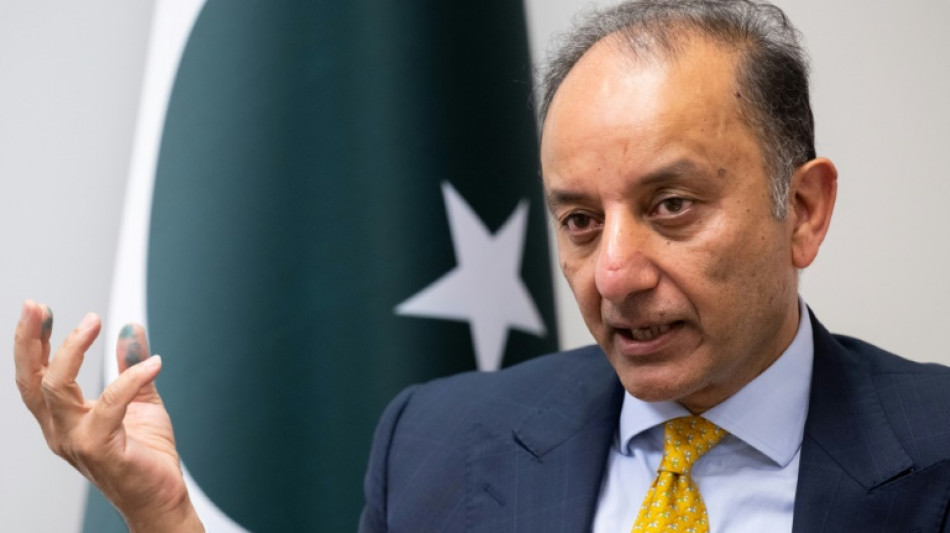
Pakistan buys Russian oil but sees diversified future / Photo: SAUL LOEB - AFP

 Vietnamese coffee farmers ride China's durian wave
 Venezuela says retains 'sovereignty' in US oil deal

 NASA's Roman telescope set to launch on cosmic mapping mission

 Data center backlash scrambles US midterm politics
 Emotional Federer inducted into tennis Hall of Fame

 Hovland takes solo lead as McIlroy surges at Tour Championship

 Djokovic 'prepared' for US Open bid for history

 Atletico down Sevilla to go top of La Liga

 US deports right-wing provocateur Milo Yiannopoulos

 Niger junta says it is back in control after soldiers' mutiny

 Erasmus calls Rennie barbs over Springbok scrumming 'nonsense'

 Lawrence's fifty leaves Pakistan facing record chase to level England series
 Netanyahu condemns settler attack in flashpoint West Bank village
 Munoz saves Iraola in Liverpool draw, big-spending Spurs lose again

 Newcastle condemn dismal Spurs to second successive defeat

 James Cleverly leaves shadow cabinet to seek London mayoralty

 Baladi Map app turns Lebanon’s local problems into a public record

 Thirty-seven Mumbai pilgrims return after Nepal flood disruption

 Ankle ligament tear ends Neeraj Chopra’s 2026 season

 Five college football games that could shape the 2026 season

 New finds strengthen case for Bethsaida at Sea of Galilee site

 Felony assaults on older New Yorkers rise sharply, police data show

 Three Texas Tech softball players hurt in jet ski collision
 Tambaram civic groups seek action on eight long-pending issues

 Cyberabad civic body demolishes 19 unauthorised structures
Facing a deep economic crisis, Pakistan has started to buy Russian oil, but the country's petroleum minister says the future lies in diversified, especially green, energy.
Minister Musadik Malik was visiting the United States for talks with corporations as well as with the government, which has led global efforts to choke off Russia's oil exports that help fund its invasion of Ukraine.
Malik confirmed that a first order was placed for Russian oil and would arrive within a month in Pakistan, which will then assess how much to import in the future.
"Based upon the results, we'll move forward and see for what part of our portfolio we can use Russian energy," he told AFP.
Asked if Pakistan will pursue more Russian imports, he said, "If today we get cheaper sources of energy, we'll go there."
- 'A little drop' -
Pakistan, the world's fifth most populous country, faces chronic energy shortages and imports 84 percent of its petroleum products, overwhelmingly from Gulf Arab allies Saudi Arabia and the United Arab Emirates.
Malik said Pakistan had been fully transparent and that its initial dealings with Moscow were far less than those of other countries -- notably China and Pakistan's rival neighbor India, whose enthusiastic buying of Russian oil has cast a shadow over New Delhi's warming relationship with Washington.
"We have not faced any problems, either with the United States or with any other country," Malik said.
"A whole lot of countries are legitimately getting energy from Russia," he said.
Pakistan's share "is a little drop, but it helps."
Russian oil exports in March jumped to their highest level since the Ukraine invasion more than a year earlier despite European cuts in purchases, according to the International Energy Agency, as China and developing countries buy at a discount.
But revenue to Russia was still significantly lower, with the Group of Seven industrial democracies trying to enforce a cap of $60 per barrel.
A State Department spokesperson said the United States understood "the pressure governments face to secure affordable fuel," while saying that Russia has shown that it is "not a reliable supplier of energy."
"We hope countries are able to leverage the oil price cap to purchase Russian oil at a lower price," the spokesperson said.
- Seeking green boost -
Michael Kugelman, director of the South Asia Institute at the Wilson Center, said he believed there was a broad consensus in Washington that "this is an opportunistic situation where Pakistan is desperate for cheap oil" and substantively different from India's historic relationship with Russia.
"My sense is that Islamabad is in such a difficult state that it's not going to risk antagonizing the United States, given Washington's influence over key international financial institutions that are important to Pakistan right now," Kugelman said.
Pakistan, fearing the collapse of its economy, has been seeking a new tranche of a bailout from the International Monetary Fund which has demanded lasting reforms including subsidy cuts, with Prime Minister Shehbaz Sharif taking the unpopular step of raising fuel prices.
Malik said he spoke with US companies about buying shale liquified natural gas, upgrading Pakistani refineries and storage facilities, exploring offshore oil and gas and starting horizontal drilling, a method the country does not yet use.
But Malik said his talks with the United States will also seek support for green energy in line with Pakistan's goal of generating 30 percent of electricity from renewables by 2030, including a plan for widespread solar power on rooftops.
Pakistan is one of the nations most vulnerable to climate change, with floods last year submerging one-third of the country. A 2020 World Bank study said Pakistan could meet all electricity demand at the time by devoting just 0.071 percent of its land for solar power.
Geoffrey Pyatt, the assistant secretary of state for energy resources, promised US backing for renewable goals on a March visit to Pakistan.
"Strategically, it's very clear to us that the future of energy security is in green energy," Malik said.
R.J.Fidalgo--PC