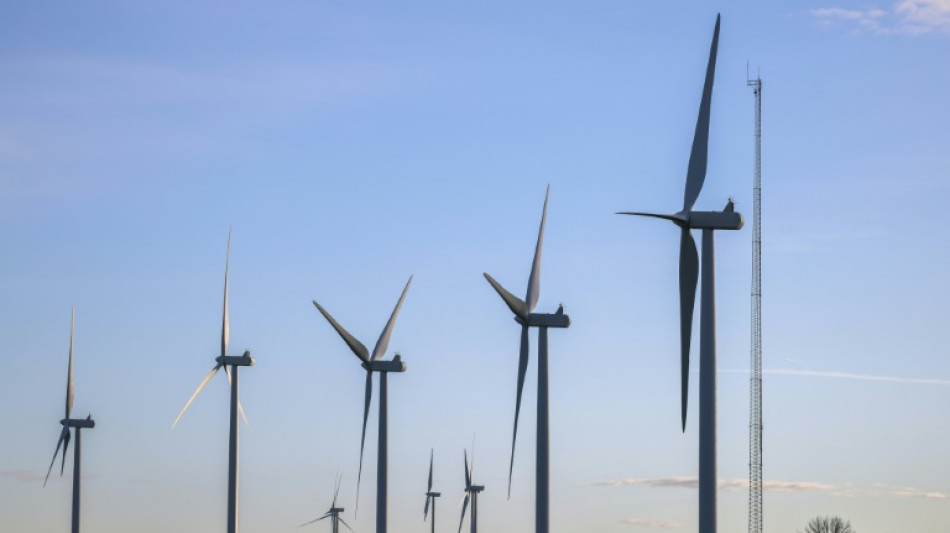
Europe must reduce China renewable dependence: agency / Photo: Charly TRIBALLEAU - AFP

 Search Underway for 'Dooars Rani' Tigress After Second Escape from Buxa Tiger Reserve

 IIM Indore Announces IPMAT 2027 Exam Date for April 24

 The Dilemma of Recording Live Music: Preserving Memories vs. Being Present

 ANC’s Renewal Rhetoric Fades as Voters Reject Party in 2026 Local Elections

 Foreign Investors Return to Indian Markets After 10-Month Selloff

 Honda CR-V and Toyota RAV4 Lead Canada’s Most Stolen Vehicles List for 2025

 China Extends Tariff Suspension on US Imports to Stabilize Trade Ties
The European Union must reduce its dependence on China when it comes to vital equipment used in producing renewable energy, the head of the International Renewable Energy Agency said Tuesday.
It is important to work to "decentralise the supply chain", Francesco La Camera, director general of the International Renewable Energy Agency, told AFP on the sidelines of a conference in Berlin on offshore wind power.
There should be "more collaboration with continental Africa, South America, Southeast Asia", he added.
As the EU races to transition to green energy, it is heavily dependent on China for supplies of rare minerals and components for solar panels and wind turbines.
The 27-member bloc gets 98 percent of its supply of rare earth minerals, vital in many green technologies, from China.
China also produces a large number of the world's wind turbines and solar panels.
Heavy dependence on China is "a matter of concern", La Camera said, adding that boosting links between different parts of the world would help "the reaching of goals by the Europeans".
The EU recently reached a deal to almost double the share of renewables in the bloc's energy consumption by 2030, as it seeks to become carbon neutral and ditch Russian fossil fuels.
The provisional political agreement seeks to raise the share of renewable energy to 42.5 percent. However green groups have criticised the agreement as not going far enough.
L.E.Campos--PC

