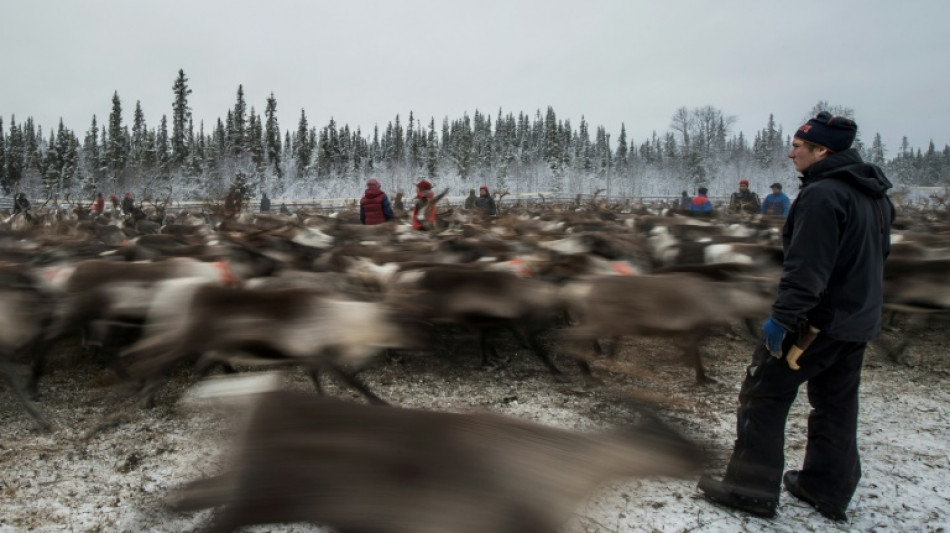
Sweden's 'Truth Commission' delves into painful Sami past / Photo: JONATHAN NACKSTRAND - AFP/File

 Vietnamese coffee farmers ride China's durian wave
 Venezuela says retains 'sovereignty' in US oil deal
 NASA's Roman telescope set to launch on cosmic mapping mission

 Data center backlash scrambles US midterm politics

 Emotional Federer inducted into tennis Hall of Fame

 Hovland takes solo lead as McIlroy surges at Tour Championship
 Djokovic 'prepared' for US Open bid for history

 Atletico down Sevilla to go top of La Liga

 US deports right-wing provocateur Milo Yiannopoulos

 Niger junta says it is back in control after soldiers' mutiny

 Erasmus calls Rennie barbs over Springbok scrumming 'nonsense'

 Lawrence's fifty leaves Pakistan facing record chase to level England series
 Netanyahu condemns settler attack in flashpoint West Bank village

 Munoz saves Iraola in Liverpool draw, big-spending Spurs lose again

 Newcastle condemn dismal Spurs to second successive defeat

 James Cleverly leaves shadow cabinet to seek London mayoralty

 Baladi Map app turns Lebanon’s local problems into a public record

 Thirty-seven Mumbai pilgrims return after Nepal flood disruption

 Ankle ligament tear ends Neeraj Chopra’s 2026 season

 Five college football games that could shape the 2026 season

 New finds strengthen case for Bethsaida at Sea of Galilee site

 Felony assaults on older New Yorkers rise sharply, police data show

 Three Texas Tech softball players hurt in jet ski collision
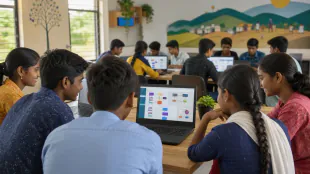
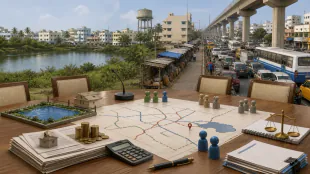 Tambaram civic groups seek action on eight long-pending issues

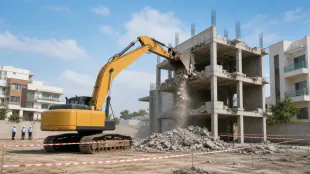 Cyberabad civic body demolishes 19 unauthorised structures

After centuries of persecution, Sweden's indigenous Sami people are beginning to provide testimony about the injustices they experienced in a recently launched "Truth Commission" probing the country's discriminatory policies and their consequences.
Experts have since February been gathering the often-painful accounts from Samis, formerly known by the pejorative term Laplanders or Lapps.
There are an estimated 100,000 Sami people across the vast Arctic wilderness of northern Finland, Norway, Sweden and Russia's Kola peninsula.
They have lived by hunting, fishing and herding reindeer for thousands of years, and been subjected to colonisation for centuries.
Like all children of Sami reindeer herders since 1913, Nils-Henrik Sikku, a Sami writer now aged 72, was taken away from his family at the age of seven and forcibly placed in a state-run boarding school.
At these "nomad schools", founded as part of a policy aimed officially at preserving the Sami, the education was basic and, paradoxically, taught in Swedish rather than the Sami language.
The children were punished if they spoke their mother tongue.
"If you did something wrong you were punished, you could be hit, you could be locked up, they could take your clothes and you would be sitting outside until the next morning," Sikku recalled in an interview with AFP.
The severe conditions led him and a few friends to escape on a freezing winter night.
"We ran... I don't know how we managed to do it," he said. "But we were more afraid to go back than to continue."
The last Sami boarding schools were closed in 1962, but this did not bring an end to the Sami's long and painful history.
The persecution of the Sami, Europe's only indigenous people, goes back to the 17th century, when the state began colonising and exploiting their resource-rich lands.
They were first brutally forced to Christianise and abandon their shamanism, before assimilation efforts intensified in the 19th and 20th centuries as the far north's economic importance grew.
- Racial biology -
The policies were motivated by the emergence of theories about a "pure Swedish race", leading to the creation in 1922 of the world's first State Institute for Racial Biology in Uppsala.
Its director travelled regularly to Lapland to collect skulls and measure and photograph Sami -- often children and the elderly, forced to strip naked -- in a bid to prove they were an "inferior race".
Sikku believes he, like his father before him, was subjected to the pseudo-scientific examinations.
"We don't know what they did with us. But we stood naked in front of the so-called doctors," he said.
The Sami were treated differently if they were reindeer herders, considered "authentic" Sami.
"Because the Sami were seen as an 'inferior race', (the authorities) thought they were going to disappear so they wanted to preserve the reindeer herders, to salvage them," explained Sami researcher Kaisa Huuva.
Children of reindeer herders were sent to the state boarding schools, while other Sami lost their land rights.
"A lot of these wrongdoings that were committed a long time ago are still reflected in the families, their living conditions or how they perceive their relations with Swedish society," Kerstin Calissendorff, head of the Truth Commission, told AFP.
- 'Stealing land' -
While neighbouring Norway and Finland are scheduled to present the conclusions of their own truth commissions later this year, Sweden is due to publish its report in 2025.
It is expected to pave the way for a reconciliation process.
But Sikku won't be participating.
"I have no confidence" in the process, he said.
"They have stolen our land, forbidden our religion and stolen our childhoods."
The past, as painful as it was, must not overshadow the problems the Sami still face, Huuva warned.
Even today, "it's all about the stealing of the land", she said.
Today's reindeer herders, considered the last guardians of Sami culture, now see their traditional way of life threatened by climate change and conflicts with industry.
A recent study revealed that the suicide rate among young male reindeer herders was significantly higher than in the general population.
"They want to pass on their culture... and they overstretch their capacity" carrying out the challenging work, study author Petter Stoor, a psychologist at Umea University, told AFP.
Swedish mining giant LKAB in January announced the discovery of Europe's biggest deposit of rare earth minerals, much needed for the green transition.
The deposit is located near Kiruna, on Sami land belonging to Huuva's family.
She's worried.
"If our land is gone, we are gone with it. We will melt like snow in the sun."
R.J.Fidalgo--PC