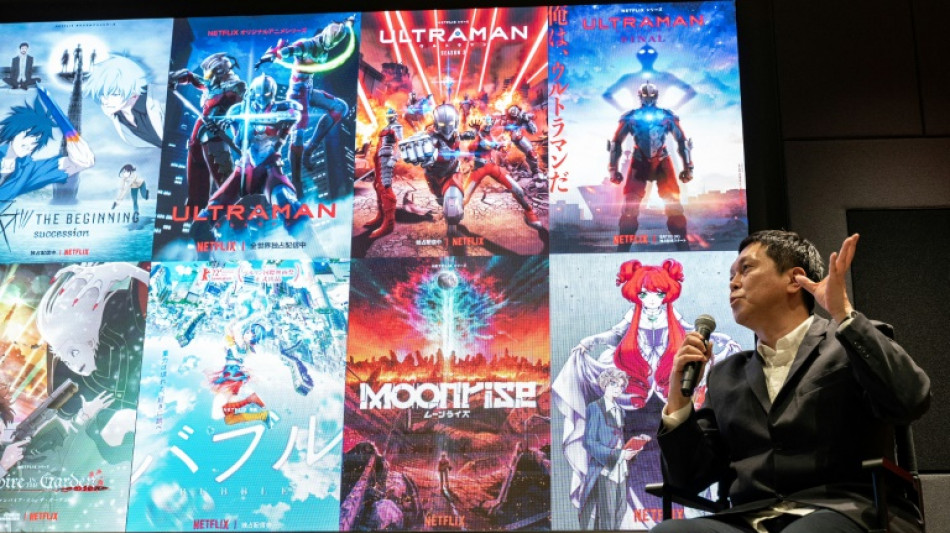
Streaming giants battle for anime supremacy / Photo: Richard A. Brooks - AFP

 Vietnamese coffee farmers ride China's durian wave

 Venezuela says retains 'sovereignty' in US oil deal

 NASA's Roman telescope set to launch on cosmic mapping mission

 Data center backlash scrambles US midterm politics

 Emotional Federer inducted into tennis Hall of Fame

 Hovland takes solo lead as McIlroy surges at Tour Championship

 Djokovic 'prepared' for US Open bid for history

 Atletico down Sevilla to go top of La Liga

 US deports right-wing provocateur Milo Yiannopoulos

 Niger junta says it is back in control after soldiers' mutiny

 Erasmus calls Rennie barbs over Springbok scrumming 'nonsense'

 Lawrence's fifty leaves Pakistan facing record chase to level England series

 Netanyahu condemns settler attack in flashpoint West Bank village
 Munoz saves Iraola in Liverpool draw, big-spending Spurs lose again

 Newcastle condemn dismal Spurs to second successive defeat

 James Cleverly leaves shadow cabinet to seek London mayoralty

 Baladi Map app turns Lebanon’s local problems into a public record

 Thirty-seven Mumbai pilgrims return after Nepal flood disruption

 Ankle ligament tear ends Neeraj Chopra’s 2026 season

 Five college football games that could shape the 2026 season

 New finds strengthen case for Bethsaida at Sea of Galilee site

 Felony assaults on older New Yorkers rise sharply, police data show

 Three Texas Tech softball players hurt in jet ski collision

 Tambaram civic groups seek action on eight long-pending issues

 Cyberabad civic body demolishes 19 unauthorised structures

From R-rated sci-fi to teen biker gang adventures, streaming platforms are locked in an intensifying battle for dominance in one of the entertainment sector's hottest and most lucrative mediums: anime.
Fuelled in part by the pandemic, the popularity of the cartoons pioneered in Japan has created a goldmine for streaming giants such as Netflix, Disney+ and Amazon Prime.
The global anime market was valued at $28.6 billion in 2022, according to Grand View Research, and is forecast to double in value by 2030.
"The peak may still be ahead of us," Aya Umezu, CEO of Tokyo-based entertainment consulting firm GEM Partners, told AFP.
"We doubt the competition in anime will slow down soon."
Globally, demand for anime increased by 35 percent from 2020 to 2021, according to industry specialist service Parrot Analytics.
It is little wonder, then, that international streamers are scrambling for ways to capitalise on the surging interest.
Recent years have seen Disney+, a relative latecomer to anime, start offering fan favourites also found elsewhere like "Demon Slayer", "Spy x Family" and "Jujutsu Kaisen".
"Having them can prevent subscription cancellations -- that's how strong these IPs (intellectual properties) are," Umezu said.
Offering these titles is seen as a baseline, and far from sufficient to win the loyalty of anime fans with increasingly diverse options available.
That has meant platforms are looking to either secure exclusive rights to content or co-produce their own original anime in a bid to stand out.
- Breaking open the market -
Last year, Disney+ announced exclusive streaming rights to season two of smash-hit teen biker gang saga "Tokyo Revengers", part of a lucrative deal with publishing giant Kodansha.
Amazon Prime has also sought to "monopolise" blockbusters, said anime expert Tadashi Sudo, including "One Piece Film: Red" -- Japan's highest-grossing movie last year.
Netflix has proven something of an outlier in this market, going beyond snatching up existing hits to work directly with animation studios, granting them an unusual amount of creative leeway to make new stories.
Traditionally, Japanese anime emerges from "production committees" made up of publishers, TV broadcasters, toy-makers and other industry players.
These have long had a key role in broadening revenue possibilities for a series, from character merchandising to gaming.
Netflix ruffled industry feathers when it teamed up directly with Tokyo animation studio Production I.G in 2018, bypassing the system.
"Some (in the anime industry) were upset because they thought we would destroy what they had built over all these years," Production I.G president Mitsuhisa Ishikawa said.
He went as far as likening Netflix to the "Black Ships" -- the 19th-century US vessels that forced the opening of Japan after hundreds of years of trade isolation.
"The domestic way of making anime was suddenly forced open," he said.
Netflix has reaped the rewards, with its original content making it "the platform that drove the largest increase in global demand for anime in 2021", said Christofer Hamilton of US-based Parrot Analytics.
- 'Experimental' push -
But even streaming goliaths with worldwide influence have comparatively small audience numbers in Japan.
That raises red flags for some industry players, especially publishers who want maximum exposure for anime adaptations of their manga titles and worry exclusive streaming deals would limit their reach in Japan.
There is "a clash of two opposing interests -- between platforms who want more exclusives and production committee players who want as little of a monopoly (for streaming services) as possible", said anime specialist Sudo.
Experts say this conflict often leads to Netflix original deals being based on works that are less likely to become national sensations like "Demon Slayer".
None of Netflix's original anime made their top-20 most-watched list for Japan users in 2022, according to GEM Partners senior data analyst Shota Ito.
The streamer is, however, an attractive prospect for studios with more commercially challenging projects that the traditional market could find too niche.
Early original content on Netflix reflected this, and was heavy on shows critics say evoked the hardcore sci-fi anime of a few decades ago.
Among these was "Devilman Crybaby", the tale of a "demon-boy" that featured violence and nudity galore.
"My sense is that creators wanted to do something with us that they had little chance to do under the existing system," Netflix chief anime producer Taiki Sakurai told AFP.
That initial "experimental" push has since given way to a broader roster, including comedy, traditional "shonen" targeting young boys and even a stop-motion project starring a teddy bear.
Long-standing fans also have other dedicated services to turn to, including the huge online anime library Crunchyroll.
Netflix content director Yuji Yamano is convinced the market is far from saturated, though, and believes competition will only make "the industry even more exciting".
"Globally, I only see more room for growth in anime."
E.Ramalho--PC