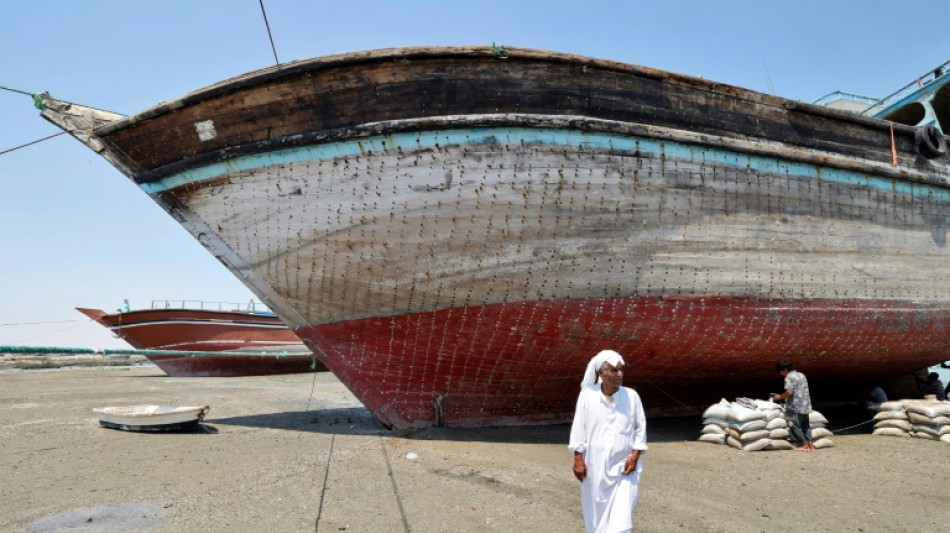
Winds of change buffet Iran's wooden boat building tradition / Photo: ATTA KENARE - AFP

 Vietnamese coffee farmers ride China's durian wave

 Venezuela says retains 'sovereignty' in US oil deal

 NASA's Roman telescope set to launch on cosmic mapping mission

 Data center backlash scrambles US midterm politics

 Emotional Federer inducted into tennis Hall of Fame

 Hovland takes solo lead as McIlroy surges at Tour Championship

 Djokovic 'prepared' for US Open bid for history

 Atletico down Sevilla to go top of La Liga

 US deports right-wing provocateur Milo Yiannopoulos

 Niger junta says it is back in control after soldiers' mutiny

 Erasmus calls Rennie barbs over Springbok scrumming 'nonsense'

 Lawrence's fifty leaves Pakistan facing record chase to level England series
 Netanyahu condemns settler attack in flashpoint West Bank village

 Munoz saves Iraola in Liverpool draw, big-spending Spurs lose again

 Newcastle condemn dismal Spurs to second successive defeat

 James Cleverly leaves shadow cabinet to seek London mayoralty

 Baladi Map app turns Lebanon’s local problems into a public record

 Thirty-seven Mumbai pilgrims return after Nepal flood disruption

 Ankle ligament tear ends Neeraj Chopra’s 2026 season

 Five college football games that could shape the 2026 season

 New finds strengthen case for Bethsaida at Sea of Galilee site

 Felony assaults on older New Yorkers rise sharply, police data show

 Three Texas Tech softball players hurt in jet ski collision

 Tambaram civic groups seek action on eight long-pending issues

 Cyberabad civic body demolishes 19 unauthorised structures

Iranian captain Hassan Rostam has braved the Strait of Hormuz aboard his lenj for four decades, but now watches with despair as the wooden ships are being replaced by cheaper, faster boats.
The sturdy vessels, built by hand, have sailed Gulf waters for centuries, their potbellied silhouette emblematic of regional maritime traditions like the dhows of the Arabian Peninsula.
But these days, "there are fewer and fewer" of them, said Rostam, 62, who has spent his life travelling the waterway between Iran and the United Arab Emirates.
With a lean body and weathered face, he gazes at the calm seas that are criss-crossed by huge tankers taking Gulf oil to the world's markets, and naval vessels patrolling the strategic waterway.
But the island of Qeshm off Bandar Abbas is also home to the much older tradition of building wooden boats, around 30 of which were resting at low tide in the coastal village of Guran.
This small port has long housed several shipyards specialising in their maintenance and repair. But that morning, fewer than two dozen workers were there, barefoot in the mud.
A half-built lenj hull propped on beams will not be finished for lack of money, as its owner plans to dismantle it and use the boards for other projects.
"Today, a new lenj is very expensive" because "the wood comes from abroad" and construction is done entirely by hand, said Ali Pouzan, who supervises the Guran site.
Each lenj is unique and the ships vary in size, with the craft "transmitted from generation to generation", he said.
UNESCO back in 2011 recognised the lenj as intangible cultural heritage requiring "urgent safeguarding".
As modern alternatives have taken the wind out of its sails, "the philosophy, the ritual context and the traditional knowledge linked to navigation in the Persian Gulf... are gradually fading", the UN body warned.
- Open-air museum -
In their golden age, the rustic lenjes were used to transport cereals, dates, dried fish, spices, wood and textiles across the Gulf and as far as the coasts of East Africa and the Indian subcontinent.
But commercial shipping has been taken over by engine-powered boats made of fibreglass or steel, navigating the turquoise waters where huge oil tankers now roam.
Lenj vessels were also used for fishing, as well as the lucrative pearling tradition, which has nearly disappeared altogether.
Younes, a 42-year-old Guran resident, has been repairing lenjes in his native village for more than 20 years.
"It's a painful job," he said in the baking heat, as he used an old technique called "kalfat koobi" to waterproof a vessel with strips of cotton soaked in sesame and coconut oil.
Recognising the demise of shipbuilding in Guran, Pouzan is betting on tourism instead, a promising sector on Qeshm as the island attracts a growing number of visitors.
"We have restored several boats to adapt them to sea trips," he said.
An old ship was being repurposed into a cafe, and there are plans to transform the scenic port, with coloured lenj hulls lying in the sand, into an open-air museum.
Near mangroves on the beach, Pouzan plans to build lenj-inspired huts for tourists. Each will bear the name of the most famous destinations the ships once reached -- from Zanzibar and Mombasa to Kolkata.
Ferreira--PC