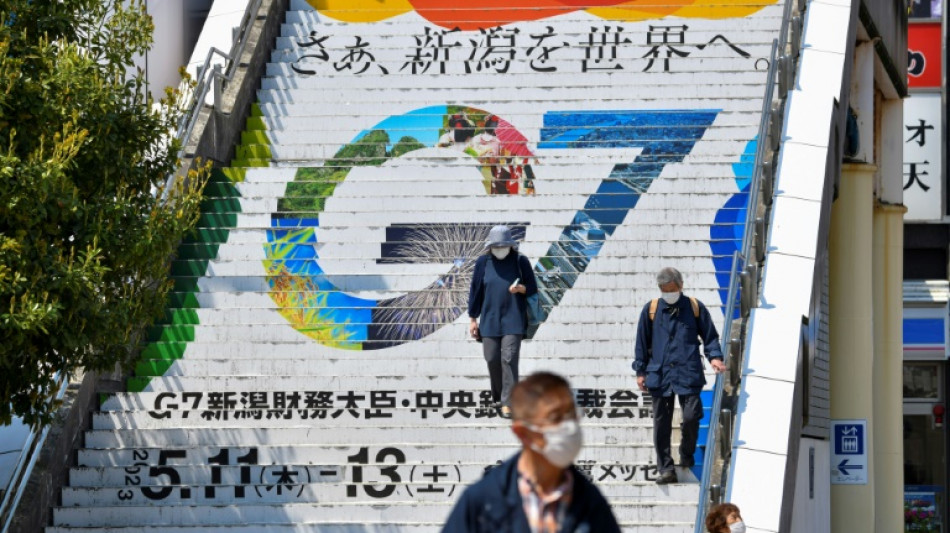
G7 finance ministers discuss crises from Ukraine to banking / Photo: Kazuhiro NOGI - AFP

 Vietnamese coffee farmers ride China's durian wave

 Venezuela says retains 'sovereignty' in US oil deal

 NASA's Roman telescope set to launch on cosmic mapping mission

 Data center backlash scrambles US midterm politics
 Emotional Federer inducted into tennis Hall of Fame

 Hovland takes solo lead as McIlroy surges at Tour Championship

 Djokovic 'prepared' for US Open bid for history

 Atletico down Sevilla to go top of La Liga

 US deports right-wing provocateur Milo Yiannopoulos

 Niger junta says it is back in control after soldiers' mutiny

 Erasmus calls Rennie barbs over Springbok scrumming 'nonsense'

 Lawrence's fifty leaves Pakistan facing record chase to level England series
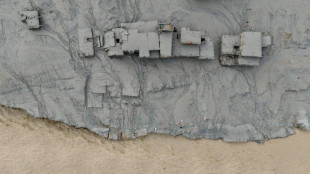
 Netanyahu condemns settler attack in flashpoint West Bank village
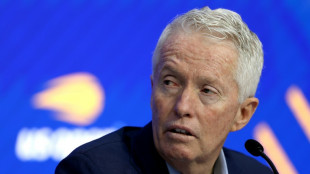
 Munoz saves Iraola in Liverpool draw, big-spending Spurs lose again

 Newcastle condemn dismal Spurs to second successive defeat

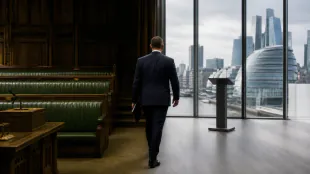 James Cleverly leaves shadow cabinet to seek London mayoralty

 Baladi Map app turns Lebanon’s local problems into a public record

 Thirty-seven Mumbai pilgrims return after Nepal flood disruption

 Ankle ligament tear ends Neeraj Chopra’s 2026 season

 Five college football games that could shape the 2026 season

 New finds strengthen case for Bethsaida at Sea of Galilee site

 Felony assaults on older New Yorkers rise sharply, police data show

 Three Texas Tech softball players hurt in jet ski collision

 Tambaram civic groups seek action on eight long-pending issues

 Cyberabad civic body demolishes 19 unauthorised structures

Support for war-torn Ukraine will top the agenda as G7 finance talks start Thursday, but ministers and central bankers will also weigh concerns ranging from banking uncertainty to US debt default fears.
The three-day meeting of the Group of Seven developed nations comes with the global economy still unsteady after years of pandemic woes compounded by Russia's invasion of Ukraine.
So the talks in the coastal city of Niigata in central Japan are a chance to set out a vision for financial stability before G7 leaders get together next weekend in Hiroshima.
US Treasury Secretary Janet Yellen arrived under the cloud of Washington's debt limit impasse, warning Thursday that a default risked "catastrophe" and even political brinkmanship on the issue could impose "serious economic costs".
In a speech as the event kicked off, she also called for the enforcement of US-led sanctions and other economic measures imposed on Moscow.
"This year, a central piece of our strategy is to take further actions to disrupt Russia's attempts to evade our sanctions," she said.
This includes "identifying and shutting down specific channels used by Russia to equip and fund its military", and pressuring companies and jurisdictions facilitating evasion, Yellen added.
When G7 finance ministers met in April in Washington, they hailed IMF approval of $15.6 billion in financing for Kyiv, recommitted to sanctions on Moscow and pledged "further actions as needed".
There has been no official indication that new measures will be agreed to during this week's talks, but the door is open, said John Kirton, director of the G7 Research Group at the University of Toronto.
Fresh action could centre around "strengthening sanctions evasion... starting with China", he told AFP ahead of the Niigata talks, which Ukrainian Finance Minister Sergii Marchenko will join virtually.
EU officials are already discussing halting exports of sensitive technologies to eight Chinese companies over suspicions they are selling them to Russia.
The G7 could also try to stop tankers from covertly selling Russian oil in violation of the group's oil price cap, or expand export bans, Kirton said.
- Banking stability -
Stronger supply chains, crypto regulation and climate finance will also be talking points for the ministers, central bank chiefs, and the heads of the IMF, OECD and World Bank.
Japanese Finance Minister Shunichi Suzuki this week also stressed the need for vigilance in the banking sector, which is likely to loom large in discussions.
Three regional US banks have collapsed since early March, sparking panic among customers and turmoil for the shares of mid-sized institutions.
In Niigata, "G7 members can agree on a strong, unified message to reassure and convince customers and counterparties to stop their assaults" on such lenders, Kirton said.
European G7 members and the United States may disagree, however, on the need for regulation on digital bank runs, he warned.
European Central Bank president Christine Lagarde has already insisted "supervision needs to be intrusive and as granular as possible" to minimise risks, in an interview with Japan's Nikkei business daily.
There will also be a gulf on monetary policy, with Japan remaining steadfast in maintaining ultra-low interest rates even as most major central banks have hiked theirs to tackle inflation in recent months.
The bloc, which includes Japan, the United States, Germany, Britain, France, Canada, Italy and the European Union, is expected to discuss infrastructure investment in less developed nations.
Japan has been keen to use this year's G7 for outreach to countries beyond the group, and finance ministers from India, Indonesia and Brazil will join the Niigata talks, along with the South Korean and Singaporean ministers.
The outreach is seen as key to swaying international opinion on both Russia and China, which funds infrastructure around the world through its huge Belt and Road Initiative.
T.Vitorino--PC