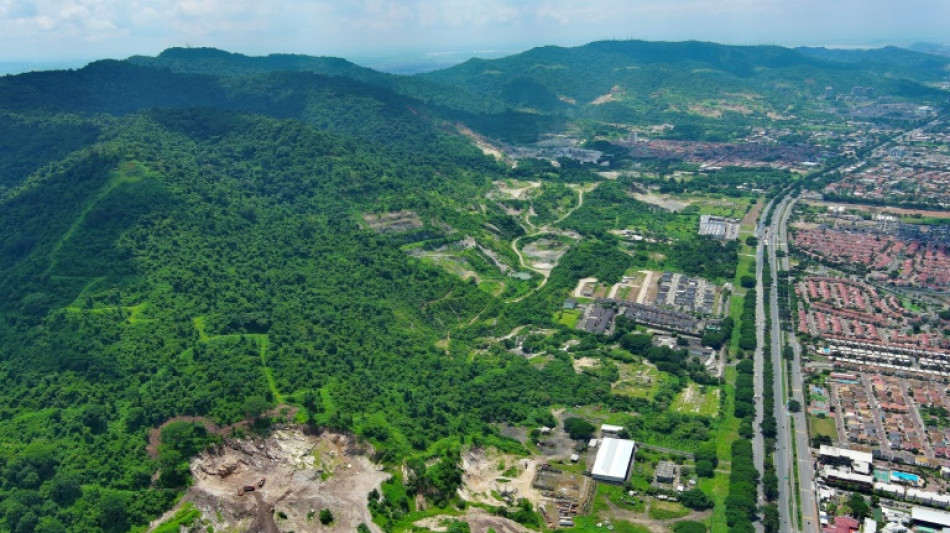
A primal forest encircled by Ecuador port faces ruination / Photo: Marcos PIN - AFP

 Vietnamese coffee farmers ride China's durian wave
 Venezuela says retains 'sovereignty' in US oil deal

 NASA's Roman telescope set to launch on cosmic mapping mission

 Data center backlash scrambles US midterm politics
 Emotional Federer inducted into tennis Hall of Fame

 Hovland takes solo lead as McIlroy surges at Tour Championship

 Djokovic 'prepared' for US Open bid for history

 Atletico down Sevilla to go top of La Liga

 US deports right-wing provocateur Milo Yiannopoulos

 Niger junta says it is back in control after soldiers' mutiny

 Erasmus calls Rennie barbs over Springbok scrumming 'nonsense'

 Lawrence's fifty leaves Pakistan facing record chase to level England series
 Netanyahu condemns settler attack in flashpoint West Bank village

 Munoz saves Iraola in Liverpool draw, big-spending Spurs lose again

 Newcastle condemn dismal Spurs to second successive defeat

 James Cleverly leaves shadow cabinet to seek London mayoralty
 Baladi Map app turns Lebanon’s local problems into a public record
 Thirty-seven Mumbai pilgrims return after Nepal flood disruption

 Ankle ligament tear ends Neeraj Chopra’s 2026 season

 Five college football games that could shape the 2026 season

 New finds strengthen case for Bethsaida at Sea of Galilee site

 Felony assaults on older New Yorkers rise sharply, police data show

 Three Texas Tech softball players hurt in jet ski collision

 Tambaram civic groups seek action on eight long-pending issues

 Cyberabad civic body demolishes 19 unauthorised structures
A hilly forest that is a bastion of exceptional flora and fauna next to Ecuador's largest city, Guayaquil, is now threatened by mining, urbanization and deforestation.
Cerro Blanco -- white hill in English -- is a vast tropical dry forest that has been gradually devoured by the port city of three million people.
In the last 15 years, Cerro Blanco has become an "island locked up and encircled by the city," Eliana Molineros, who created a foundation to protect wild animals, told AFP.
The forest's fragile and rich ecosystem has been declared in danger by the International Union for the Conservation of Nature.
The forest of 6,000 hectares (14,800 acres) is home to hundreds of bird species, around 60 mammal species, including jaguars -- the largest felines on the continent -- and dozens of endemic plants.
Only about 10 percent of the world's original tropical dry forests remain.
Cerro Blanco and its virgin forest is one of the few remaining such environments in Latin America.
But it is also a mining area that provides the primary material for cement, and from where the hill gets its name due to the color of the limestone.
There are 36 quarries, including 10 government-run sites, that devour the forest's vegetation.
Those quarries are supposedly authorized by the national agency that controls mining, but locals complain that some of them are illegal.
Some abandoned illegal mines stick out like scars on the landscape.
- 'Guayaquil's lungs' -
On Saturday, dozens of local inhabitants of an area that was deforested for mining protested against the proliferation of mines, shouting "Quarries out!" and "Protect Guayaquil's lungs from depredation."
Four local associations demanded the creation of a protected area that would ban mining and other extraction activities in Cerro Blanco.
With white butterflies fluttering overhead, biologist Paul Cun stopped in front of a 40-meter (130 feet) tall fig tree.
"We are standing in the best preserved tropical dry forest in Ecuador," said Cun, who has been volunteering in the forest since 1998.
With his boots sinking into the mud, Cun recounted stories about being bitten by snakes or having howler monkeys throw fruit at him.
Among the more than 250 species of birds that nest here is the snail kite, a rare bird of prey whose song sounds like a burst of laughter.
The large pijio trees that are typical to this area harbor the Guayaquil parrot, the emblem of the city but whose numbers have dwindled to just 60 birds living in the wild, according to experts.
There is an abundance of mushrooms, some purple and sticky, others black that emerge from the ground like a claw and are known locally as the "hand of death."
All around, trees as tall as high-rise buildings disperse the sun's rays.
On the southern part of the hill, lots with about 30 upper middle-class homes are carved out of the forest.
To the north there are the "Mount Sinai" and "City of God" slums, the poorest parts of a city marked by huge wealth disparity and that has become a hotbed of violence related to drug trafficking.
The slums are the most dangerous neighborhoods on the Cerro Blanco.
The forest's two unarmed rangers are helpless in the face of arsonists and squatters who flock to the forest looking to make their fortune.
- Thriving tourism -
Before it was turned into a private reserve, Cerro Blanco was exploited by a major landowner in the 1950s.
In 1989, the state expropriated the forest and sold it to Swiss building materials company, Holcim.
In order to respect its environmental commitments, Holcim turned 2,000 hectares (4,950 acres) into a protected forest.
The Probosque Foundation, to which Cun belongs, has been tasked with managing the protected reserve.
These days, tourists and hikers trek along the forest trails looking for unique fauna to photograph.
In 2022, around 13,000 people, 15 percent of whom were foreigners, visited the forest, according to Probosque.
Yet the foundation's head of tourism, Romina Escudero, is angry at the lack of support from the local government.
"The only thing they've done is put up a road sign with the forest's name," said Escudero.
Despite the air being sucked out of the city's green lungs, visitors continue to marvel at the wildlife within.
"We saw a giant cat," enthused Saul Vivero, a mountain biker who spotted a jaguarundi, a wild feline slightly larger than a domestic cat and known for its long tail.
H.Portela--PC