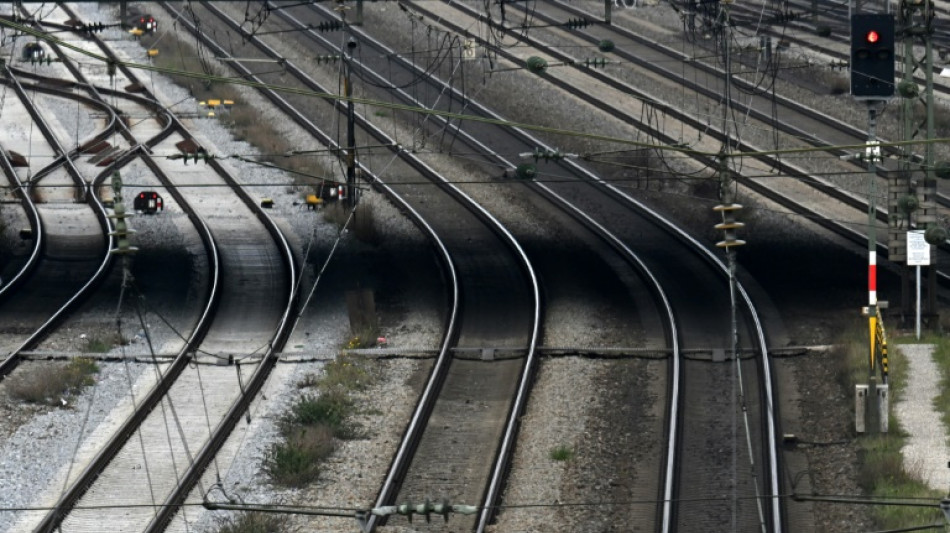
German union calls new two-day rail strike / Photo: Christof STACHE - AFP/File

 Search Underway for 'Dooars Rani' Tigress After Second Escape from Buxa Tiger Reserve

 IIM Indore Announces IPMAT 2027 Exam Date for April 24

 The Dilemma of Recording Live Music: Preserving Memories vs. Being Present

 ANC’s Renewal Rhetoric Fades as Voters Reject Party in 2026 Local Elections

 Foreign Investors Return to Indian Markets After 10-Month Selloff

 Honda CR-V and Toyota RAV4 Lead Canada’s Most Stolen Vehicles List for 2025

 China Extends Tariff Suspension on US Imports to Stabilize Trade Ties
Transport union EVG on Thursday called a new round of strikes on Germany's rail network as workers demand higher wages to cope with inflation, an industrial action slammed as "insane" by train operator Deutsche Bahn.
The latest strike to hit Europe's largest economy will begin at 10:00 pm local time (2000 GMT) on Sunday and end on the night of Tuesday to Wednesday at midnight.
The walkout is the latest in a series of strikes on Germany's rail system in an escalating pay dispute between the union and management.
"Workers' patience is now really exhausted," said EVG's deputy chairwoman Cosima Ingenschay.
"We are forced to go on strike for 50 hours to show how serious the situation is," Ingenschay said at a press conference.
But Deutsche Bahn's human resources chief Martin Seiler blasted the action.
"This insane strike is completely unfounded and overblown," he said.
"Millions of travellers won't get where they want to go -- to school, to work, to their loved ones," Seiler said.
Deutsche Bahn said it anticipated the walkout having a "massive impact" on the rail network.
Previous strikes have seen the entirety of the country's regional and long-distance services grind to a halt.
Freight services across Europe will also be impacted by the strike, Deutsche Bahn warned, with a number of key cargo corridors passing through Germany.
- Inflation worries -
EVG represents 230,000 workers across some 50 transport companies, including Deutsche Bahn.
The union is demanding a 12-percent pay rise over one year for the workers it represents, with a minimum increase of 650 euros ($712) a month.
EVG has rejected Deutsche Bahn's offer of a five-percent increase in two steps, covering 27 months, plus an "inflation bonus" of 2,500 euros.
Progress in negotiations over a new pay deal has been "difficult, if there is any at all", Ingenschay said in a statement.
"The existing offers have to be improved considerably."
Accusing the union of refusing to negotiate, Seiler said: "We have opened the doors wide, but EVG will not walk through them."
Over the last few months, workers in different sectors including healthcare, childcare and transport have gone on strike to demand better conditions.
The industrial unrest comes as consumers struggle with steep increases in prices, as the cost of energy and food have soared.
Inflation has cooled slightly in Germany in recent months but remained very elevated in April at 7.2 percent.
The rail system was largely brought to a halt in a major walkout at the end of March led by EVG and fellow union Verdi.
Another shorter strike followed in mid-April, with similar disruption to rail traffic.
The newly announced industrial action is the longest yet in the current dispute between transport workers and operators.
T.Batista--PC

