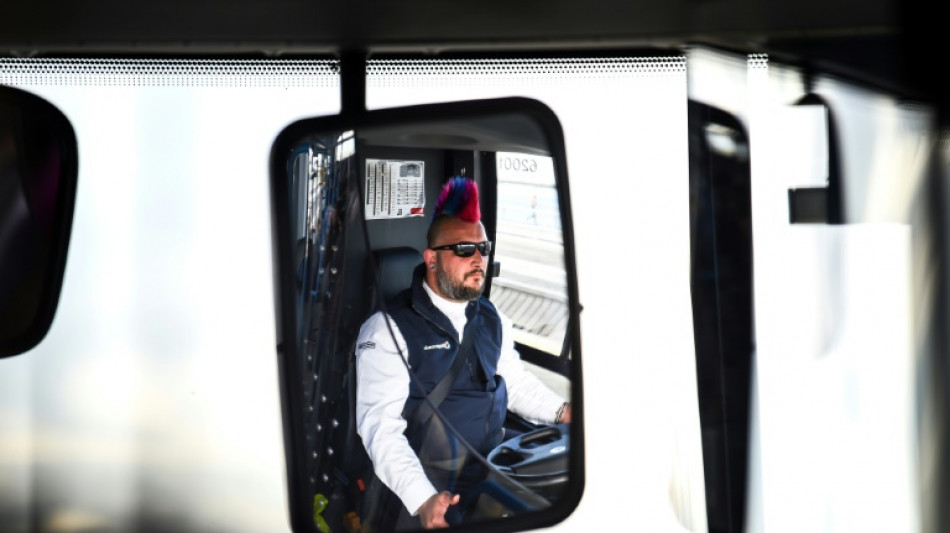
UK to roll out first driverless bus service / Photo: Andy Buchanan - AFP

 Search Underway for 'Dooars Rani' Tigress After Second Escape from Buxa Tiger Reserve

 IIM Indore Announces IPMAT 2027 Exam Date for April 24

 The Dilemma of Recording Live Music: Preserving Memories vs. Being Present

 ANC’s Renewal Rhetoric Fades as Voters Reject Party in 2026 Local Elections

 Foreign Investors Return to Indian Markets After 10-Month Selloff

 Honda CR-V and Toyota RAV4 Lead Canada’s Most Stolen Vehicles List for 2025

 China Extends Tariff Suspension on US Imports to Stabilize Trade Ties
The UK will roll out its first driverless bus network in Scotland next week with drivers on standby behind the steering wheel, ready to take control should an emergency arise.
The service, which aims to carry 10,000 passengers a week over a 14-mile (22.5-kilometre) route on five single-deck buses, will be the world's first automated local bus service, its operator said.
"The autonomous technology on this bus has been tested before but this is the first time that it has been put on to a bus that's now a registered local bus service," Peter Stevens, policy director of Stagecoach bus service, told AFP after a demonstration near Edinburgh.
From Monday, the buses, which will travel at up to 50 miles per hour, will have a safety driver to monitor the technology, as required by UK law, which does not yet permit fully autonomous vehicles.
Drivers do not touch the controls while the vehicle is in autonomous mode, and a conductor onboard handles ticketing and passenger enquiries.
The onboard system will detect other road users to prevent collisions, while optical cameras and radar will scan the road to check for pedestrians.
The control system includes an artificial intelligence engine that receives information from throughout the bus to determine its exact location and calculate the safest route to its destination.
Stevens said the service would be safer, more fuel efficient and would offer a better experience for customers.
- 'Technological revolution'-
"The system is designed to increase safety," he said.
"The driver has now got 360-degree vision, and the system can respond faster than a human can in terms of reaction time.
"There's always going to be a safety driver in the seat even when the bus is driving itself. So that if there is a need for them to take control, they can take control."
Stevens said the buses would be learning the route continually and collecting thousands of hours of data a month.
"As the service starts, we'll be collecting more data and then we'll be increasing the amount of autonomous travel," he said.
Bus driver Callum Jones said the service was "something new, exciting to see, part of our technological revolution".
"It's good," he said.
A driverless bus tested in South Korea's capital, Seoul, last year as part of an experiment that engineers said aimed to make people feel more comfortable with driverless vehicles on the roads.
In 2021 a driverless electric bus began operating in Malaga, Spain, in a project presented as a first in Europe with Singapore launching a trial of self-driving buses earlier in the year.
S.Caetano--PC

