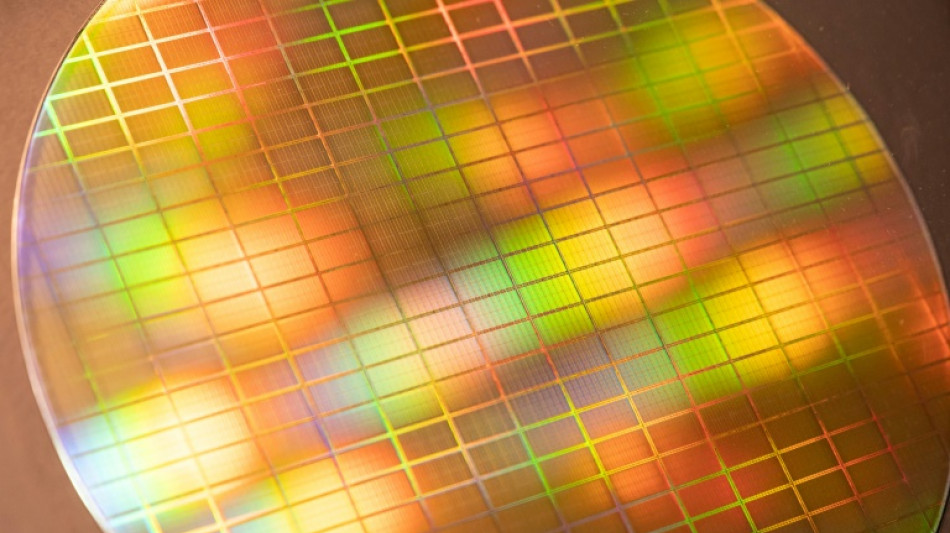
China says US chipmaker Micron failed national security review / Photo: Yuichi YAMAZAKI - AFP/File

 Iceland in suspense after close EU vote

 Wallabies hold on for victory in Argentina

 Juve notch second straight win, Fiorentina's centenary party falls flat

 Rybakina eases injury fears ahead of US Open

 Djokovic kicks off latest Grand Slam quest under US Open lights

 'Sorry' De Zerbi won't panic after Spurs shambles

 UN, Nepal warn of climate threat after deadly floods

 USTA boss says structure of new player council not yet set

 Tiny Elversberg stun Leverkusen on Bundesliga debut, Dortmund beat Hamburg

 Tamil Nadu and NUS agree to expand postgraduate and research links

 Police appeal for footage after life-threatening Stratford assault

 Family searches for Boston engineer missing after Nepal-Tibet floods

 Dolly Parton’s Imagination Library leaves global children’s reading legacy

 BMC rejects negligence claims in three Rajawadi Hospital maternity cases

 Chembur man held over alleged poisoning of woman’s soft drink

 Andhra Pradesh Speaker seeks stronger sports quota and school facilities

 Kolkata police register new FIR against Mamata Banerjee over rally timing

 India and China have not named two new border meeting sites

 Chennai councillors unite across parties to demand ward development funds

 Tambaram civic groups seek action on eight long-pending issues

 Three Texas Tech softball players hurt in jet ski collision

 Felony assaults on older New Yorkers rise sharply, police data show

 New finds strengthen case for Bethsaida at Sea of Galilee site

 Five college football games that could shape the 2026 season

 Norway's King Haakon VIII pays tribute to late father in first speech

US semiconductor giant Micron has failed a national security review, China's cybersecurity watchdog said Sunday, telling operators of "critical information infrastructure" to stop buying its products.
It marked the latest escalation in the bitter chip war between the United States and China, with Washington looking to cut off Beijing's access to cutting-edge semiconductors.
Chinese authorities had launched a review in March of products sold in the country by Micron, one of the world's major chip manufacturers.
Micron's products "have relatively serious potential network security issues, which pose a major security risk to China's critical information infrastructure supply chain and affect China's national security", the cybersecurity administration said in a statement.
"Operators of critical information infrastructure in China should stop purchasing Micron products."
China's broad definition of critical information infrastructure includes sectors ranging from transport to healthcare.
About 10 percent of Micron's $30.8 billion annual revenue last year came from China, according to company data.
But a large portion of Micron products sold in the country were bought by foreign manufacturers, analysts had said earlier, and it was not clear if the cybersecurity watchdog's decision affects sales to foreign buyers.
AFP has reached out to Micron for comment on the cybersecurity administration's announcement.
China in 2021 announced rules to protect critical information infrastructure with stricter requirements over data security.
It has recently also strengthened the enforcement of its data security and anti-espionage laws.
- 'Bullying tactics' -
The chip war between Beijing and Washington escalated last year when the United States imposed restrictions on China's access to high-end chips, chipmaking equipment and software used to design semiconductors.
Washington also blacklisted Chinese firms, including Micron rival Yangtze Memory Technologies Co Ltd.
Washington cited national security concerns, and said it wanted to prevent tech that could help develop advanced military equipment from being acquired by China's armed forces and intelligence services.
The United States imposed targeted controls on the ability of domestic industry leaders to sell their products overseas.
It has also sought to persuade key allies to follow suit.
The Netherlands and Japan -- both leading manufacturers of specialised semiconductor technology equipment -- have recently announced new restrictions on exporting certain products, but without naming China.
Beijing has slammed the moves as "US bullying tactics" and accused Washington of "technological terrorism", vowing that such controls will only strengthen its resolve to achieve self-reliance in the sector.
The development of a robust domestic semiconductor industry has been a longstanding goal of the Chinese government, which has invested billions of dollars in domestic chip firms.
Chips are the lifeblood of the modern global economy, powering everything from cars to smartphones, and they are forecast to become a $1 trillion industry globally by 2030.
Nowhere is their essential nature more visible than in China, the world's second-largest economy, which relies on a steady supply of foreign chips for its huge electronics manufacturing base.
In 2021, China imported semiconductors worth $430 billion, more than it spent on oil.
E.Borba--PC